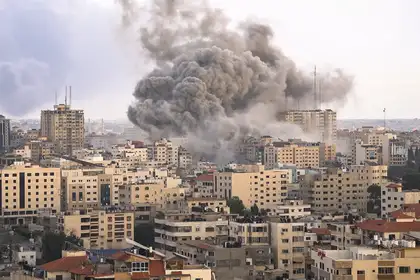
Israeli airstrike on Gaza Strip. Image credit: Jaber Jehad Badwan, CC BY-SA 4.0 via Wikimedia Commons.
I recently finished teaching a second-year course in International Communication. And when preparing for one of the tutorials, I checked to see how regularly New Zealand’s Minister of Foreign Affairs (and then Deputy Prime Minister), Winston Peters, had referenced Gaza on his X/Twitter account.
Each weekly tutorial with my small distance class began with an informal news round-up where we reflected on the international stories that grabbed our attention over the past week. Gaza has featured a lot in our conversations this semester. On this particular day (May 7), I shared details with the students of a story I had just read in The Irish Times titled Taoiseach Micheál Martin accuses Israel of war crime over blocking of aid entering Gaza.
The article reported that the Taoiseach (Irish Prime Minister) had condemned the Israeli blockade of aid to Gaza, which had entered its eighth week. It was “simply wrong, in principle, and in law, to inflict hunger and suffering on a civilian population, whatever the circumstances”, Martin stated. “This behaviour clearly constitutes a war crime”.
Martin’s statement wasn’t the first time since October 2023 that I had thought about the differences in the political and media discourse about Gaza in Ireland and Aotearoa New Zealand.
Making comparisons between one national context and another can always be a little invidious; one is never quite sure if you are comparing like with like.
Nonetheless, I introduced Martin’s comments to the students with a pedagogical intent that transcended my own biography as an Irish citizen who has been working at Te Kunenga ki Pūrehuroa Massey University since 2003. I suggested there are many good historical, political and cultural reasons why Ireland might offer an appropriate comparison for thinking about the foreign policy discourse of New Zealand.
I pointed to the similar diplomatic posture of both countries. Both like to appeal to a flattering national mythology on the international stage – of two small countries “punching above their weight”, determinedly pursuing independent foreign policies that affirm the internationalism of the United Nations (UN), while never wanting to go too far against the grain of United States (US) and Western elite political priorities.
The Irish Government has justifiably won many admirers (alongside detractors) for its willingness to speak out about the horrors taking place in Gaza. However, it has also been criticised at home for prevaricating on its commitment to introduce an Occupied Territories Bill that would “prohibi[t] the import of goods and services produced in the unlawful Israeli settlements in the West Bank”.
Comparing ministerial posts
I didn’t start searching Peters’ personal X account expecting to see a repeat of Martin’s “war crime” comment. Nor did I expect to anything similar on the X account of Martin’s New Zealand counterpart Christoper Luxon.
However, the absence of any recent reference to the blockade on either account surprised me. So I thought it might be helpful to see how the world looked on the X account of the Irish Minister for Foreign Affairs and Tánaiste (and Deputy Prime Minister) Simon Harris.
On the day of my tutorial, Harris had referenced Gaza or Palestine in three posts in the previous week alone, alongside another post that referenced the Middle East. Two of the posts cited the full text of ministerial press statements on “the situation on Gaza” that were published on 2 May and 6 May.
A third cited a video clip of Harris talking about Gaza during a primetime appearance on The Late Late Show, Ireland’s longest-running television chat show; the kind of popular, publicly-funded broadcasting space that now seems barely imaginable in New Zealand.
My expectations when looking at Peters’ X account were low; the assumption that Gaza would be more prominent in the Irish Foreign Minister’s X account was hardly a long shot. However, I surprised both myself and the students when I saw how invisible the topics of Palestine, Gaza or Israel were on Peters’ X account.
Israel was referenced in a single January 2025 post that denounced the left-wing activist John Minto. Aside from that, we would need to go back to 9 April 2024 to find any explicit reference to Gaza, Palestine, Israel or even the Middle East on Peters’ X account. The post contained a video clip of Peters addressing the United Nations General Assembly on the same day. It was a repost of a message first posted on a second X account in Peters’ name – an official Minister of Foreign Affairs account that currently has only 9,800 followers compared to the 86,900 followers of Peters’ personal account.
I hadn’t noted the existence of the ministerial X account at the initial tutorial. So, I checked it after class to make sure I hadn’t missed additional posts on Gaza/Palestine/Israel that did not appear in Peters’ personal account.
The topic was not quite as invisible on the ministerial account, yet the coverage was still meagre. Backdated from 3 June, the last post that explicitly referenced Gaza/Palestine/Israel was sent on 20 March – two days after Israeli airstrikes on Gaza had ended the ceasefire with Hamas.
Harris doesn’t seem to have a separate ministerial account, so a comparison with his personal X account is again illustrative. For the same 20 March to 3 June period, I counted 24 Harris posts that explicitly referenced Gaza or Palestine. Another 20 referenced Israel, Middle East or Lebanon (where the Irish army has had a UN peacekeeping force since 1978).
Public diplomacy New Zealand style
What bigger point might be taken from a quick comparison of what government ministers post on a platform that is hardly an idyllic discursive space, particularly since its transformation into a far-right media machine by Elon Musk?
I discussed the topics of public diplomacy and digital diplomacy in an earlier video lecture with my students. So the point of the Peters/Harris comparison was partly to encourage the students to think about how the diplomatic priorities of the New Zealand and Irish Governments might be inferred from what their Minsters of Foreign Affairs did – and did not – talk about on X.
The comparison suggested that publicly speaking out against the wars crime and genocidal actions taking place in Gaza is an urgent priority for the Irish state. In contrast, the evidence from both of Peters’ X accounts suggests a state that does not really want to talk about the topic of Israel/Palestine at all. We see a similar dynamic at work in the Government’s reluctance to condemn the illegal Israeli and US airstrikes on Iran.
The official ministerial account captures a Government focused on enhancing its diplomatic and trading relationships with different countries, with a “strong focus on the Pacific and Asia” and backgrounded by a context where New Zealand’s every diplomatic move now seems attuned to the geopolitical rivalries between the US and China.
The impressions from Peters’ personal X account communicated a rather different set of political priorities. It suggests a Minister for Foreign Affairs who spends most of his time online fighting a self-declared “war on woke”.
In the same March to June timeframe, we find, among other posts, messages disparaging a Radio NZ (RNZ) journalist as an “arrogant wokester loser”, messages characterising any future Labour/Green/Te Pāti Māori coalition as a “radical woke show”, messages denouncing the previous Labour government’s support for “woke DEI [Diversity, Equality and Inclusion] ideology”, messages mocking the “Marxist and globalists” who peddle “their wacky woke ideologies”, and messages criticising the “cancerous social engineering” of a “woke ideology” which undermines “sex-based” legal rights and protections.
Palestinian solidarity and the stigmatisation of wokeness
It might be thought that Peters’ anti-woke rhetoric has little to do with the question of Palestine, since the everyday media discourses that shape our understandings of the world are often not very good at illuminating the connections between one issue and another.
However, the two issues are in fact intimately connected. In the last two years, the US far-right’s obsession with “wokeness” has been most pointedly directed towards the Palestinian solidarity movement that emerged on university campuses in the US and elsewhere from October 2023.
And we see a tacit version of the same ideological narrative in Peters’ rhetoric.
When Peters gave his state of the nation address in Christchurch in March, the topic of wokeness (including apparently “woke banks”) was one of the central themes.
“We need common sense brought back to our country”, Peters told his audience of adoring supporters:
“We cannot underestimate the nature and importance of the war on woke. It is not only the DEI in our public sector, but also in our education system. New Zealand First set out in the election to get rid of the relationships and sexual education guidelines in our schools - and we have done that. We campaign on ensuring the pathway of separatism and cultural Marxism was stopped with the likes of He Puapua and co-governance and we are doing just that. We campaign on ensuring we have fairness in women’s sports – that men cannot compete against women and girls – and we have done that. But there is still so much more we need to do to continue the fight – including fighting against the use of puberty blockers for children. We may have won some battles, but the war is yet to be won.”
Peters’ speech was interrupted on different occasions by Palestinian solidarity activists, and at least once by a pro-Israeli heckler.
He responded, essentially to the Palestine supporters, with all the dignity of his ministerial office. The activists were disparaged as “left-wing fascists”, “communist, fascist, and anti-democratic losers” and “anti-democratic Marxist whingers”.
A few days after the speech, Peters posted a post, supported by photographs, describing one of the protestors as a “ginger nut”, “deranged moron” and “Marxist loser”. The keffiyeh-wearing student (University of Canterbury student and member of Students for Justice in Palestine Joseph Bray) was also identified as a participant in a recent panel discussion with Green Party MP Tamatha Paul about the New Zealand police system that was reported on rather sensationally (and amplified in part by another Peters intervention).
The post was lauded in Peters’ replies. One account responded with an image of what it described as a few more “nut cases”: a photograph of a group of Green party MPs wearing keffiyehs in Parliament.
The political consequences
Peters gives lurid expression to an anti-woke energy that has become the spiritual engine of the current coalition Government and their media supporters. The antagonism to an amorphous “wokeness” functions as an ideological strategy for delegitimising different institutions and political constituencies.
The hyperbole might be dismissed as obscene culture war spectacle. It might even be concluded that this kind of knockabout stuff has little political impact beyond a world of loyal New Zealand First voters.
However, that conclusion would be wrong. Because perhaps the most significant political consequence of the normalisation of anti-woke critique in New Zealand and elsewhere is that it can put discursive constraints on what gutless and nominally centre-left politicians are willing to do in the name of some notionally progressive politics. Consider the case of last year’s US presidential election. The stereotypically woke campaign ticket of Harris/Waltz could barely distinguish its stance on Gaza from the Trump/Vance campaign, other than with platitudinal recognitions of Palestinian suffering tagged on to blanket affirmations of “Israel’s right to defend itself”.
We could make the same point with respect to the discursive policing of how Western media have covered Gaza, including under-the-cosh public media outlets like RNZ. It is not hard to argue that the political silences in New Zealand have been internalised in journalistic silences, lest too much perceived sympathy for Palestinians generate far-right flak about the coverage being too “woke”.
The state of the nation
When Peters gave his state of the nation speech, he began by mocking the protestors who had gathered outside, depicting them as opponents of “freedom of speech” and “democracy” who want to “impose their absolute minority view on the mass majority of New Zealanders”.
He drew a boastful contrast between himself and the protestors by reciting his wondrous diplomatic achievements in communicating New Zealand’s position on the “issue of Gaza” to other countries.
“Not one of them protesting outside has ever spoken to the Palestinian Authority, or the neighbouring Egyptian Government, or the biggest Islamic country in the world, Indonesia, or dare we say the president of Turkey,” he suggested.
“Those so-called protesters outside wouldn’t know what geopolitics or diplomacy looks like. Yet they have the arrogance to try and lecture you, and disrupt you, like they have a clue what they are talking about.
“These no hopers have come here today, with the one certain intention to grab the mainstream media headlines, and try to destroy a process that we, as one of only eight other countries, have practiced unbroken since 1854 – it’s called democracy.”
The rhetorical excess may be the essence of Peters’ political brand; his proto-Trumpian ability to combine the conspiratorial and the comedic seems to have given “Winnie” a cultural license to say things that others would be held accountable for.
However, if his speech was intended as a homage to a culture of free speech and democracy, we might conclude that New Zealand’s political culture is in a rather sorry place indeed.
We should not be so inured from the authoritarian shtick of our Minister of Foreign Affairs to miss his contempt for protestors who want to bring public and media attention to a genocide taking place in real time.
It suggests a Government that is reluctant to speak out publicly about the topic.
It also suggests a Government that will stigmatise those who do, for fear of encouraging a serious public conversation about New Zealand’s complicity with a racist Western diplomatic order that has condoned the Israeli state’s massacre of Palestinians.
Originally published on Mohan Dutta: Culture-Centered Approach.
Dr Sean Phelan is an Associate Professor within the School of Humanities, Media and Creative Communication.