
Image credit: Gerd Altmann via Pixabay.
The Legislation (Definitions of Woman and Man) Amendment Bill has passed its first reading in Parliament, with National and ACT lining up behind New Zealand First to write into Aotearoa New Zealand's law that a woman is “an adult human biological female” and a man “an adult human biological male.” Jenny Marcroft, the MP whose name the bill carries, told the House that what it means to be a woman is “under attack,” and that this legislation will deliver clarity and consistency by reflecting reality in the language of our laws. New Zealand First leader Winston Peters framed the bill as Aotearoa “catching up” to the United Kingdom's Supreme Court, and his party has vowed to fight what it calls “cancerous social engineering” and “woke ideology.”
This is the same script, almost word for word, that the transnational far right has been circulating for the better part of a decade. It is worth pausing on what is actually being claimed, what the science actually says, where this script comes from, and what it does to the people in its path.
The science the bill claims to honour
The bill positions itself as a return to biological reality, against ideology, yet the biology it invokes does not exist as the bill describes it. Contemporary biology, endocrinology, genetics, neuroscience, and reproductive science have moved well past the simple male/female binary that the legislation seeks to enshrine. Sex itself, when examined across chromosomes, gonads, hormones, secondary characteristics, and brain development, presents as a multi-dimensional cluster rather than a clean two-box scheme. Intersex variations are not vanishingly rare anomalies that prove the rule – they are part of the ordinary range of human bodies, accounting for up to two per cent of live births.
The Williams Institute at UCLA has documented in granular detail what happens when states attempt to legislate sex as a binary category. Their analysis of President Trump's executive order redefining sex shows that transgender, nonbinary, and intersex people lose access to healthcare, identification documents, shelter, and basic protections when the law refuses to recognise their existence. The LSE United States Politics and Policy blog shows that these definitions, sold as protection for women, produce harm for transgender people, for cisgender women who do not conform to narrow expectations of femininity, and for men too. The Human Rights Campaign's tracking of executive orders and the Trans Legislation Tracker record the cascade: hundreds of anti-trans bills moving through US state legislatures, a coordinated campaign that the Lemkin Institute has now classified as a red flag alert for anti-trans genocide in the United States.
This is the body of evidence the bill ignores when it claims to be on the side of science.
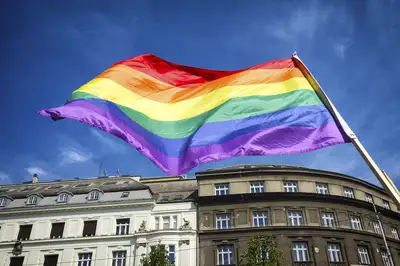
Image credit: Astrobobo via Pixabay.
The colonial making of the binary
The binary the bill wants to write into law is not a universal human inheritance. It is a colonial artefact. The two-sex, two-gender scheme that European empires carried across the world was a product of a specific historical moment in Western thought, tied to whiteness, to Christian theology, to the consolidation of property and patriarchal lineage. It was then violently imposed on societies that already had their own, often more capacious frameworks for understanding gender and sexual difference.
The work compiled by colleagues at the UCLA Luskin Center on the shadow of empire and the shaping of attitudes toward transgender people in India, documents what British rule did to hijra communities through the Criminal Tribes Act and a battery of regulations that criminalised gender variance and tried to liquidate it. CLASP's (Center for Law and Social Policy) analysis of the intersection of colonialism and trans oppression extends this account across multiple geographies, showing how settler-colonial regimes targeted two-spirit, muxe, fa'afafine, and many other gender configurations for elimination, precisely because they could not be assimilated into the colonial grid. The Transgender Studies Quarterly piece, ‘Is “Gender Ideology” Western Colonialism?’ turns the script of the contemporary right on its head: it is the rigid binary, not gender variance, that is the colonial import. The GNET report on transmisogyny, colonialism, and anti-trans activism connects the historical thread to the present, mapping how today's anti-trans movements draw on, and reanimate, colonial logics of racial and gendered hierarchy.
In Aotearoa, the work of Associate Professor Leonie Pihama and the Honour Project Aotearoa lays out with care what takatāpui have always known. The gender frameworks that whakapapa carries are not the colonial binary. Mātauranga Māori holds room for whakawāhine, tangata ira tāne, and other articulations of gender that the missionary and the magistrate worked to erase. The volume Honouring Our Ancestors makes this lineage visible. Dr Pihama (2019) traces precisely how colonisation imported ideologies of race, gender, and class into Aotearoa as an interlocking apparatus, and Angela Wilton (2024) extends this analysis to the settler-colonial structuring of contemporary gender and development discourse in this country. When New Zealand First wraps itself in “common sense” and “biological reality,” what it is actually defending is the colonial settlement of gender, the whiteness-coded hierarchy that the Crown brought to these islands, and that takatāpui have been pushing back against ever since.
So when the bill is described as a defence of tradition, the question to ask is: whose tradition? It is the tradition of the coloniser, dressed up as nature.
The Trumpian ecosystem in Aotearoa
For five years now, I have been warning that the US Trumpian ecosystem is being seeded and circulated in Aotearoa with the explicit aim of dividing people and corroding social cohesion. The bill is not a homegrown New Zealand initiative emerging from some grassroots concern in our communities. It is part of a wider transnational network. The Trans Legislation Tracker shows the scale of similar efforts in the United States, while the Lemkin Institute's red flag alert names what is being built there. The bill's framing, referencing the “biological female”, the invocation of the UK Supreme Court ruling, the war-on-woke vocabulary, appeals to “common sense” and “reality,” and claims about “social engineering,” closely mirrors these overseas narratives. These are not coincidences. They are the product of a coordinated culture-war infrastructure that runs through US-funded think tanks, the Free Speech Union nexus, the platforming of figures like Posie Parker through her Speak Up For Women circuits and the LAVA grouping, and the rolling drumbeat of imported moral panic.
What is happening with this bill is what I have been calling, in our work on preventing violence in the raced margins, the importation of structural violence dressed up as policy. The targets of this violence are takatāpui, trans, and rainbow communities. The vehicle is the state itself.

Professor Mohan Dutta.
Communicative inversion: when the threat parades as cohesion
The current coalition Government has made social cohesion a centrepiece of its rhetoric. At the same time, it is advancing a bill whose direct effect will be to further marginalise some of the most targeted communities. This is what the culture-centered approach names as communicative inversion. The very thing that threatens social cohesion is wrapped in the language of social cohesion. The very policy that imports division is sold as a defence against division. The bill that hardens hierarchy is presented as a return to clarity.
The inversion is doing political work. It allows the Government to claim the moral high ground while it normalises hate. It allows MPs to vote for legislation that erases people from the law while telling themselves they are protecting women. It allows the coalition to platform a transnational far-right talking point. while presenting itself as the voice of common sense.
This mechanism is familiar. As I have written, and as our CARE work on family violence prevention has documented in the CARE Executive Summary on alternate rationalities, structural violence depends on communicative work that renders its targets unspeakable, illegible, or threatening. The bill is doing exactly this. It defines trans and nonbinary people out of the language of the law. It tells them, through the most authoritative channel a society possesses, that they are not who they say they are. And it does this while the Government parades the slogan of cohesion.
The price, paid in bodies
We know what this costs. The Honour Project Aotearoa, led by takatāpui researchers, documents the rates of violence, suicidal distress, housing precarity, and health crisis already carried by takatāpui and trans whānau in this country. Professor Papaarangi Reid, Associate Professor Donna Cormack and Professor Sarah-Jane Paine (2019) show how colonial histories and racism produce and reproduce health inequities for Māori and Indigenous peoples, and the harm this bill will compound runs along precisely those structural pathways. The international evidence base, from the Williams Institute, the Human Rights Campaign, and the LSE analysis, is unambiguous. Every legislative attack of this kind raises rates of psychological distress, self-harm, and suicide among transgender people. Every legal redefinition that excludes them functions as a signal to the wider society that this group can be targeted with impunity. The Washington trans community organising against the wave of US anti-trans legislation makes the human cost legible: refusing to disappear under the weight of laws designed to disappear them.
Policy is not neutral. When Parliament writes that trans women are not women, that nonbinary people do not exist, that intersex bodies are an embarrassment to the statute book, it produces material harm. It normalises hate. It tells employers, landlords, school principals, doctors, and the keyboard warriors of the Free Speech Union ecosystem that the state agrees with them. The hate that follows is then attributable, in part, to the institutions that gave it the imprimatur of law.
What comes next?
The bill now goes to select committee. There will be submissions. Takatāpui, trans, and rainbow communities, alongside their whānau and allies, will once again carry the labour of explaining their humanity to a Parliament that should already know it. Pacific leaders are already speaking with care about what this bill will do to Pacific MVPFAFF+ communities. Researchers, clinicians, and educators will document, again, what every reputable scientific body has already documented.
But the harder work is political and structural. It is to name what this bill is. It is a colonial-binary statute, drafted in the vocabulary of the US far right, advanced through New Zealand First, supported by National and ACT, marketed as common sense, and aimed at the most precarious among us. It is the importation of the Trumpian culture war into Aotearoa New Zealand's lawmaking. It is communicative inversion at the scale of the state. It is the threat to social cohesion masquerading as its guardian.
The communities this bill targets have been here long before the colonial binary arrived. They will be here long after this Government is gone. The question is what the rest of us, and our institutions, do in the time between.
Professor Mohan Dutta is Dean's Chair Professor of Communication at Massey University and founding Director of the Center for Culture-Centered Approach to Research and Evaluation (CARE).
Related news
Global change makers invited to join international conference
Te Kunenga ki Pūrehuroa Massey University is inviting researchers, creatives and movement organisers to be part of a major international communication conference in Palmerston North this June.

University Research Medals awarded to eight exceptional researchers
Te Kunenga ki Pūrehuroa Massey University’s most prestigious research honours, the University Research Medals, have been announced for 2025, celebrating staff at the pinnacle of their academic research.

Opinion: The Mamdani Mandate: An unapologetic socialist register, forged by the people, for the people
By Professor Mohan Dutta
Opinion: The immorality of famine as a colonial tool: Gaza, Bengal, and the echoes of hunger
By Professor Mohan Dutta