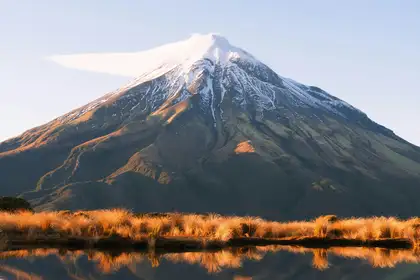
Taranaki Maunga
One of the potentially largest mining projects in Aotearoa’s history entered a critical point this month when the $1billion investment proposal of Trans-Tasman Resources (TTR) to extract 50million tonnes of sand annually off the South Taranaki seabed for the next 20 years were subjected to community, environmental and Iwi comment in front of the Panel assessing the proposal.
The hearings were held at the TSB Hub In Hawera, with the maunga, Mount Taranaki as a backdrop. In February this year Taranaki maunga, along with Pouākai and Kaitake maunga, which are collectively known as Te Kāhui Tupua, was granted legal personhood under the Te Ture Whakatupua mō te Kāhui Maunga, or Taranaki Maunga Collective Redress Act. This was part of a broader settlement process to redress historical and systematic injustices inflicted by the Crown on tangata whenua in the region and was passed unanimously by Parliament.
Te Kāhui Tupua now sits alongside Whanganui awa (river) and Te Urewera as prominent natural features in Aotearoa’s landscape recognised legally as having personhood. The Act also created Te Tōpuni Kōkōrangi (s27) as the ‘human face and voice of Te Kāhui Tupua’.
At the panel hearing Taranaki maunga spoke through the chair of Te Tōpuni Kōkōrangi Board, Liana Poutu and two of the other Board members Rex Hendry and Dr Te Aroha Hohaia. The maunga presented a short statement and responded to questions from the panel.
Our interest in this process as a geographer and a resource planner respectively, is how the voices of the maunga, the eight Taranaki Iwi, community, and environmental groups intersect with formal planning systems, and fast-tracked large-scale industrial and infrastructure interests
We left the hearings with three overriding impressions;
It didn’t go the way the Minister intended
The panel hearings we attended did not appear to go the way the Minister of Resources and Regional Development, Shane Jones intended. When advised that Te Tōpuni Kōkōrangi, the maunga, had been invited to make a submission to the panel, Jones fumed that he didn’t expect the process to come down to the “matua verses the maunga” and didn’t appear to see a connection between the maunga and the offshore ironsands when he asked:.
This partitioning and reductionist approach contrasts with a more holistic and connected view that can be found in both science and te ao Māori.
For geologists the seabed ironsand material is derived directly from the mountain.
For tangata whenua, including Te Tōpuni Kōkōrangi, the moana (ocean), the maunga, and the people who live as, by, from and with them are intrinsically connected in boundless relational and genealogical flows. In this much broader and encompassing understanding of connections between elements of the environment – as the chair of Te Tōpuni Kōkōrangi noted:
“If you look at removing those minerals, that content, in a metaphysical sense and physical, it’s removing a part of the maunga”
The citizens and locals hold great knowledge
The significance of the ‘citizen science’ and local knowledge that was presented to the panel was powerful. Local user groups presented the panel with a mix of strong experiential evidence and highly polished science and analysis. Over the two days we heard from Project Reef and the South Taranaki Underwater Club, Greenpeace and Kiwis Against Sea-Bed Mining, Ngā Motu Marine Reserve Society, Wanganui-Manawatu Sea Fishing Club, Patea and Districts Boating Club, and Patea boating association among others. These groups were able to draw on thousands of hours of site observations to describe a broad array of cultural and natural values such as rich fishing grounds, unmapped reefs, and a wide distribution of species, including endangered ones. Between them they painted a picture of a much more diverse and fragile social-ecological system than originally described in data provided by TTR's consultants.
Granting approval would breach treaty rights
Despite Minister Jones’ position on tangata whenua involvement in the fast-track approval (FTA) process, that “It’s not designed to be a feeding feast for every hapū and iwi”, the combined opposition of all eight Taranaki Iwi to TTR’s application is a real problem for him.
Under the FTA legislation the panel must decline an approval when, among other criteria “the panel considers that granting the approval would breach section 7” (s85 (b), which references the Section 7 obligations under Treaty settlements and customary rights. This includes customary rights recognised under Marine and Coastal Areas legislation.
And alongside the position of Iwi grounded in a world view that sees the fundamental inter-connectedness of people, place and environments is this more prosaic local Iwi view of the TTR application:
“Ngāti Ruanui has an unbroken connection to the whenua and moana of South Taranaki for more than 700 years. We are no strangers to the mining industry, and we know a good operator when we see one. We also know when someone is trying to pull the wool over our eyes."
So too, it seems, does the maunga.
Professor Glenn Banks is a professor of geography and Dr Martin Garcia Cartagena is a lecturer in resource and environmental planning, within Massey University's School of People, Environment and Planning.
Related news
Opinion: International Court of Justice ruling marks new era in climate accountability
Co-written By Professor Regina Scheyvens and Professor Glenn Banks

Opinion: The hard questions NZ must ask about the claimed economic benefits of fast-track mining projects
By Professor Glenn Banks
Opinion: Recrafting the narrative of mining in New Zealand: Is Shane Jones a closet post-structuralist?
By Professor Glenn Banks
Conference explores nature-inspired solutions for sustainable development
How we can work in harmony with nature to achieve the United Nations’ Sustainable Development Goals (SDGs) was the topic of a summit led by Te Kunenga ki Pūrehuroa Massey University last week.