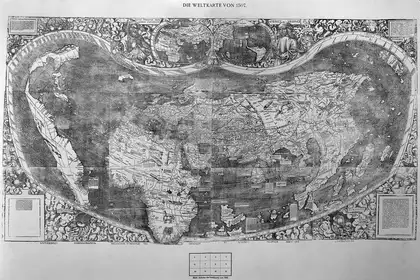
The term America was used for the first time in this 1507 map, the Universalis Cosmographia.
Just over a week ago Economist and Nobel laurate Paul Krugman posted a video on his YouTube channel explaining why he doesn't speak “American”, a language no one can speak because it doesn’t exist.
Krugman was referring to comments made by United States Secretary of War Pete Hegseth and President Donald Trump during a gathering of 12 Latin American leaders for the launch of “The Shield of the Americas”, hosted by President Trump in Miami. During that event Pete Hegseth boasted that he “only speaks American” and moments later the President himself told his guests “I'm not learning your damn language. I don't have time.”
Krugman regrets that he only speaks English and never learnt another language but takes issue with labelling the English language “American” and the agenda and “belligerent ignorance” behind both men’s comments.
Whenever I visit secondary schools around Aotearoa New Zealand, I ask students if Washington is the capital of America. Students of Spanish can immediately detect what I am getting at, but most others say yes, because the name America has become exclusively associated with the United States.
This has changed over my lifetime. In primary school, I learnt that America includes all the territory from Alaska to Tierra del Fuego, and that there wasn’t one America and other Americas. I also learnt that there is one continent divided into North America, Central America, the Caribbean, and South America.
That is what I have been teaching for almost four decades. Students of today find it interesting to discover that Bolivians, Guatemalans and Paraguayans, among many others, are also American and that they speak Spanish and many indigenous languages.
The birth of the term America began with a map, the Universalis Cosmographia, in which German cartographer Martin Waldseemüller used it for the first time in 1507, in honour of Italian explorer and navigator Amerigo Vespucci.
During the nineteenth century the rise of the United States as a powerhouse economy and its policies towards Latin America led to the exclusivity denoted in the term America. The total collapse of the Spanish empire after the Spanish-American war of 1898, in which Spain lost its last colonies (Cuba, Puerto Rico, the Philippines, and Guam), cemented US dominance in the region.
The US-Latin America relationship has been extremely complex and fraught from the beginning and it explains the current state of affairs. Rather than a relationship it is much more about political, economic and military interventionism.
This reference by US leaders to a non-existent ‘American language’ is symbolic of new alarming connotations for those Americans, like myself, who speak other American languages, and for our world.
Professor Leonel Alvarado teaches Latin American studies in the School of Humanities Media and Creative Communications at Te Kunenga ki Pūrehuroa Massey University
Related news
Opinion: The dangerous logic behind ‘no stupid rules of engagement’
By Professor Bethan Greener
International poetry festival honours Massey professor
Professor Leonel Alvarado from the School of Humanities, Media and Creative Communication will be honoured at the upcoming eighth edition of the International Poetry Festival Los Confines.
Brazilian Government honours Massey Professor
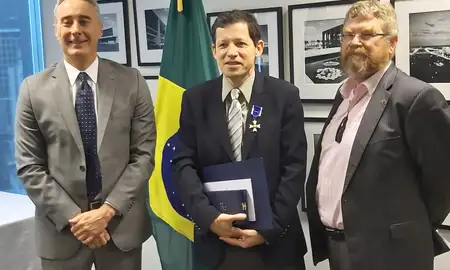
Professor Leonel Alvarado from the School of Humanities, Media and Creative Communication has been made an Officer of the Order of Rio Branco for his services to the Portuguese language and Brazilian culture in Aotearoa New Zealand.
Massey students experience Brazil with PM Scholarship
A group of 13 Massey University students have discovered there is much more to Brazil than just soccer, samba and sun during a recent four-week language and culture immersion programme.