Who first invented the concept of artificial intelligence? Artists did. Among them was Karel Čapek, a Czech playwright who introduced the word “robot” to the world in 1921.
So, while many artists are anxious that artificial intelligence (AI) will replace them, which is understandable given AI can copy and merge existing artistic styles to give the appearance of something new, the rise of AI in fact only demonstrates just how irreplaceable artists are.
AI-generated art is only a concern when we conflate artistic process with the products it produces. If we understand art as a form of deeply human intelligence that AI will never replicate, the unique value of art and artists becomes clear. That value is not about the commodities artists create, rather the artistic intelligence which enables them to solve problems in ways AI cannot.
AI works by learning how things have been done before and aggregating existing patterns. It can’t recognise bias in its training data or feel the absurdity of injustice in past systems. It also reflects the profit-driven priorities of its creators, appropriating and decontextualising Indigenous knowledge without consent, for example, without questioning the systems it operates in.
Artistic intelligence, by contrast, uses unlearning: subverting what we think we know to expose hidden assumptions and marginalised perspectives. Artists deliberately sidestep the dominant. Then, we dream up something completely different.
Our artistic training develops this ability to dream: to take risks, veer off-script, follow hunches down improbable paths, imagine alternative realities and prototype different worlds. Not only AI itself but many human inventions were first seeded by artists’ freewheeling imaginations.
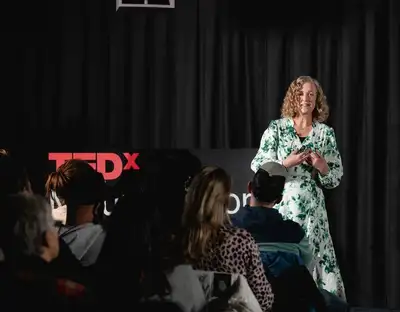
Professor Elspeth Tilley.
Artists also listen: to others, the marginalised, even to the more-than-human world. AI is anthropocentric, locked inside a human-generated dataset. Artists, using empathy and extrospection, explore the voices of other species, the atmosphere, the ocean and more.
And of course, the real environmental cost of generative AI is huge, whereas artists are increasingly leading low-carbon practices. In Aotearoa, for example, Playmarket’s Green Theatre Plan shows how artists are taking environmental responsibility.
Then there’s embodiment. Much art is physical. It breathes, sweats and literally moves us. Neuroscience shows that live art can synchronise audience heartbeats, trigger empathy hormones and build community. AI is code in a box. It has no heartbeat, no breath, no communal ties or ancestral connections. Artists know that some things must be lived, breathed and felt to be understood.
Art also teaches us to be comfortable with uncertainty. Poet John Keats called this “negative capability”; the ability to sit with mystery without needing a tidy answer. AI calculates the most “correct” answers. Artists know that humans are messy and passionate. Sometimes many things, even conflicting things, can be true at the same time. In a world of increasing polarity, artists’ abilities to hold plurality and paradox in tension are vital.
AI is undoubtedly useful and here to stay. But it will never be able to help us with ambiguity, plurality, emotion, resistance to domination and imagination, the areas where artistic intelligence soars. Practices like unlearning and dreaming can help us build a more just, sustainable and joyful world in ways that machine learning and probability-based algorithms simply cannot imagine.
So, let’s stop undervaluing the arts and recognise that artistic intelligence is exactly what we need more of right now. Climate change is a crisis generated precisely by our very human inability to stop following, aggregating and justifying our old, world-destroying ways of perceiving and doing things. AI doubles down on those old ways. By contrast, artists’ empathetic, paradigm-busting, big-dreaming, creative problem-solving abilities are the answer to the impasse.
Related news
New competency framework aims to lift standards across New Zealand’s financial capability sector
Te Kunenga ki Pūrehuroa Massey University’s NZ Financial Education Centre (Fin-Ed Centre) has launched a new framework designed to raise professional standards for financial capability practitioners working across Aotearoa.
Opinion: Music is at the forefront of AI disruption, but NZ artists still have few protections
By Associate Professor Dave Carter, Dr Jesse Austin-Stewart and Professor Oli Wilson
Opinion: How should teachers consider AI in assessment?
By Professor Giselle Byrnes