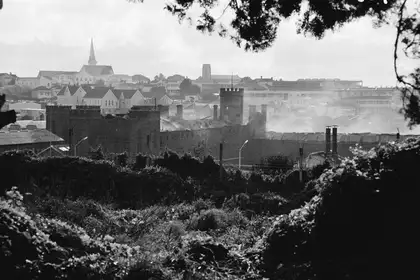
Smoke rises during the 1965 Auckland prison riot.
Confirmation early this month that New Zealand Special Air Service (SAS) soldiers with tracking expertise were used on several occasions between 2024 and 2025 to search for Tom Phillips and his children, despite Police denials, comes as no surprise to those with knowledge of the expertise and specialised surveillance and reconnaissance skills that the SAS possess.
Under provisions within the Defence Act, our military forces, including the SAS, are permitted alongside civilian agencies to perform any public service or provide assistance in time of emergency. Being ready to counter any efforts on the part of the French to free their two imprisoned DGSE (Directorate General for External Security) intelligence officers in the wake of the Rainbow Warrior bombing in 1985, is known to many. We are also familiar with the counter terrorist support that SAS provided to Police during the Christchurch Mosque attacks in 2019. More recently, specialist SAS personnel were sent to recover the bodies of those killed in the Whakaari/White Island December 2019 eruption, and during Operation PROTECT, SAS personnel were tasked with managing New Zealand-born ‘Section 501’ criminals deported from Australia during the pandemic.
While the use of the SAS on such tasks happens rarely, they nevertheless have occurred on a number of occasions in the past, and not just in the form of the tracking tasks used to help find Phillips. In January 1968, Auckland Police sought SAS assistance in finding armed fugitive David Heron, who was wanted in connection with a fatal shooting several days earlier. As the soldiers were exercising in the region where Heron was suspected of having escaped to, the SAS were asked to help with the search. They were able to track and locate Heron and even confidently offered to ‘apprehend’ the wanted fugitive. Police declined the offer, and SAS soldiers had to be content with maintaining a perimeter around the escapees’ hideout until Police arrived. Heron was later convicted of manslaughter and sentenced to nine years in prison.
In 1965, two prisoners tried to escape custody at Auckland’s Mt Eden Prison, releasing inmates and taking prison officers hostage in the process. The stand-off prompted a request for SAS assistance. The SAS squadron assembled in front of the prison, formed up in immaculate ranks with weapons (to this day it remains unclear whether ammunition had been provided or not), in plain sight of the rioting inmates. Shortly after, the rioters returned to their cells without the SAS needing to directly intervene. While the soldiers had not needed to enter the prison, British SAS troops stormed a Scottish prison in 1987 to rescue a prison officer who was held hostage for five days during a similar riot. Perhaps more relevant to the strength of reputation of the SAS took place in London in 1975, when a six-day siege ended with four IRA (Irish Republican Army) members surrendering and releasing their two hostages immediately after the BBC reported that the SAS were preparing to storm the house.
Further examples of the SAS being called on to utilise their diverse skill-sets in various non-traditional situations here in New Zealand and overseas have not been publicised in any significant detail, but deserve to be told if only to demonstrate such valuable versatility. In early 2019, New Zealand soldiers, including SAS members, travelled to Mali in West Africa to assist their British counterparts in providing bushcraft and tracking training for African park rangers in counter-poaching operations. While many of these skills were learnt in the jungles of Malaya and then practiced in Borneo and Vietnam, during the 1970s and early 1980s the SAS would conduct regular training in areas throughout the country controlled and administered by departments that now fall under the umbrella of the Department of Conservation (DOC). When using these areas, many inhospitable and difficult to access, these departments would seek reciprocal support with tasks that were complimentary to SAS training like climbing and abseiling into remote areas to remove pests or lay traps. On a number of occasions, the SAS were tasked with tracking poachers that were targeting endangered native species for overseas wildlife markets. Many of these operations were concealed under the cover of training exercises, but there is sufficient anecdotal evidence to suggest that the SAS were often successful in providing evidence to law enforcement and wildlife services that saw the interception of international poachers before they were able to leave the country.
Even less well known was a request, along with Police and public health staff, for assistance during a psychiatric nurses’ strike at Auckland’s Oakley Hospital in June 1971. In a post-strike report, hospital superintendent Pat Savage praised the contribution of the SAS soldiers, their demonstrations of discipline, empathy and resilience when necessary. Savage added that “the [SAS] treated the operation as a minor civil disturbance of the type noted in Northern Ireland and patrolled the grounds vigilantly…It was of considerable reassurance to female members of the staff.” Whether the SAS saw it this way is not known, although it was something of a warzone for one SAS member who was “knocked out by a male newly admitted patient and had to be admitted to a military hospital.” The SAS contribution to the Oakley strike would also show something of their “hearts and minds” soft skills. It is here that the SAS soldiers called in a favour from the original SAS commander, Frank Rennie, who had retired from the Army and was now working for international tobacco firm Rothmans. Thanks to his position, Rennie was able to provide the SAS carers with a sufficient quantity of what was, at the time, a most valuable currency of trade. The soldiers departed Oakley after the strike ended two weeks later.
The unique training and expertise that SAS personnel bring to a variety of risky scenarios, some of which can of course be violent – or lead to violence - is the value proposition that this unit has always brought to its political masters. The SAS have consistently maintained the highest levels of necessary training and discipline to handle a variety of situations, often using a minimum amount of force. This reputation has stayed with them since they were first formed 70 years ago in Malaya.
Any response in the form of criticism of the SAS being used in New Zealand to find Phillips and his children, beyond Police concern that such assistance could escalate the situation, was either muted or non-existent, suggesting that the reputation of the SAS and public faith in their abilities and contributions have returned to post-Operation Burnham levels. The story of the New Zealand SAS is rich – there is much that need not be hidden.
Dr Rhys Ball is a Senior Lecturer in Security Studies at Te Kunenga ki Pūrehuroa Massey University, and spent a number of years as an intelligence officer. He often comments in the media about issues regarding security and intelligence.
More news
Opinion: The Mamdani Mandate: An unapologetic socialist register, forged by the people, for the people
By Professor Mohan Dutta

Opinion: Savvy politicians know how to ‘perform’ authenticity – the Jacinda Ardern doco offers a masterclass
By Associate Professor Susan Fountaine

Opinion: Auckland Transport has delivered, but politics have derailed it
By Professor Imran Muhammad and Dr Fawad Ahmad
Opinion: Good sleep health to support good mental health
By Professor Leigh Signal and Dr Dee Muller