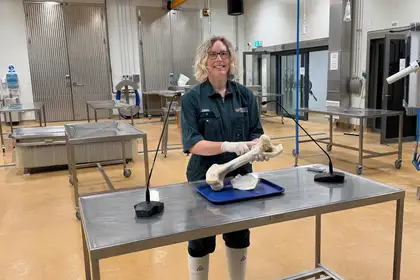
Professor of Veterinary Pathology Keren Dittmer inside the pathology suite.
The 2026 theme for World Veterinary Day, ‘Veterinarians: Guardians of Food and Health’, is particularly fitting when you consider that the country’s largest employer of Te Kunenga ki Pūrehuroa Massey University’s veterinary graduates is the Ministry for Primary Industries, reflecting the central role vets play in safeguarding food systems and biosecurity.
The pathology suite plays a vital role in preparing this next generation of veterinary professionals for the wide range of careers they’ll pursue.
“We need vets to protect food systems and respond to disease, but before they can do that, they have to understand disease and this is where that begins,” Professor of Veterinary Pathology Keren Dittmer says, standing within the large, carefully organised teaching environment of the pathology suite.
The suite has several purpose-built spaces including a tutorial room equipped with multiheaded microscopes, and a large autopsy area with stainless steel tables, with hydraulic tables for large animals. There are dedicated areas for photography and clinical laboratory work, as well as chillers and freezers.
Professor Dittmer specialises in bone diseases of animals, vitamin D, and genetic diseases. In addition to teaching endocrine and skeletal pathology to third-year veterinary students and autopsies to fifth-year students, she leads the pathology group responsible for their pathology education.
A typical teaching day in pathology for fifth-years begins in the tutorial room, where students are assigned real cases submitted by veterinary clinics and discuss clinical histories and possible diagnoses. In the pathology suite, students then lead supervised autopsies, collecting samples for further testing. The session concludes with a group case review, where findings are discussed and diagnoses refined. Afternoons may include tutorials or laboratory work, followed by students writing reports, which are reviewed with feedback provided. Final results are compiled into reports sent back to the veterinarian who submitted the case.
“Performing autopsies allows students to turn theory into practice. By working through real cases, they see how different diseases affect animals’ bodies, develop diagnostic and problem-solving skills and learn how to collect and interpret samples. It also strengthens their practical abilities and reinforces the importance of compassion, respect and professional judgement in veterinary care.”
Professor Dittmer says that while students can be taken aback when they first enter the suite, the team works to ensure it remains a professional and supportive learning environment by preparing students in advance.
“We explain clearly why it’s so important, and want it to be experienced as the valuable learning environment it is rather than a confronting one. Sessions are led by experienced staff who guide students through the findings, keeping the focus on learning. By maintaining a calm, respectful atmosphere, the suite remains a positive environment, and students are supported if they find the experience challenging,” Professor Dittmer explains.

Professor Keren Dittmer.
Massey’s pathology suite is capable of supporting the Ministry for Primary Industries (MPI) in responding to animal disease outbreaks, however, Professor Dittmer says it’s most important role is educating future veterinarians and veterinary pathologists.
“In particular, we focus on helping students recognise diseases that are not present in New Zealand and understand how to respond if they encounter a suspicious case. Because we carry out autopsies on a wide range of animal species from across the country, any cases that show features resembling an exotic disease are reported to MPI for further investigation.”
Massey also provides a three-year pathology residency programme, providing advanced specialist training for veterinary graduates who will go on to work in diagnostic laboratories across New Zealand.
“These graduates play a key role in identifying and referring any potential exotic disease cases to MPI, helping to keep the country safe.”
For Professor Dittmer, one of the most rewarding aspects of teaching is seeing students recognise the lesions of a specific disease for the first time.
“You can see that moment where it clicks for them, and it’s incredibly validating. All that time they’ve spent studying and revising suddenly feels worthwhile in a very real, practical way. It’s just as great when a student says, ‘Oh, now I understand, I can see how this leads to those clinical signs.’ Moments like that help everything fall into place and give them a much clearer overall picture – and that’s where I see these future veterinarians beginning to take on their role in safeguarding animal and human health, food systems and our country.”
Interested in knowing more about the process for application to the Bachelor of Veterinary Science? Join the Massey team for an online information session at 7pm on Thursday 7 May to learn more about becoming a veterinarian. This webinar is for future students currently within New Zealand, parents and teachers.
Related news
Massey enters world top 15 in 2026 QS Subject Rankings
Te Kunenga ki Pūrehuroa Massey University has achieved remarkable results in the 2026 Quacquarelli Symonds (QS) Subject Rankings with a new global top 15 subject ranking.
Making visits to the V-E-T as exciting as a W-A-L-K
Behaviour enthusiast and veterinary nurse at Massey's Companion Animal Hospital Renee Greenwood is the driving force behind Purely Pawsitive, a programme delivering positive visits designed to make veterinary care less stressful for pets, owners and the veterinary team.
Massey University unveils new $70m veterinary research facility
The final new build in a ten plus year project to upgrade the veterinary facilities at Te Kunenga ki Pūrehuroa Massey University was officially opened this morning by Minister for Universities, Honourable Dr Shane Reti.