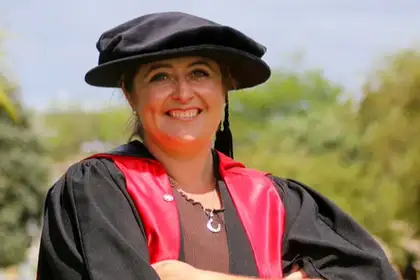
Graduating with her Doctor of Philosophy (PhD) marks the culmination of Dr Burling’s remarkable 14-year journey with Te Kunenga ki Pūrehuroa Massey University. Across her studies, she has contributed to significant advances in biomedical research, with findings that hold potential to improve future healthcare.
A drive for genetics and science
Growing up in Kerikeri, the 30-year-old was always drawn to animal breeding and genetics. Competing in equestrian sport at a high level made her acutely aware of how genetics shape performance and health. Dr Burling envisioned a career at the intersection of equine sport and science, and says Massey stood out as the right place to pursue that path.
“Not only did Massey have strong foundations in animal science, but the support for distance learning also made it possible to keep pursuing my equestrian goals while undertaking rigorous academic research,” Dr Burling says.
After completing a Bachelor of Science in genetics and a Bachelor of Science (Honours) in biochemistry, Dr Burling embarked on her PhD.
Her research focused on motor neurone disease (MND), a devastating and rapidly progressing neurodegenerative condition. New Zealanders are disproportionately affected yet face the same global challenge: very few treatment options exist, and none can stop or reverse the disease.
Models are essential research tools that represent a disease, allowing it to be studied and enabling treatments to be developed and tested safely.
“Accurate models are the foundation of research and drug discovery. Without them, it’s almost impossible to develop treatments that truly help patients,” Dr Burling explains.
“The most commonly used model for MND is a mouse model, but it represents only a small fraction of patients, and because mice aren’t humans, more than 90 per cent of drugs that succeed in mouse models fail in human trials.”
Cell-based models exist, but most only represent motor neurones, despite the disease affecting multiple systems including muscles, nerves and other tissues. These limitations contribute to why only three approved MND drugs exist, each extending quality of life by just one to three months.
“By building models that better reflect real patients, especially those with the more common, non-inherited forms of MND, research becomes more relevant and the search for meaningful treatments can accelerate.”
A patient-specific approach to MND
To create her model, Dr Burling collected cells from New Zealanders living with MND, focusing particularly on those without known genetic causes. This allowed her to build a diverse and representative cell bank that more accurately mirrors the New Zealand MND population.
“I met many of the patients and their families and got to know them, learning their stories beyond what was happening in my culture dishes. Because MND progresses so quickly, often within three to five years, some of these patients very sadly lost their fight during the project. That reality intensified the purpose behind everything I was doing,” Dr Burling says.
Using donated cells, she generated induced pluripotent stem cells – cells capable of forming almost any tissue type. From these, she produced nine different cell types, including multiple types of neurons, muscle, blood vessels and even gut tissue. This approach enabled a more complete study of the disease, rather than isolating one single cell type.
“We still don’t know what causes motor neuron disease or whether motor neurons are the starting point or victims of processes happening elsewhere in the body. This model offers a more realistic and holistic way to study the disease and test potential treatments.”
Dr Burling’s model could save years of research time, allowing effective treatments to be identified, developed and delivered to patients more quickly than the current 10 to 15 year development timeline.
“By creating patient-specific models that reflect the real MND population here in New Zealand, if a drug shows benefit in this model, there’s a much higher chance of it helping the people it represents. This work could fast-track drug discovery and improve our understanding of why MND is so common here,” Dr Burling says.
Purpose meets passion for future pursuits
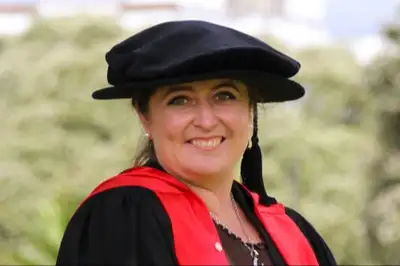
During her PhD, Dr Burling spent six months at Massachusetts Institute of Technology working with the miBrain team, which develops multicellular ‘mini-brains’ for Alzheimer’s and Parkinson’s research.
“My focus was on developing protocols to generate specific types of neurons, especially those involved in muscle control and the gut-brain connection. The environment was fast-paced and incredibly collaborative, and it strengthened my approach to building complex, reliable models.”
Outside the lab, Dr Burling stays busy, breeding elite sport horses and flying planes. She runs a small laboratory as part of her business, Maverick Sporthorses, working with embryos, frozen semen and advanced fertility techniques.
“It challenges my scientific knowledge while connecting me to my rural roots. Flying taught me patience, discipline and purpose, skills that helped me stay resilient when experiments didn’t go as planned!”
Curiosity, purpose and personal connection kept her motivated through her PhD challenges.
“I was determined to understand this devastating disease that affects real people and their families. Devising experiments, solving complex problems and building models that reflect human biology is demanding, but incredibly rewarding.”
Now settled in Halcombe in the Manawatū, Dr Burling hopes to secure a role that allows her to continue this work.
“MND and disease modelling are my true passions. I have deep roots in the innovation sector and venture capital, and I’d love to balance research with a spin-out. Commercialisation is ultimately how research can make a real impact for patients.”
While a cure for MND would be transformative, Dr Burling’s immediate goal is to offer people more options that genuinely improve their quality of life.
“I want this work to change lives. Every insight and every drug that shows promise in these models could mean more time for patients and their families.”
Related news
Exploring kiwifruit’s potential as a natural sleep and mood booster
Dr Alexander Kanon’s PhD research explored whether kiwifruit could be the secret ingredient to supporting better sleep, mood and brain health, with his findings revealing the New Zealand-grown fruit may offer more benefits than previously understood.
Safeguarding New Zealand fur seal/kekeno through assessing population trends and threat factors
Dr Alasdair Hall’s fascination with marine mammals began long before his research into Aotearoa New Zealand’s fur seal/kekeno population, work that has improved understanding of how the species is faring and the challenges present.
New brain research paves the way for future treatment of neurological disorders
New research has uncovered a process in the brain that could pave the way for future treatments of neurodevelopmental and neurodegenerative disorders, such as Alzheimer’s disease.