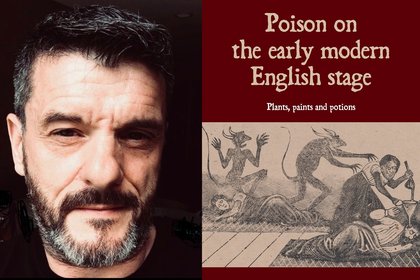
Dr Bill Angus has co-edited a book on poison being used in stage plays in the 16th and 17th centuries.
In Shakespeare’s time, the possibility of being deliberately poisoned, especially if you held high office, was a constant fear.
Shakespeare scholar and Senior Lecturer Dr Bill Angus says people had little medical knowledge and because poisons were difficult to trace, they couldn’t protect themselves against them.
The co-editor of Poison on the Early Modern English Stage: Plants Paints and Potions, Dr Angus says the new collection of essays opens a Pandora’s box of poisons used in stage plays from the mid-16th to the late 17th centuries.
Dr Angus says, "The English very much suspected the Italians of being poisoners. Italy was a Catholic country so was distrusted. A typical xenophobia of the time really; the English thinking everyone else is sneaky and immoral while regarding themselves as straightforward, upstanding, honourable opponents.”
If it wasn’t the Italians, it was women who were to be feared, he adds.
“Poison was supposed to be a woman’s tool. The great fear of a patriarchal, masculine society was that women might poison you with the very food they’re preparing for you.”
Plays of the time featuring poisonings, most famously in Hamlet where King Hamlet’s brother Claudius commits murder by pouring poison into the sleeping monarch’s ear, reflected the deep-seated fears of the audience, Dr Angus says.
“There was a religious aspect to the idea of poisoning too, around the right and wrong use of nature. It’s the demonic use of herbs and natural substances that is the issue. The historical culprit here would be the woman herbalist living on the edge of the village, who was obviously a witch.”
The crossover between poison and witchcraft was complicated by the dissolution of the monasteries under Henry VIII. The monasteries’ medicinal herbal gardens fell into disuse, leaving women in control of the herbal environment. And women, it was thought, couldn’t be trusted.
One of the essays in the collection, Poxy Doxies and Poison Damsels, looks at venereal disease, another kind of poisoning engendering deep-seated fear in society.
Dr Angus says syphilis was the AIDS of the era.
"Men were not seen as the main issue, it was the view that women were poisonous. And syphilis was treated with mercury, in itself a poison.”
The prevailing fears around the concept of poisoning also had racial overtones. Poison might have the effect of darkening the skin, so black skin was thought to be poisonous too.
Poison could also take many other forms, some of which have resonance in the modern era of ‘fake news’ and social media.
“Another deep paranoia of the age was that rulers could be poisoned by unreliable paid informers or spies who embellish or make up conversations and feed them into the ear of the monarch. There are a number of plays at that time that dealt with the idea that if you poison the ruler, you poison the whole of society.
“In Hamlet, almost every single character is an informer. This circulates around the idea of the king being poisoned and the whole state of Denmark being rotten.”
Poison was a useful dramatic device because it was easy to use on stage.
“You just swigged a bit of coloured water, and it looked authentic. But the way it was administered could be very creative. For example, in the Jacobean revenge tragedy The Duchess of Malfi, there is a Cardinal who gets his mistress to kiss a poisoned Bible, an interesting way of commenting on the breakdown of trust in authority and in religious truth," Dr Angus says.
“You’re left with enough ambiguity to get around the censors. And setting a play in Italy as Shakespeare often did gets around censorship too – it’s not us, it’s those terrible Italians. Or it’s the State of Denmark that is rotten, not Elizabethan England.
“So yes, poisoning is a convenient dramatic device but it can also be a very powerful metaphor for some of the overarching problems based around mistrust of authority. All the old authorities have been taken away. The Pope has no authority so where does the king get his authority from? Such anxieties lead to these kinds of depictions on stage.”
In putting together the collection of essays, Dr Angus says he was interested to see how other academics were formulating their ideas of the meaning of poison, everything from snake venom to disease and the 'ocular fascination' which caused lovesick men ensnared by a woman to lose control of their faculties. Even the theatre itself was seen by the church preachers of the time to be poisonous and sinful.
“A book like this gives you a window into a time when if you’d mentioned the word poison it could have meant any of these things,” he says.
Poison on the Early Modern English Stage: Plants Paints and Potions is edited by Dr Angus and Professor Lisa Hopkins of Sheffield Hallam University. It will be published by Manchester University Press in August.
Related news
Love of literature thriving in digital age - Shakespeare man
A preoccupation with digital media does not mean reading books is off the menu for youth - that's the view of Massey University Shakespeare specialist Dr Bill Angus.

Surveillance in Shakespeare – the plot thickens
Citizens of the 21st century are well used to mass surveillance of the cyber variety, but a new book exposes just how prevalent spies and informers were in Shakespeare's life and lines.