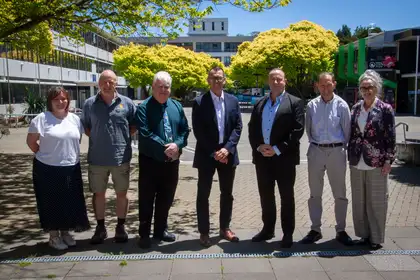
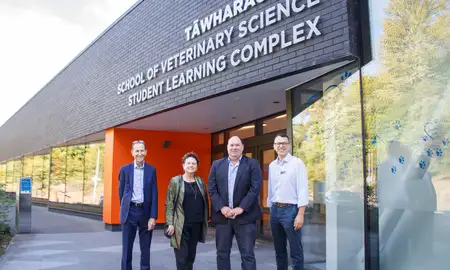
Dr Sarah Golding, Professor Danny Donaghy, Professor Jamie Quinton, Professor Jon Huxley, Dr John Roche, Pro Vice-Chancellor College of Sciences Professor Ray Geor and Provost Professor Giselle Byrnes.
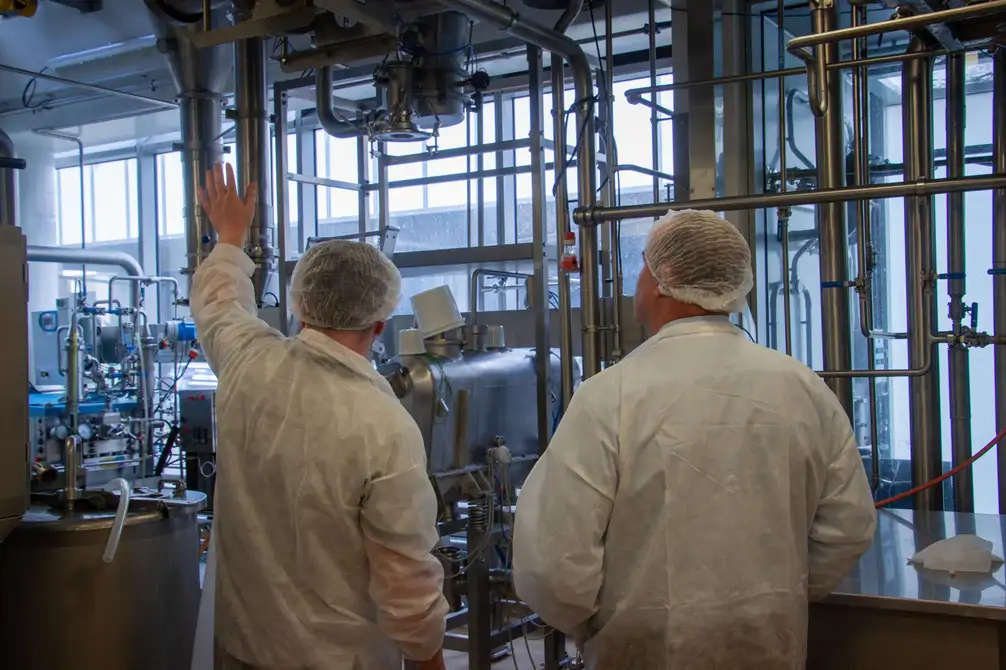
Dr Roche was welcomed onto campus by the Provost Professor Giselle Byrnes and Pro Vice-Chancellor College of Sciences Professor Ray Geor. Following a meeting with Director Research Operations Dr Viv Smith, Dr Roche began his day with a tour of the FoodPilot, home to the largest collection of food pilot factory equipment in the Southern Hemisphere.
Guided by FoodPilot Senior Technologist Branagh Ward and Pilot Plant Manager Garry Radford , Dr Roche explored the high-tech equipment used to transform ideas into safe, ready-to-produce food products. With a personal background in agricultural science and farm systems, he took a particular interest in the FoodPilot’s capabilities in primary produce processing and the milk-processing technology on display.
He also learned about the FoodPilot’s Risk Management Plan, one of the most stringent in the country, which enables the processing of a wide range of food products, including pet food, dairy, meat and snacks. The facility brings students, teachers, researchers and industry partners together in one space, and provides the flexibility to support diverse collaborative projects.
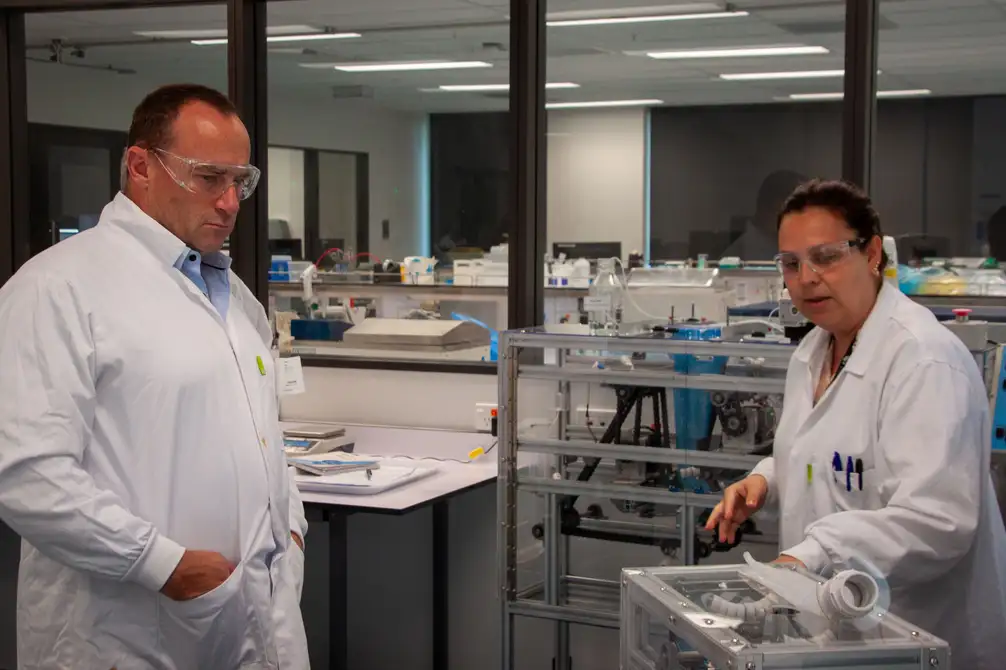
Dr Roche then visited Te Rourou, the home of the Riddet Institute, where Associate Director of Operations John Henley-King guided him through the research laboratories. Food digestion researcher Dr Juliana Leite outlined the development and application of the Institute’s innovative Human Gastric Simulator. Dr Roche, with his knowledge in nutritional biochemistry, noted how the simulator enables significant advances in monitoring both physical and chemical digestion in 3D and tracking nutrient absorption from food.
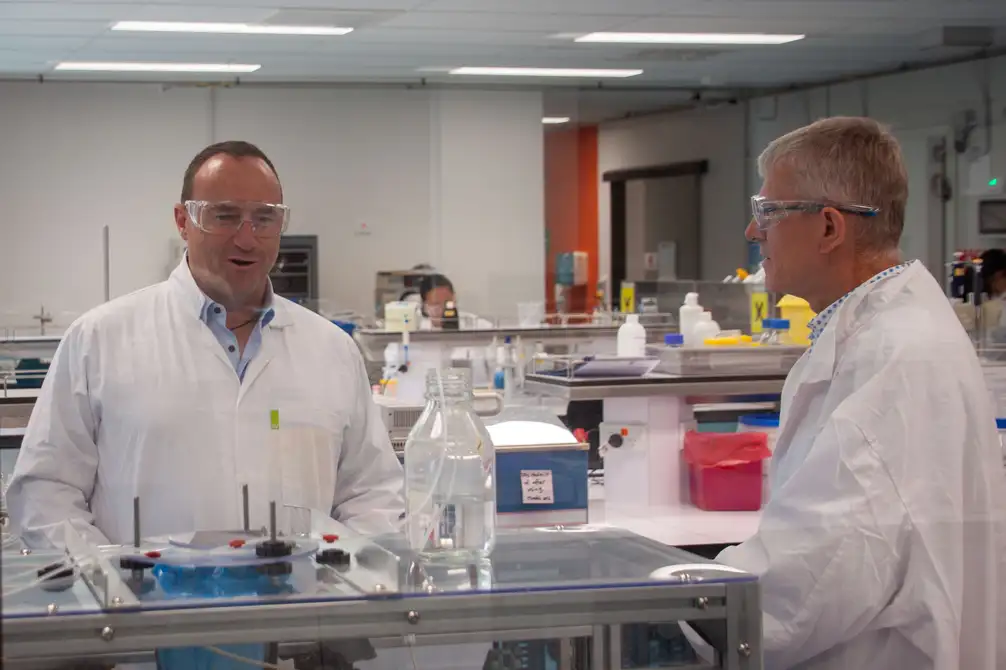
The final stage of the tour was a visit to the Food Experience and Sensory Testing (Feast) Lab with Fonterra-Riddet Chair in Consumer and Sensory Science Professor Joanne Hort. Professor Hort described Massey’s mission to elevate consumer and sensory science in Aotearoa New Zealand, showcasing new technologies the team are using to investigate responses not only to food but also to other products, including fragrances.
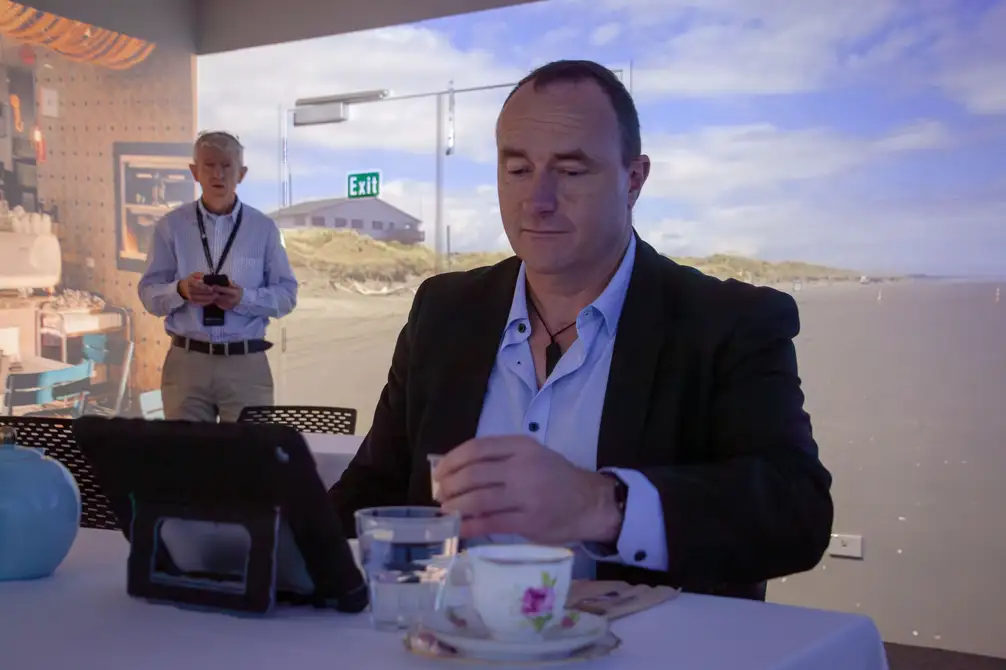
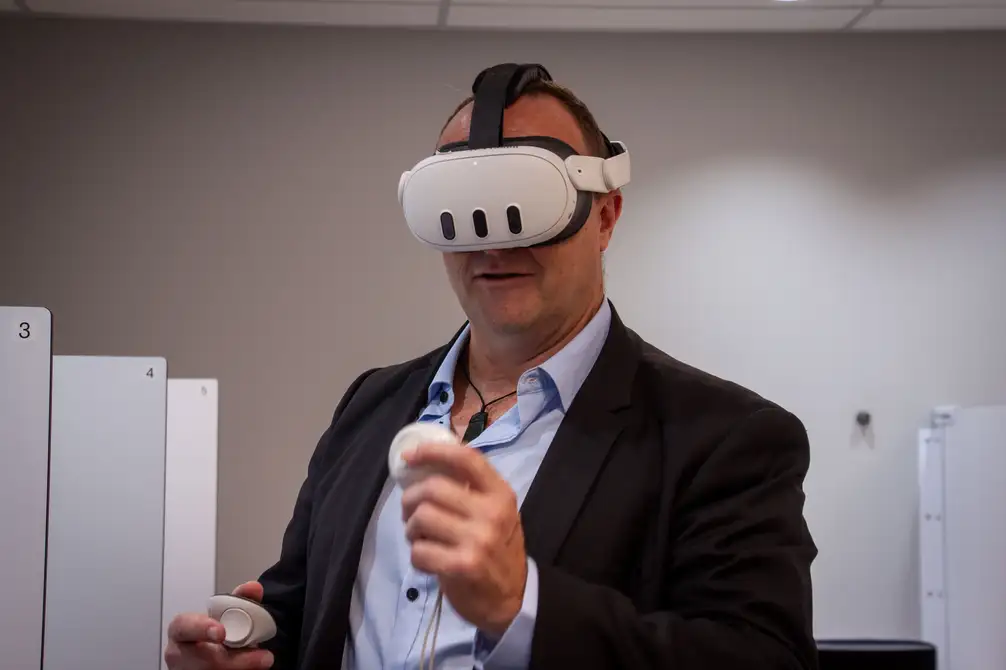
Dr Roche toured the panel room, viewed eye-tracking technology used for product assessments, met with researchers and summer students and even experienced a virtual-reality bar/diner environment. He described the experience as “a real show-and-tell". Professor Hort explained how Feast has pioneered sensory-assessment technologies that allow researchers to compare booth-based data with responses in virtual environments or in the immersive space – the only facility of its kind in New Zealand and one of just three at universities studying food sensory science worldwide.
In the immersive space, transporting him from a cafe to Foxton Beach within seconds, Dr Roche put his tastebuds to work in a triangle test on milk to detect product differences. Professor Hort outlined how the same testing was used within the Whenua Haumanu programme to evaluate whether milk from cows grazing on contemporary versus regenerative pastures produced taste differences in the milk for consumers.
Dr Roche’s visit at Feast concluded with discussions on how the team’s research can be applied internationally, including work on indigenous food packaging, wine and verjuice and how lactation period affects consumer perceptions of milk.
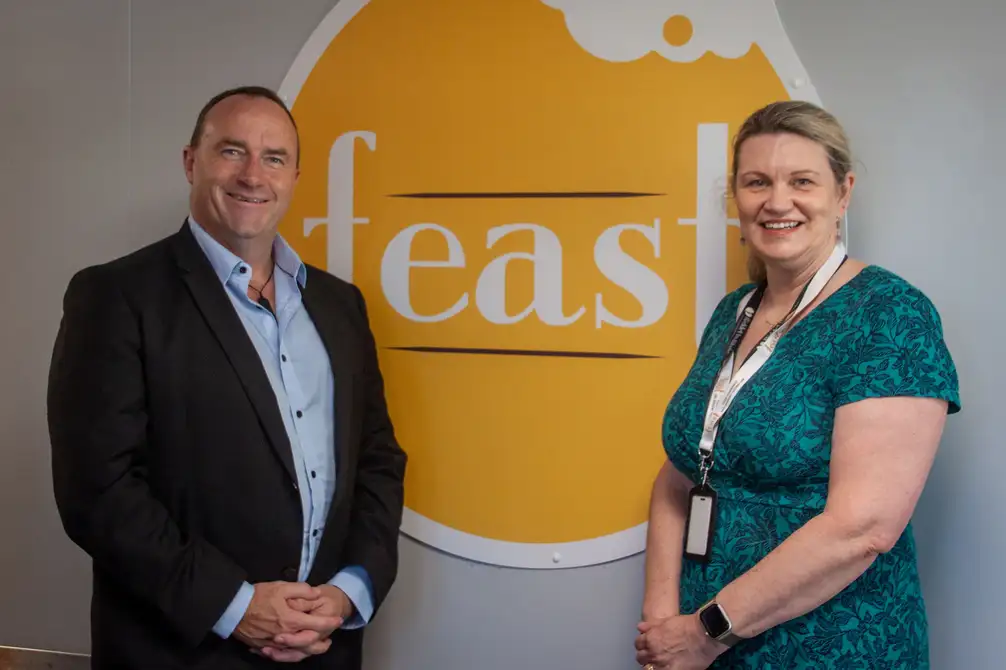
Following the tour, Dr Roche joined Professor Geor and the Provost for further discussion alongside key sciences leaders, including Head of Tāwharau Ora School of Veterinary Science Professor Jon Huxley, Head of the School of Food Technology and Natural Sciences Professor Jamie Quinton and Deputy Head of School of Agriculture and Environment and Leader of the Ministry for Primary Industries (MPI)-funded Whenua Haumanu Programme Professor Danny Donaghy.
Reflecting on his visit, Dr Roche was impressed with Massey’s work in food technology, highlighting the scale and impact of the research.
“When you think of Massey, you immediately think of agriculture but the activity at Massey is bigger than I thought it was, particularly with the amount of work that is going on regarding the understanding of food and the consumer acceptance of food.”
“Massey has been educating some of the best New Zealand graduates for nearly a century, the impacts have been huge, and we look to Massey to continue to do that.”
Dr Roche also stressed the importance of future science skills to meet emerging challenges.
“The world has changed. The ability of technology has increased, but an ability to use the technology that continues to be developed at pace will be incredibly important for the next generation of scientists.”
“Our pressing challenges are adapting to climate change and mitigating our greenhouse gases, we need to manage our impact on fresh water. Over the past 20 to 30 years, science has come up with some amazing solutions as we have defined the problems. These problems will not go away so we have a fertile ground for science and scientists for a long time to come.”
He added that while New Zealand’s science system produces excellent research, there is a need to bridge the gap between research and practical application.
“There is great science being done, however, we recognise that our science system has not been delivering as much as it could to our society and the economy. We are putting things in place to address that and help ensure that science can become something that New Zealand can use even more productively.”
Professor Geor says it was wonderful to have the opportunity to show the Prime Minister's Chief Science Advisor around and let him see firsthand how Massey is advancing the fields of food and agriculture.
“We have worked with John over several years in his role as Chief Scientist at MPI. He is very familiar with our strengths in agriculture, supported by 2,000+ hectares of working farms that host some of the research supported and funded by MPI, such as the Whenua Haumanu Programme. It was great to be able to show him another of Massey’s strengths along the agrifood chain: food technology.
“Our flagship qualifications and world-ranked food technology group provide strong support to the food industry in Aotearoa New Zealand. John had the chance to ask many questions and gain a deep understanding of the work we are doing across the applied sciences – including agriculture, veterinary science and food technology – and how we contribute to New Zealand’s bioeconomy. We had some great conversations, and it was a pleasure to host him. We look forward to welcoming him again in the future.”
Related news
Food technology continues to shine with back-to-back top 50 global rankings
Food Science and Technology has once again been ranked as Te Kunenga ki Pūrehuroa Massey University’s top subject in the recently released 2025 Shanghai Ranking’s Global Ranking of Academic Subjects.
Minister Andrew Hoggard visits College of Sciences on Manawatū campus
Last Friday, the Minister for Biosecurity and Food Safety and Associate Minister of Agriculture, the honourable Andrew Hoggard, visited Massey’s Manawatū campus, hosted by the College of Sciences.
Feast Laboratory: The virtual all-around tasting experience
With 80 per cent of new products failing in the marketplace, conducting consumer testing beforehand becomes imperative, highlighting the potential for virtual reality technologies to revolutionise predictions of consumer acceptance.