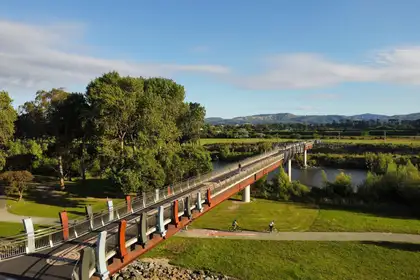
He Ara Kotahi bridge. Photo credit: Palmerston North City Council.
The refreshed degree through Te Kunenga ki Pūrehuroa Massey University’s School of People, Environment and Planning which launches in 2026, is a distinctive, Te Tiriti-led qualification that aims to give graduates the courage and skills to lead transformation.
Programme Coordinator, Dr April Bennett says planning education around the world tends to focus on either technical skills, regulatory knowledge, or social and environmental justice.
“Massey’s refreshed BRP integrates all three, giving students expertise in technology, legislation and planning processes while emphasising Indigenous worldviews, environmental care and co-governance under Te Tiriti o Waitangi.”
The transformation builds on more than a decade of work embedding Indigenous perspectives into Massey’s teaching.
“This transformation has been four years in the making. It’s a bold reimagining of planning education that reflects our values and our responsibility to Aotearoa and the planet. We want to equip students with the tools to create hope, not just respond to crises,” Dr Bennett says.
The new BRP is built around ten kaupapa (principles) that will guide students’ learning: being Tiriti-led, walking the talk, planning with courage, hope and heart, taking a holistic approach, valuing diversity, caring for the environment, making a difference and focusing on what really matters.
“These principles ensure students don’t just graduate with technical knowledge, but with a strong ethical foundation and the ability to make meaningful contributions to their communities,” Dr Bennett says.
Hands-on learning, strong networks
Students will have direct engagement with iwi, councils, government agencies and industry, working on real-world projects that build professional skills and confidence. Workshops, field trips, role plays, studio work and case studies ensure that graduates are career ready.
“Our graduates leave with technical knowledge, relational skills and professional networks that set them apart. The programme’s design reflects feedback from employers and professional bodies to ensure students are work-ready from day one.”
Graduates of Massey’s planning programme go on to roles in central and local government, consultancy and community organisations. Career pathways include resource consent planners, environmental and transport planners and policy advisors.
Integrated urban and natural resource planning
Unlike programmes that separate urban and natural resource planning, Massey’s approach reflects the interconnected nature of planning issues. Students learn to navigate complex systems from both environmental and urban perspectives, preparing them to work on everything from city transport planning to rural resource management.
By the final year, students are applying advanced policy and strategic thinking in projects designed to bridge theory and practice.
Massey’s BRP is the only undergraduate planning degree in New Zealand accredited by the New Zealand Planning Institute (NZPI) that is available both for internal students and via distance study, making it accessible to students balancing work, family, or living outside major centres.
Refreshed BRP is designed to build both skills and confidence in the next generation of planners.
The BRP is accredited by NZPI and open to students on campus or via distance learning.
Find out more about the Bachelor of Resource and Environmental Planning or contact Professor Imran Muhammad if you have any enquiries.
Related news
Research reframes circular economy as a tool for equity and community wellbeing
A newly published article by Te Kunenga ki Pūrehuroa Massey University Professor Kelly Dombroski and collaborators is challenging narrow interpretations of the circular economy — urging policymakers and practitioners to think beyond recycling and materials to focus on equity, care and community-led innovation.
Advancing tsunami evacuation planning for coastal resilience in a changing climate
As climate change increases the threat of natural disasters, effective tsunami evacuation planning is more vital than ever. For Dr Azin Fathianpour, her PhD research became a personal mission, leading her to develop a simulation tool to enhance emergency planning and support the resilience of coastal cities.