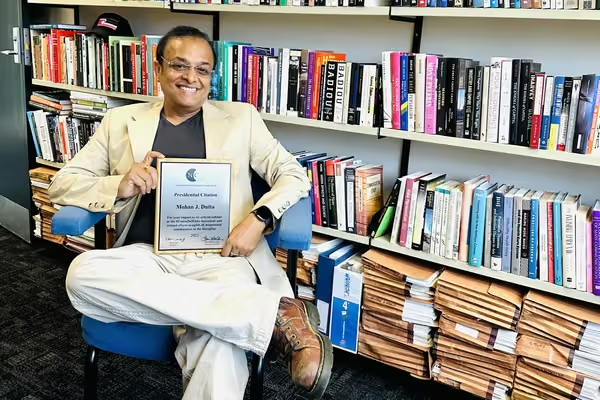
Professor Mohan Dutta
Professor Mohan Dutta and Ambar Basu’s 2008 article, Meanings of health: Interrogating structure and culture, has been named one of three recipients of the 2026 Teresa (Teri) Thompson Health Communication article awards.
Published in Health Communication, the article grew from conversations with 18 men living in villages in rural West Bengal, India.
Professor Dutta says rather than arriving with a predetermined definition of health, the researchers listened to how the men themselves understood it.
“What they described was mostly absence. The clinic too far to reach, the medicine that had run out, the doctor whose post existed on paper.
“They also spoke about health as something held in common, a resource the community owned and a responsibility the community carried.”
The research highlighted how poverty, access to resources and wider social structures shaped people’s health. It challenged an approach to health communication that Professor Dutta says largely focused at the time on changing individual behaviour.
“The men we spoke with were already analysing the structures that were making them sick.
“Our argument was that research has to build openings through which that analysis can enter theory, policy and practice, and that dialogue is the method by which those openings get made.”
Professor Dutta says the work was an early statement of the culture-centred approach, which he originated, and helped lay foundations for health communication scholarship on the structural determinants of health.
Nearly 20 years later, he says the recognition is an opportunity to reflect on how far those ideas have travelled.
“The recognition tells me the argument travelled, carried by students and colleagues who took the culture-centred approach into community sites across the world and did the slow work of listening.”
However, he says the continued relevance of the research also points to a more difficult reality.
“Writing stays current when the problem it names stays current, and that is a poor sort of relevance for a paper to earn.”
Professor Dutta says terms such as structural determinants, lived experience, community voice and co-design are now much more prominent in health research and policy, while the resources that would change people’s conditions have stayed where they were.
“The vocabulary has been absorbed and the resources have not moved. An agency can run a co-design workshop in the morning and sign off a budget in the afternoon that closes a service, and both get described as putting the community at the centre.”
The ideas underpinning the article have also shaped his subsequent research with communities in Aotearoa New Zealand, Singapore and India, including work with Māori communities, migrant workers in dormitories, refugee and Rohingya communities, food insecure communities across three countries, and communities here working on violence prevention.
That work has increasingly shifted from carrying out research about communities towards working alongside communities to identify issues, develop research questions and advocate for change.
“A finding leaves those rooms as a demand rather than as a theme in a results section.”
He says the research has also moved upstream, into the policy machinery that produces the conditions communities describe, including the lobbies, policy institutes and corporate interests behind the privatisation of health services.
“When a community tells you the clinic closed, the next question is who decided that, on whose advice, and who profits from it. Doing that analysis with communities, rather than on their behalf, builds the literacy a community needs to take on the policy machinery.”
The award has particular significance for Professor Dutta because it carries the name of Teresa Thompson, founding editor of Health Communication, who published the article in 2008.
Professor Dutta says Professor Thompson was willing to make space for research that challenged established thinking in the discipline.
“She took it, and she kept making room for work that unsettled the paradigm she had helped establish, which is rarer in editors than it should be.”
He says receiving an award carrying her name is also recognition that culture-centred and critical approaches have become an important part of the wider health communication field.
Professor Dutta says the questions the article raised are sharper now than when it was written, with inequality widening, work becoming more precarious, living costs rising and economic power concentrating in a small number of technology companies.
“The structures driving ill health today are the ones making people poorer. Wages that do not cover rent, food prices that empty a household budget, work that disappears or turns casual, and health systems being sold off in pieces. Communication research has to be able to follow the decisions that produce those conditions into the policy institutes, the lobbies and the corporate interests that write them.”
“The concentration of power in a handful of technology companies is a health question and a democratic one. The same systems that threaten people’s work and wages carry disinformation and racial hatred at a speed no community health programme was built to withstand, and the decisions shaping them are made far from any community that lives with the consequences.”
He says the response lies in the slow work of local democratic participation.
“Community kitchens, tenants’ meetings, union halls, marae, the room where workers gather at the end of a shift. Communities organising from those spaces are the ones who can move policy towards redistribution, and that is where the next twenty years of this work will be decided.”
“The men who sat with us made that article. The work now is to build the capacity of communities to read the structures that are making them sick, and to organise to change them.”
The award will be presented at the National Communication Association Health Communication Division business meeting in New Orleans on 21 November. Professor Dutta will attend the conference virtually.
Related news
Professor Mohan Dutta to deliver prestigious lecture in the field of communication
Te Kunenga ki Pūrehuroa Massey University’s Dean’s Chair in Communication Professor Mohan Dutta, has been selected to deliver the Carroll C Arnold Distinguished Lecture at the National Communication Association.
Professor Mohan Dutta receives 2024 Global Communication Award
Professor Dutta has been recognised for his pioneering work in de-westernising communication research and promoting social justice through community-led initiatives.
Professor Mohan Dutta’s academic-activism recognised with prestigious Presidential Citation
Professor Mohan Dutta has been recognised by the National Communication Association (NCA) with the Presidential Citation.