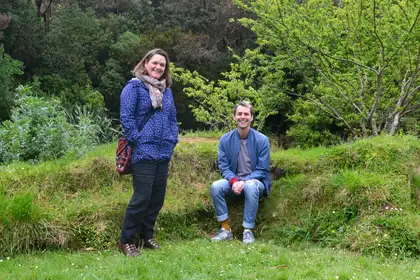
Professor Kelly Dombroski and Dr Gradon Diprose
Co-authored with Dr Gradon Diprose, Dr Dean Stronge and Dr Alison Greenaway from Manaaki Whenua – Landcare Research, Expanding circular economies through transformative re-investments examines how surplus, whether financial, material or relational, can be reinvested in ways that benefit people and planet.
The article focuses on three New Zealand-based case studies: car-share company Mevo, social electricity retailer Toast Electric and the Wellington Region Fruit and Vege Co-op. While none of these organisations explicitly identify with the term "circular economy," the authors argue their work exemplifies circular principles in action — through mutual aid, reduced waste, shared infrastructure and support for community wellbeing.
“We often see circular economy framed in technical or efficiency terms, but what’s often missing is the social side. If we want to build truly regenerative systems, we need to reinvest surplus in ways that support people, not just profits,” says Dr Dombroski.
Each of the enterprises reinvests surplus differently, whether through lower-cost services, access to healthy food or carbon-negative operations, but all emphasise shared benefit and local resilience over extractive models of growth.
The article draws on the growing field of community economies research, which explores how values like care, reciprocity and sufficiency can shape more just and sustainable economic systems.
“Circular economy efforts will fall short if they don’t address who gets to participate and who benefits. Our research shows that social innovation for more circular economies is already happening — we just need to recognise it, support it and learn from it,” adds Dr Diprose.
Published in the journal Local Environment, the article contributes to international scholarship on just transitions and was funded through Āmiomio Aotearoa and the Building Better Homes, Towns and Cities National Science Challenge.
Related news
Advancing tsunami evacuation planning for coastal resilience in a changing climate
As climate change increases the threat of natural disasters, effective tsunami evacuation planning is more vital than ever. For Dr Azin Fathianpour, her PhD research became a personal mission, leading her to develop a simulation tool to enhance emergency planning and support the resilience of coastal cities.
Retirement planning a moving target
The latest Retirement Expenditure Guidelines shows the cost of living is a key issue in current financial management and retirement planning, with excess expenditure above NZ Superannuation having increased for all retired household groups.