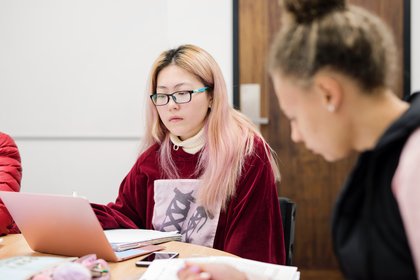
The transition into first year study can be one of the most significant in a student’s life.
Universities need to accommodate the changing needs of students, which means being student-ready, rather than expecting students to be university-ready, according to researcher Rachel Dickinson.
A Lecturer in the School of Sport, Exercise and Nutrition, Ms Dickinson completed a professional inquiry research project on first-year students in the School of Nursing as part of her Master of Education.
“From my own experience and from all the literature the consensus is that transition into first year study is one of the most significant in a student’s life,” Ms Dickinson says.
“School leavers traditionally leave the family home and maybe the city they grew up in. They need to learn to support themselves and make adult decisions. So they’re dealing with life transitions alongside study transitions and marrying that to career aspirations.”
Ms Dickinson’s research focused on six female student nurses who responded to an invitation sent out to returning second-year students in 2022 across all three Massey campuses. All six identified as New Zealand European and had just successfully completed their first year of study.
“Over 90 per cent of students were female, so the response reflected the gender demographics, but I was hoping for a bit more diversity in terms of ethnicity,” Ms Dickinson says.
“In the end I chose to look at diversity in terms of the age of the six students and what stage they were at in life. The youngest was a school leaver still living at home with no employment and the oldest was a mature student with children, a partner and a 28-hour-a-week job."
Ms Dickinson says it was very clear from their responses that the more mature students were better equipped to deal with their first year experience.
“On the other hand they often had more competing commitments like work and family than younger students. All the students bar one reported that they were coping OK overall during the year. At some points they were thriving, but at others some acknowledged they were only just surviving.”
Ms Dickinson says pressure points arose when assessments were due from several different courses at the same time, or during placements which are typically fulltime, making it difficult for people juggling jobs.
And then there were the COVID-19 lockdowns to contend with. The wholesale move to online learning created extra stresses. Student placements were rescheduled and deadlines were extended into the following year alongside their second year requirements. Some students enjoyed working from home, while others who were dealing with poor wifi and overcrowding found it quite stressful.

School of Sport, Exercise and Nutrition Lecturer Rachel Dickinson.
Ms Dickinson says the key thing that came out from the research, beyond the emphasis you see in the literature on success and engagement in learning, was the importance the students placed on wellbeing.
“The other findings were expected, but that was a new theme. Students weren’t prepared to sacrifice wellbeing beyond a certain point just to be successful and gain qualifications. Maybe that’s because their career pathway is centred around wellbeing.”
Student/staff relationships emerged as an important factor in giving students a sense of wellbeing, particularly in the context of online learning. Ms Dickinson says university staff are conditioned to foster relationships with students when teaching face-to-face, but it is important to maintain that approach in the online space.
“A couple of students talked about trust - they said they’d only seen their tutor on screen and didn’t feel they knew them well enough to want to put their hand up.”
She says that as a teaching practitioner she is all for expanding online options for students, but not at the expense of face-to-face learning.
“At the end of the day we are all social beings. Some of the soft skills need to be developed alongside academic learning. For most of the students, the highlight of the year was their placement. It confirmed their career and study choice to be in that working environment and using their skills.”
Based on the results of her research, Ms Dickinson plans to make changes to her own teaching practice.
“Making connections with students was always important to me, but now I feel I have a mandate to prioritise that. It will be very intentional in my planning. There can be a status difference between students and teachers. You want to keep the relationship professional, but students do have a life outside of their study. A simple enquiry about how they are getting on if they have children to care for, or if my students have important sporting commitments, can help to create goodwill and a sense of belonging. It’s good to notice if someone is looking a bit stressed.”
Rather than rely upon the responses of individual academics, Ms Dickinson would like to see a formalised institution-wide transition process designed to assist first-year students and to stay up to date with their changing needs.
She is now contemplating continuing her research as part of her study for a PhD.
“Maybe I will look at students who are parents or competitive athletes. People dealing with competing commitments.”
Related news
Massey students learning to be WellMates
Agricultural students are receiving a boost to their mental health thanks to a new wellbeing programme being piloted at Massey.

Higher education beyond COVID-19: Putting students at the centre
The current global lockdown as a result of the COVID-19 pandemic has given us all the opportunity to pause, reflect and think about what we do and why, says Provost Professor Giselle Byrnes.
Researching youth wellbeing in New Zealand
Improving youth wellbeing is an increasing priority of policymakers, researchers and politicians in New Zealand, but what does wellbeing mean to young New Zealanders today?