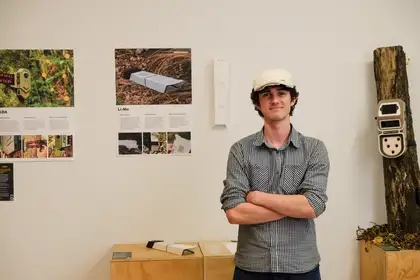
Student Noah Bernhardt with his Li.No prototype, which is a lightweight lizard trapping system that rangers can assemble in the field. Photo credit: Sam Blamires.
Massey Industrial Design students have presented Department of Conservation (DOC) engineers and senior leaders with a selection of prototypes that could be developed to tackle some of the challenges that come with managing the conservation estate.
DOC manages around a third of New Zealand’s land and recorded 3.38 million visitors during the 2024/2025 season.
The Future Industries Exhibition at Toi Rauwhārangi College of Creative Arts earlier this month marked the end of a 12-week course led by Senior Tutor Dr Zené Krige, where students considered how design might support environmental protection, the visitor experience and better management of infrastructure.
“Rather than producing finished products, the focus was on using design to explore problems, test possibilities and think critically about the relationship between people and the natural environment,” Dr Krige says.
The students are in their third year of a Bachelor of Design, majoring in Industrial Design. Some of their projects focused on the practical challenges of species conservation and track management, while others tackled behaviour change, education, and how people engage with landscapes.
Noah Bernhardt designed his prototype, Li.Mo to address the current pain points DOC staff experience when monitoring threatened alpine lizard populations.
“Current trap methods are very bulky and heat up too much in the sun for the animals. So, I thought, how can I develop something more functional, sustainable and safe for the lizard?” Noah says.
Li.Mo is a lightweight trapping system that rangers can assemble in the field to collect data from lizard populations including weight and length and also indexing individuals through their unique footprints.
The design includes an SD card to store data, reducing the need for frequent manual collection.
Ngā Pae Māhutonga School of Design Senior Lecturer Matthijs Siljee praised Noah’s prototype for using minimal materials to great effect.
“The fact that Li.Mo is so lightweight and can be put together on the spot is excellent, because it’s providing a very high level of functionality,” Mr Siljee says.
Leila Barraud designed her project Tracksafe, to improve tramper safety on busy tracks and great walks, such as the Tongariro Crossing.
The Tracksafe prototype is a small wearable device that could be issued to walkers at the start of a track. Using Global Navigation Satellite System (GNSS) receivers placed at two-kilometre intervals along the route, the system would share basic location data with DOC and include an emergency alert button.
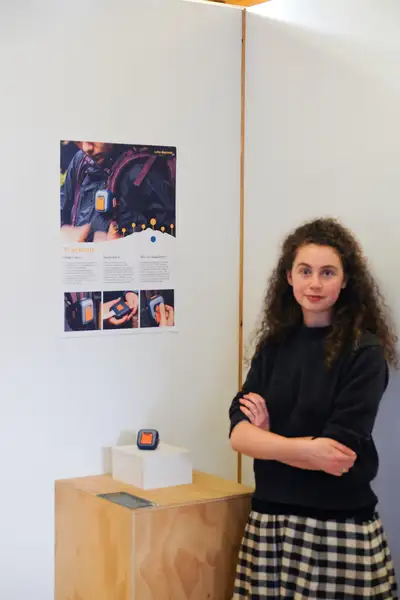
Leila Barraud designed Tracksafe to improve tramper safety on Great Walks.
“My idea is that it would be handed out to individuals when they check in before their walk and it would become both an activity monitor and a safety device for DOC.”
Jimmy Zhou’s prototype PinPlant is a simple way to monitor the movement of invasive plant species. He designed highly visible markers that can be placed next to invasive species in forested areas to make it easier to identify and track over time.
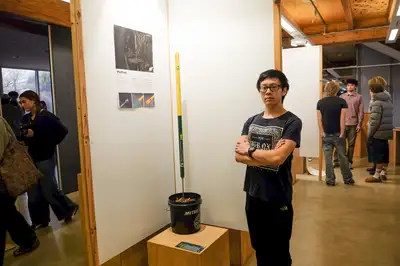
Jimmy Zhou with his prototype, PinPlant.
Dr Krige says the exhibition was a great way of showcasing the value of industrial design to nature and human experiences alike.
“Our students gained a better understanding of the interconnectedness of software, hardware and user experiences, while also enabling DOC to explore new ways to integrate emerging technologies into the large landmass they are the kaitiaki of. We look forward to further discussions about projects that may be trialled or developed alongside the Department in the future.”
Related news
Massey’s RIBB design set to have global impact on vaccine safety
Researchers at Te Kunenga ki Pūrehuroa Massey University have worked with New Zealand Health - Te Whatu Ora to test, launch and commercialise a device that could save millions of dollars in wasted vaccines and temperature sensitive pharmaceuticals.

Massey retains top two ranking at Red Dot Design Awards
For the third consecutive year, Te Kunenga ki Pūrehuroa Massey University has been ranked second among universities in Asia-Pacific at the prestigious Red Dot Design awards in Singapore.
Success at Dyson Design Awards with groundbreaking fruit measuring device
Massey Industrial Design graduate Dr Zené Krige has been named runner-up in the James Dyson Design Award New Zealand for her fruit measuring device, Foresight.

Kākāpō egg incubator wins global recognition
With just 238 birds alive today, some of the new eggs laid by the critically endangered kākāpō must be transported to the safety of incubation facilities.