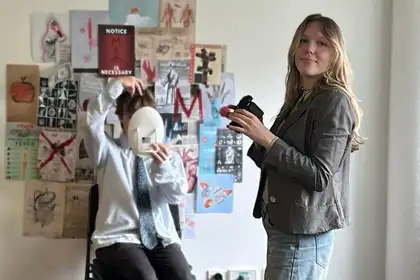
Jessica Kennington
When Jessica began her degree in 2023, she had a practical goal in mind. She enrolled in communication with a major in digital marketing, drawn to the growing importance of social media and digital platforms and the opportunity to combine creative interests with career pathways. By the time she graduated, the role of communication had taken on broader significance.
Jessica says it became clear that communication underpins every industry, workplace and relationship, particularly as new technologies reshape how people create and share information.
AI tools entered her studies partway through her degree, bringing rapid change to how learning and assessment were approached. Early caution from lecturers about misuse and superficial work evolved into more structured and transparent use of AI, with higher expectations placed on students’ thinking and analysis.
Studying through these shifts meant Jessica effectively experienced three different learning environments in as many years, each shaped by emerging technology. This constant adaptation became one of the most valuable aspects of her education.
Like many graduates, Jessica had concerns about employability in a labour market where AI can already generate marketing copy, captions and media releases. But she says her studies highlighted what automated outputs still struggle to replicate.
“Studying communication taught me what those outputs lack: connection, context, relatability and humanity.”
Through her minor in expressive arts, Jessica developed skills that focused less on producing content quickly and more on understanding people, interpreting meaning and navigating complexity. She says creative practice encouraged experimentation, collaboration and reflection, with a strong emphasis on connecting ideas and audiences.
Those capabilities have translated directly into her early professional experience. As a marketing and communication intern with sustainability not-for--profit The Good Carbon Farm, much of her work involves translating complex ideas about climate action into accessible and engaging content.
She says the challenge is not speed, but clarity and empathy.
“The hardest part isn’t producing material quickly, it’s communicating with intention and making sure people feel included and understood.”
The same skills are required in Jessica’s work promoting the New Zealand Fringe Festival show Ecz-asth-perated Fever, which explores experiences of chronic illness and frustrations with the healthcare system. Jessica says promoting the show requires care and creativity to ensure its humour and world-building are communicated responsibly.
Across both roles, she has seen how employers respond to her skillset. Discussions about AI frequently arise in job interviews, but in Jessica’s experience, employers are often more interested in the thinking behind creative work than the tools used to produce it.
“While AI can suggest scripts or edits, employers have been most interested in my decisions about tone, audience and meaning, and why I made them.”
Jessica notes that skills such as communication, ethical reasoning and creative problem solving are increasingly cited by employers as essential for graduates, despite often being labelled as “soft skills”.
As conversations continue about how AI will reshape the workforce, Jessica believes her experience points to a clearer understanding of the role humanities education plays.
“The value of a humanities degree isn’t diminishing, it’s clarifying. Technical tools will keep evolving, but the ability to communicate with empathy, creativity and judgement remains fundamentally human.”
For students weighing their study options in an uncertain job market, Jessica’s message is simple: humanities study is not a risk, but vital preparation for an increasingly automated world.
Related news
Opinion: Communication graduates have the human skills the world needs most
By Professor Elspeth Tilley

Blending purpose and passion through communication
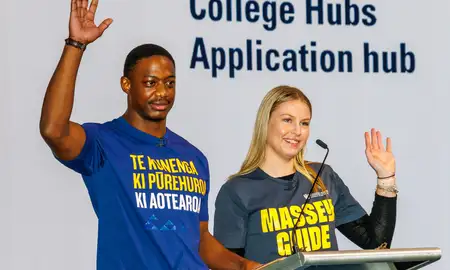
Despite growing up on a farm in the small Southland town of Otautau, Takunda Mabonga has always been drawn to creativity, connection and storytelling. Now studying for a Bachelor of Communication, he is channelling those interests into a degree that blends purpose with passion.
Before the cap and gown: Bachelor of Communication student’s PR career already underway
Bachelor of Communication student Isabelle Monk landed a full-time communications role before graduating, thanks to Massey’s practical, hands-on learning. An internship through the programme helped her gain real-world experience, build confidence and step straight into a career in public relations.
Exploring the world through communication
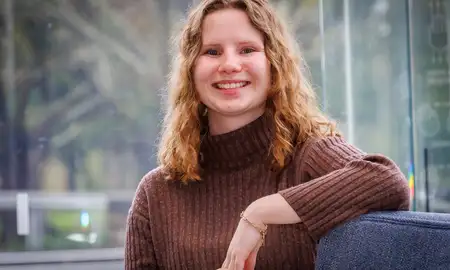
Nikki Harris has always been passionate about language, culture and bringing people together. That passion, combined with a curiosity about media and storytelling, led her to pursue a Bachelor of Communication.