Mickey Espino
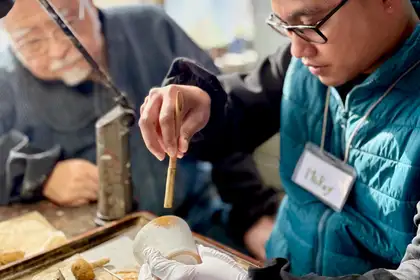
As part of his Master's research, Mickey developed and explored a workshop combining Kintsugi with principles from Acceptance and Commitment Therapy (ACT). Participants repaired broken pottery with their own hands while reflecting on their experiences and the psychological ideas explored through the activity.
For one participant, repairing a broken piece of pottery helped make sense of a question she had carried for years while grieving. The woman was taking part in Mickey's research workshop. As she mend her broken pottery, memories of her late husband and the decision he made before his death came back to her. Her husband got seriously ill, and decided on his own to stop his treatment. For years they both made decisions together, but not this one. She was grieving, and she struggled with feeling excluded from something she believed should have been theirs to decide together. As she worked on her broken pottery piece, the question returned: What was he thinking? This time, she allowed herself to sit with it. She came to understand his late husband’s decision with compassion. Rather than seeing it as something that had excluded her, her kintsugi piece showed the sweetest perspective: "My husband was protecting me up to his very last moment." She realised that he did not want her to carry that burden of deciding to face his passing, that’s why he decided on his own. Her finished Kintsugi piece represented her family. Three connected shards at the top represented herself and her two daughters, held closely together, while the base represented her husband, holding them all together.
Mickey's research explores how the Japanese art of Kintsugi can be combined with principles from ACT in a community-based, non-clinical setting.
Kintsugi is traditionally done using lacquer mixed with powdered gold. Rather than hiding the damage, the repairs become part of the finished object.
For Mickey, the philosophy of Kintsugi offered a natural connection to ACT, which focuses on developing psychological flexibility and learning to respond differently to difficult thoughts and feelings.
"While I was studying Acceptance and Commitment Therapy, I remember reading that for it to be effective, it has to be communicated in a language you feel comfortable with. For me, that language is art."
Mickey's own professional art practice is heavily influenced by the aesthetics and philosophy of Kintsugi. He wanted to explore whether combining it with psychological principles could offer people a different way of engaging with ideas around wellbeing.
Nine adults took part in the research workshop. Participants repaired a broken piece of pottery with their own hands and reflected on what came up for them during the process.
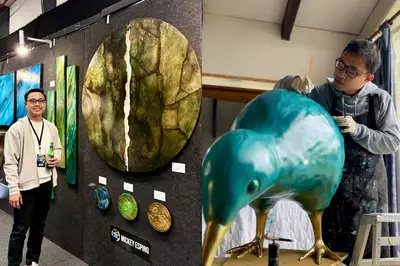
Rather than treating the activity as a clinical intervention, the research explored how a creative, embodied experience could provide a way for people to engage with ACT principles and ideas around psychological flexibility.
Participants described the process in terms of healing, transformation and connection.
For Mickey, one of the most interesting aspects was the way participants' reflections moved within, beyond and across.
Looking within, participants described healing as an ongoing process that could be difficult and messy rather than something that happened all at once.
Looking beyond, the transformation extended beyond the repaired object itself, as participants gave new meaning and value to something that had been broken.
Looking across, participants found connection through sharing their experiences. Their experiences of brokenness were individual, but sharing them helped create a sense of connection with others.
"ACT is a process. Kintsugi is a process. And so is healing. We say that a lot, healing is a process, but this research project showed me it is not a straight line, and it is not a fairytale. It is messy. It takes hard work, acceptance and commitment," Mickey explains.
The project also changed his understanding of his own relationship with art and psychology.
He had previously treated the two as separate parts of his life, turning to art when he became stressed with his psychology studies.
"I felt fragmented. This project is about putting things together, and I did not expect it to also put me together."
Mickey says the research helped him realise that art and psychology did not have to be competing interests.
"For a long time, I thought I had to pick between art and psychology. I treated them like two separate loves. This project showed me they are not separate. They are both gifts I was given."
He now wants to continue exploring how creative practices can be used to make psychological ideas more accessible outside academic and clinical settings.
"When I began this research, I knew it was only the beginning. I envision this project out in the community, where people can sit down, do the mending with their own hands and create personal meaning from it."
Mickey will present his research at Toi Piringa: The Art of Connection Symposium on Art in Dunedin next month.
Presenting the work in Dunedin has particular significance for Mickey. It was where he was based when he began the project, making the presentation an opportunity to return to the place where it all began.
His research has now been published, marking another step in Mickey's exploration of what happens when art and psychology are brought together.
"I used to pursue them separately. This project showed me they are not separate at all."
Related news
Psychology Professor recognised with national fellowship
Head of School of Psychology Professor Kirsty Ross has been elected a Fellow of the New Zealand Psychological Society, in recognition of her outstanding contributions to the profession.
The need for lived experience in psychology education
To eradicate mental health stigma and discrimination, people who have lived experience of mental distress should be included in the training and education of mental health providers, but this isn’t always the case.
The psychology of progress: Turning setbacks into record-breaking success
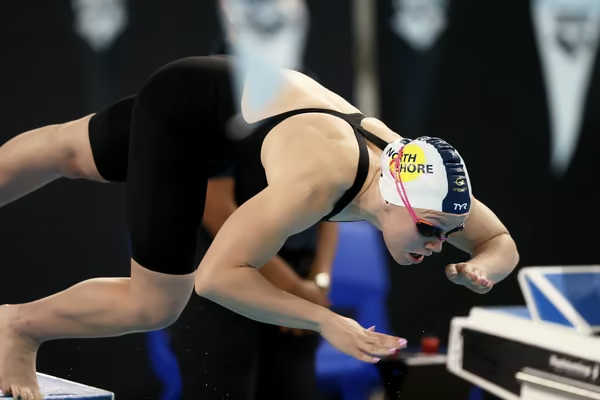
Bachelor of Science student Chelsey Edwards, Ngāti Raukawa, is proof that stepping back can push you forward. As the first New Zealand woman in 15 years to break the 50-metre freestyle (long course) record, she’s thriving in a new training environment with refreshed athletic and academic goals.