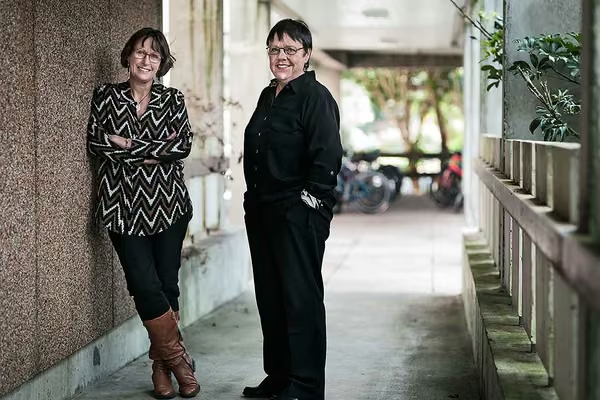
From left: Professor Jackie Sanders and Professor Robyn Munford, Massey University’s School of Social Work. Photo credit: Jane Ussher.
That insight sits at the heart of the Relational Resources for Change programme, led by Professor Jackie Sanders and Professor Robyn Munford from Te Kunenga ki Pūrehuroa Massey University’s School of Social Work. The research received an ‘exceeding’ assessment from the Ministry of Business, Innovation and Employment (MBIE) — meaning it significantly outperformed expectations and ranks among the top seven per cent of funded projects nationwide.
Head of the School of Social Work Professor Kieran O’Donoghue says the programme reflects not only research excellence, but a broader shift in how knowledge is generated and applied.
“This work demonstrates Massey’s commitment to research that transforms practice. It shows how rigorous, longitudinal research can directly influence how services are delivered and how institutions think about supporting young people. Overall, this research programme provides a lasting legacy for kaimahi in the youth sector and makes a real difference in the lives of young people.”
For decades, youth services have largely been designed around programmes: structured interventions, measurable outputs and tightly defined deliverables. Rather than asking what programmes work best, the research conducted by Massey asked a more fundamental question: what actually helps young people move forward when their lives are marked by uncertainty, instability or structural disadvantage?
Over multiple years, the research followed people aged 11 to 25 as they navigated education, employment and wellbeing challenges. What emerged consistently was the power of relational connection — not as a ‘soft skill’, but as a measurable and decisive factor in positive change.
“The evidence gives kaimahi the confidence to take the time needed to build trust-based, respectful partnerships with rangatahi, and to collaborate meaningfully with each other so that environments of skill development and authentic support can emerge,” Professor Munford says.
The findings showed that when young people experienced at least one relationship with an adult grounded in trust, respect and cultural understanding, they were more likely to engage, make decisions confidently and work toward their goals.
Relationships were not an add-on to practice. They were central to it.
Importantly, the programme did not stop at identifying the importance of relational practice. The research was translated into practical frameworks that could be embedded across services.
One of these is PARTH – a structured framework designed to help practitioners reflect on and strengthen relational practice in consistent, evidence-informed ways. Alongside tools such as Tōu Ake Mana and Moana, PARTH provides guidance that supports kaimahi to move beyond transactional service delivery and build meaningful partnerships with rangatahi.
“The latest MBIE-funded phase of the project worked extensively with provider organisations across Aotearoa to ensure the research findings could be packaged in ways that were usable for frontline kaimahi and service managers,” Professor Sanders says.
“This has included the development of many practical tools, two websites which house extensive libraries of resources, and the development and testing of peer-to-peer training programmes so that the resources and learnings from the research can continue to be shared in ways that ensure fidelity with the research data and rigour.”
Professor Sanders adds that the project has been strengthened by unwavering institutional backing.
“We are deeply appreciative of the support of our Head of School Professor Kieran O’Donoghue, and the College, whose commitment has enabled this long-term programme to flourish.
“Two community-based kaitiaki rōpū have been created to care for and share the resources and the training programmes into the future so that the learnings from the research will continue to be widely shared and ongoing application of evidence-informed, effective relational practices can continue.”
Today, the resources developed through the programme are being used across youth work, social services, health and education contexts throughout Aotearoa.
As Aotearoa continues to grapple with youth wellbeing challenges, the research offers both clarity and direction: when at least one adult shows up well, consistently and respectfully, trajectories change.
Practitioners, service providers and those interested in relational approaches can explore the full suite of tools and resources at youthsay.co.nz.
Related news
Māori youth at centre of new resource
Tōu Ake Mana, a new practice framework developed from research by Massey University School of Social Work staff, will be launched next week in Palmerston North.

Supporting young people into employment
Two Massey University academics have used their research findings to craft guidelines for businesses, to help support young people into employment.
World first tool getting youth on the right PARTH
A new online tool for people working with vulnerable youth, based on research and expertise from Massey University's School of Social Work, is being launched in Auckland this Friday.