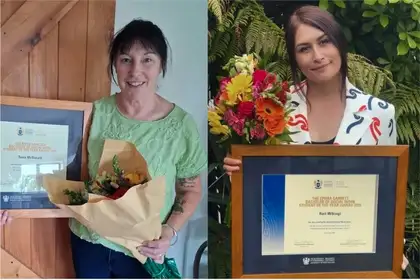
Tania McDonald and Hari Wikingi
Bachelor of Social Work lecturer Jack Scanlan says these students reflect the heart of social work.
“Hari and Tania are deserving recipients of the Merv Hancock and Ephra Garrett awards for their hard work, compassion, empathy and kindness. These are all traits that will take them far in social work, and no doubt will impact the next generation of social workers eager to learn from them.”
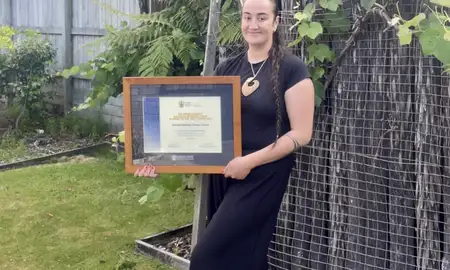
Ephra Garrett Award recipient Hari Wikingi
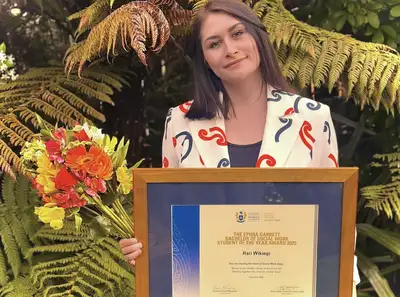
Ephra Garrett Award recipient Hari Wikingi
For Hari Wikingi, Ngāti Tarāwhai, Ngāti Rangitihi, Ngāti Whakaue, Whakatōhea, the journey into social work is deeply rooted in identity, whakapapa and lived experience.
Growing up in a ‘colourful, dynamic whānau with many ups and many downs,’ Hari was shaped early on by a home where caring for others was simply part of everyday life.Her parents were caregivers for deaf rangatahi in Ōtautahi Christchurch, and her father is deaf.
Hari’s passion for te ao Māori–centred practice was reignited in 2019 while working with Oranga Tamariki Ministry for Children during a Māori-centred practice shift.
“It was there that I first recognised how strongly I aligned with te ao Māori theories and practices, and how powerful they could be when woven into social work practice. The intensive learning, wānanga and kōrero I engaged in during this time began unlocking a deep sense of purpose, one centred on integrating who I am with how I practice,” Hari says.
Hari credits her lecturers and the Te Ao Māori Social Work course for strengthening her commitment to restorative, relational and culturally-grounded practice. Her final-year placement at Wairau Hospital marked a transformative shift from iwi-led health and social services into a clinical environment, with the guidance of supervisor Desma Reedy.
What grounded her through this transition were the mātāpono that shape her practice — manaakitanga (support), āhuatanga (way of being), whakawhanaungatanga (building and maintaining relationships) and ūkaipōtanga (sense of belonging/home).
“Social work is about walking alongside whānau, honouring their mana, and creating spaces where identity, connection and wellbeing are upheld. While systems set obligations of care, the way we engage with whānau must always be grounded in respect, cultural safety and authenticity. That realisation had a profound impact on the social worker I am becoming.”
For Hari, receiving the Ephra Garrett Award isa recognition of collective strength.
“’Ehara taku toa i te toa takitahi, engari she toa takitini. My strength is not of mine alone, but the strength of many.’ This whakataukī beautifully captures the essence of my studying journey. My success is not mine alone, it is a reflection of the many hands, hearts and minds that have supported me along the way.”
Looking ahead, Hari carries with her taonga tuku iho, the inherited wisdom of her tūpuna and whānau as she continues to learn, serve and uplift communities.
“This award is not just a recognition of my work, it is a celebration of kotahitanga, of unity, and of the shared strength that exists when we come together to support one another.”
Merv Hancock Award recipient Tania McDonald
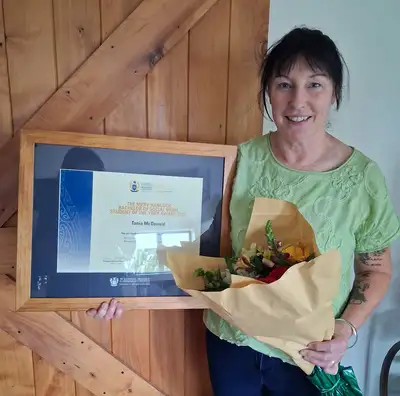
Merv Hancock Award recipient Tania McDonald
For Tania McDonald, the path to social work began long before her formal studies. Having always felt driven to support others, she describes her journey as one shaped by personal experiences of grief, loss and the resilience built within her whānau. Engaging with various social services during those challenging years inspired her to give back to the people and systems that once supported her.
Her studies at Massey affirmed what she had always felt: that social work aligns naturally with her values of empathy, advocacy, empowerment and social change.
“I now feel my passion and skills for helping people have been partnered with a degree that has provided the knowledge to allow me to grow and develop as the best version of myself.”
One of the most profound moments in her learning journey came during a noho marae with Dr Paulè Ruwhiu and Deacon Fisher. Entering the degree while still healing from grief, Tania found the spiritual connection within that space transformative.
“This space reminds me of the importance of taking time to connect with the people and places that ground you, understanding this personally before supporting others. I’m grateful for the shared knowledge and critical reflections that have challenged my thinking. There have been many memorable moments on this journey, but the constant is always the people. Those who challenged me, supported my learning, walked alongside me, and those whose journeys I was privileged to share.”
Receiving the Merv Hancock Award is an honour that Tania describes with humility and gratitude.
“Working with people, the most important thing I can offer is myself. I hope to continue to connect with people, affirm their views, and validate their challenges.”
Tania hopes to be involved in local initiatives focused on supporting diverse and evolving community needs, continuing to grow and adapt as the landscape of social work shifts.
Become a changemaker in communities and social practice
Related news
Whānau, hapū, iwi: Anchoring Social Work in collective responsibility
As Aotearoa New Zealand Social Workers' Day is celebrated across the motu, Te Kunenga ki Pūrehuroa Massey University’s School of Social Work is bringing the kaupapa to life with a seminar filled with powerful kōrero, international insights, and an unwavering focus on future generations
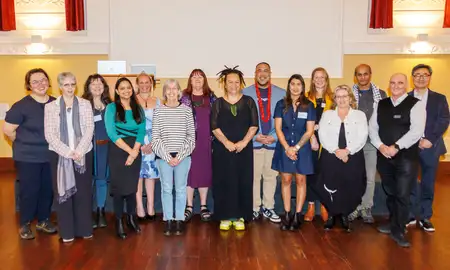
Celebrating outstanding social work students
The terrific trio, Georjah Kaharoa Timoko Tansey, Courtney Williamson and Katelyn Ward Donnellan, have been named this year’s recipients of two esteemed awards for fourth-year Bachelor of Social Work students.
From advocate to social work professional
For Hawa Lee, pursuing a Master of Applied Social Work was more than just a return to academia. It was a transformative journey that deepened her commitment to helping others and grew her passion for mental health advocacy.