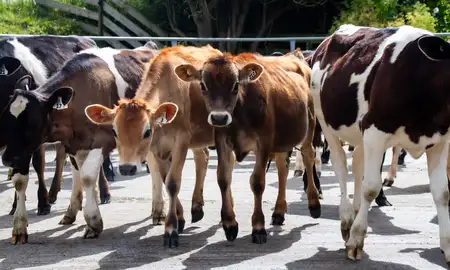
Coat patterns are some of the oldest traits selected by humans, likely since the dawn of domestication, showing how farmers have long shaped cattle populations.
For other breeds, the DNA variants behind unique patterns, such as the white face of Herefords or the belts of Galloways, are already known. Now, a study involving Te Kunenga ki Pūrehuroa Massey University’s Professor Matt Littlejohn has solved the mystery of the Holstein’s unique coat.
Using genomic techniques, the team analysed the coat patterns of thousands of cows and identified two specific DNA variants controlling two different genes – KIT and MITF – that explain much of the variation in Holstein spotting.
“These genes are well-known for controlling pigmentation in humans, mice, dogs, horses, birds and other species,” Professor Littlejohn says.
The KIT gene variant found in Holsteins is unusual because it doesn’t sit within the gene itself. Instead, it regulates the gene from a different position on the chromosome.
“Think of it like a light switch turning on a light in another room,” Professor Littlejohn says.
The MITF variant is also unusual for its ability to create unique coat patterns when different breeds are crossbred.
“This variant can create black speckles in dairy crosses, ‘black socks’ in Belgian Blue cattle, or reversal of the white face expected from a Hereford cross,” Professor Littlejohn explains.
While these patterns are interesting to look at, they aren’t simply aesthetic.
“Many dairy farmers cross Holsteins with Herefords to produce calves that will perform well in beef systems. The white face is important, since this marks the calf as a Hereford cross. When ‘splotchy’ faced calves are born as a result of the MITF variant, these calves are harder to recognise as beef crosses and are often less valuable. Genetic testing could help produce calves with more predictable coat patterns in the future,” Professor Littlejohn says.
Other practical applications of the research include possible animal welfare benefits. Skin pigmentation affects heat absorption and UV protection. Black coats absorb more heat but also provide better UV protection. Knowing how genes control pigmentation could help farmers select coat patterns that improve cattle comfort and performance.
“This research not only solves the mystery about how the Holstein gets its spots, but also shows how genes can interact to create unique and unexpected patterns,” Professor Littlejohn says.
“It’s a great example of how modern genomics can uncover the hidden mechanisms behind traits we often take for granted. Early animal breeders likely selected spotted animals hundreds, if not thousands, of years ago, and we now know the molecular basis of these unique patterns.”
This work was supported by the Ministry of Business, Innovation and Employment Endeavor Fund and the Livestock Improvement Corporation.
Read the paper: Structural and epistatic regulatory variants cause hallmark white spotting in cattle.
Related news
Sustainable science in action at Fieldays® 2025
Back at Fieldays® for another year of connection, collaboration and showcasing leading research and innovation, we’re delivering real-world, research-led solutions to the challenges facing modern agriculture.

Genetic research aims to improve health and performance of New Zealand working dogs
Early research in a three-year project to better understand the genetic make-up of working farm dogs has yielded some surprising results.
Pilot study will determine the impacts of rearing method on the dairy calf, the cow and their production
The study will compare the artificial rearing of calves to calves that remain with their mothers until they are weaned.