
How does the brain communicate during emotionally significant memory recall, and how does that communication change over time?
Dr Yi Wang, a computer scientist from Te Kunenga ki Pūrehuroa Massey University, has been part of an international research team which used advanced AI techniques to uncover how different regions of the brain work together to recall recent and older memories.
The research, carried out in collaboration with scientists at Japan’s RIKEN Center for Brain Science and the University of Tokyo, was recently published in the leading journal Nature Communications.
The study focused on three key brain regions: the hippocampus, which is crucial for forming and recalling recent memories and includes contextual details such as where and when an event occurred; the anterior cingulate cortex, part of the prefrontal cortex that becomes increasingly involved as memories mature and stabilise over time; and the basolateral amygdala, which helps shape how experiences with strong emotional content are encoded and remembered.
“Memory isn’t static. When we first experience something, the memory is rich in detail but over time it becomes more abstract. We remember the most important parts, but not every detail. Understanding how the brain manages this transition is a major challenge in neuroscience,” Dr Wang explains.
By recording electrical activity from these brain regions simultaneously, researchers analysed local field potentials – signals that represent the combined activity of many neurons at once. These signals capture the overall ‘conversation’ happening within and between brain regions.
This approach generated vast amounts of data, far too complex for traditional analysis methods alone. To address this, Dr Wang and his team used two complementary AI approaches: a powerful machine-learning model to identify key features in the data and a deep-learning ‘Transformer’ model that uses an attention mechanism to highlight the most informative patterns. The models were then used to classify brain activity as belonging to either recent memory recall or remote, older memory recall.
The results showed that both models performed well, accurately distinguishing recent from remote memory recall using brain activity patterns alone.
Dr Wang says the analysis revealed clear differences in how the brain operates over time.
“Recent memories rely strongly on activity in the hippocampus, with intense, fast brain rhythms that make memories feel vivid and intermediate. Older memories depend more on coordinated communication across multiple brain regions.”
The use of multiple methods – one machine learning model, one neural network, and traditional statistical analysis – all pointed to the same conclusion. This consistency provides strong evidence that genuine biological patterns were identified, showing that communication between brain regions changes in measurable ways as memories age.
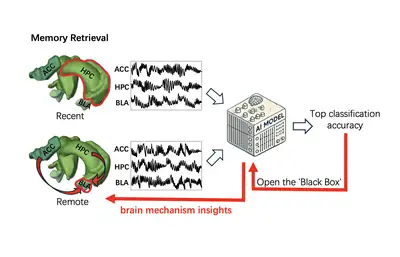
Overview of the data retrieval and analysis process.
The study highlights the growing role of AI in advancing neuroscience and demonstrates that complex brain data can be successfully decoded.
“The brain generates enormous amounts of data, and many important patterns are impossible to see without computational tools. AI allows us to uncover how different brain regions interact, rather than studying them in isolation. This same AI framework can now be applied to many other brain studies, helping researchers interpret neural data more efficiently and reliably,” Dr Wang says.
While the findings are foundational, Dr Wang says they represent an important step toward understanding how memory systems work and how they may fail in disease.
“In the long term, this research could contribute to improved understanding of memory-related conditions such as Alzheimer’s disease, potentially guiding future therapeutic strategies. More broadly, the work demonstrates how combining big data with AI is opening new pathways for addressing some of science’s most complex and unanswered questions.”
Keen to be a technology leader in a changing world?
Learn more about the new artificial intelligence major in the Bachelor of Information Sciences – the first New Zealand AI undergraduate major that can be completed entirely online, from anywhere.
Related news
New artificial intelligence major set to launch in 2026
A new major spotlighting artificial intelligence (AI) will be added to the Bachelor of Information Sciences in 2026, helping prepare tomorrow’s technology leaders for a changing world.
New webinar series to provide bite-sized science for curious minds
The College of Sciences has launched a new webinar series aimed at bringing science to the forefront of the conversation in a way that’s both accessible and engaging.
Research team to investigate how AI can be used for infectious disease modelling
A Massey-led One Health team will explore how artificial intelligence can be used to investigate the risk of zoonotic diseases linked to climate change.