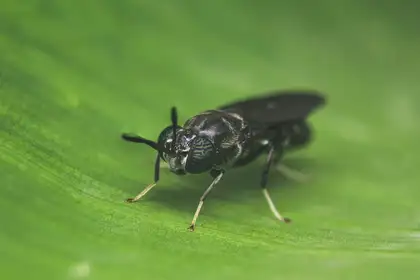
Hermetia illucens - Black Soldier Fly.
Ongoing work at Te Kunenga ki Pūrehuroa Massey University is exploring how we produce food and interact with animals involved in the process, contributing to a circular bioeconomy that includes invertebrates in Aotearoa New Zealand.
Associate Professor in Ecology and Zoology Dr Maria Minor specialises in the ecology of soil invertebrates. She says that rather than treating waste as an endpoint, circular approaches repurpose it through processes such as composting, bio-conversion via invertebrates, and soil regeneration, helping to reduce landfill pressure and close nutrient loops.
“The drive for a circular economy is significant, as it focuses on keeping resources in use for as long as possible through recycling, reusing and repairing to extend their lifecycle. This extends to crop residue, orchard by-products and household food scraps. Turning this waste into valuable, reusable products results helps save water, protect resources and build resilience.”
Classified as animals without a backbone, invertebrates include spiders, worms, snails and insects such as flies and butterflies. Research into invertebrates at Massey spans ecology and biodiversity, as well as soil and freshwater systems, where they act as indicators of environmental health and help assess the impacts of land use and farming practices.
A current focus is Black Soldier Fly larvae, which have become a topic of growing interest among postgraduate students and researchers across agriculture, environment and natural sciences, who are studying their lifecycle, nutrient composition and behaviour.
This interest stems from the larvae’s remarkable ability to break down organic waste, including crop residue, orchard by-products and household food scraps, at an exceptional rate. They can consume up to twice their body weight daily and, by using specialised digestive enzymes, can break down complex nutrients.
“They process waste in roughly 15 days, converting it into, on average, two to three kilograms of nutrient-rich frass (fertiliser) for every one kilogram of larvae, while reducing waste volume by up to 80 per cent. They are one of very few animals able to convert organic waste into protein,” Dr Minor explains.
Researchers are currently exploring the optimal conditions for larvae to convert waste, analysing how factors such as moisture levels, light and substrates affect their efficiency. They are also investigating how supplements, including amino acids and other nutrients, can enhance larval activity and protein content. Broader research is examining the role of invertebrates in environmental regeneration, soil health and their potential benefits in animal feed.
This work connects with further research in Massey’s food technology area on alternative proteins and how to sustainably feed a growing global population, including investigating insects and invertebrates as future protein sources.
“The amino acid content of the Black Fly Soldier larvae can be influenced by what they are fed. For example, feeding them meat by-products can increase taurine levels, making them suitable for feeding chickens, pigs or companion animals,” says Professor David Thomas, an Animal Science researcher who is a national expert on companion animal pet food nutrition and digestibility.
Studies at Massey have assessed the effective growth and nutrition of chickens and pigs fed diets including Black Soldier Fly larvae, and pre-pupae are already being used commercially as a prebiotic ingredient in dry pet food. Massey is building on this by exploring the palatability of raw larvae in protein blends for canned diets, an area aligned with New Zealand’s strengths in pet food production.
While Black Soldier Fly larvae cannot completely replace animal protein, as they do not provide the optimal amino acid balance for companion animals, with protein a finite resource in a growing global population, they offer a promising supplementary alternative that can help ease pressure on traditional sources.
Want to see Black Soldier Fly larvae in action? Visit the Massey stand at the Mystery Creek Pavilion (site PE51) at Fieldays, 10 - 13 June 2026.
Related news
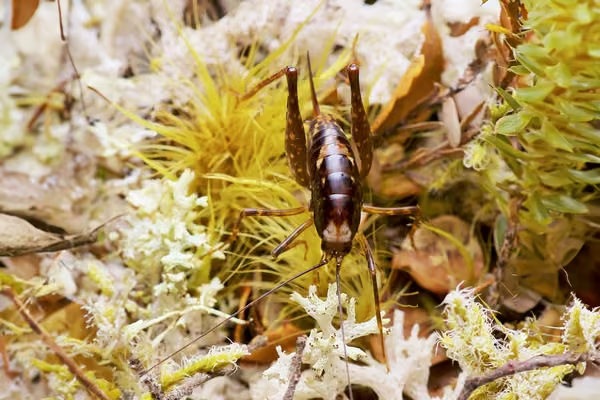
Frozen but unfazed: insights from New Zealand’s coolest bugs
In the icy heights of Aotearoa New Zealand’s alpine zones, some endemic insects endure sub-zero temperatures by freezing solid, only to thaw and spring back to life. A team of ecologists is studying these cold-tolerant creatures to understand how they do it.
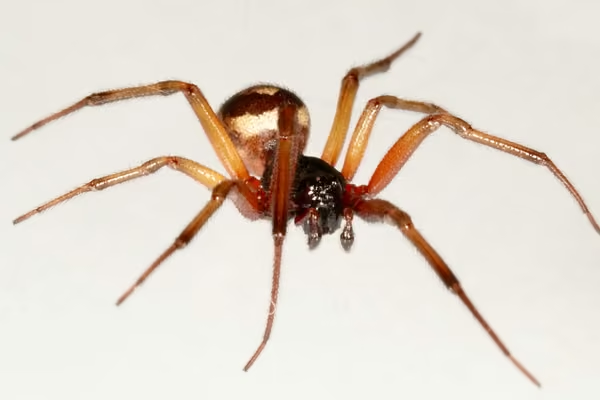
Invasive spider with potentially sinister bite confirmed in Aotearoa New Zealand
The noble false widow spider (Steatoda nobilis), already considered one of the world’s most invasive arachnids, has officially established itself in New Zealand. While bites are rare, the spider raises concerns for human health and native ecosystems.
New species and genera of wētā discovered in the south
Three new species of wētā have been discovered in the southern regions of Aotearoa New Zealand, belonging to two new genera.