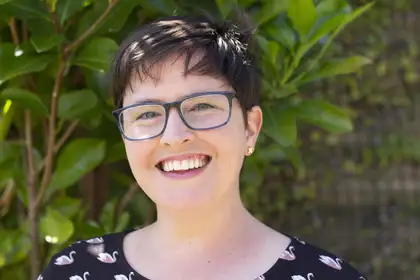
Associate Professor Julia de Bres
Her latest appearance on Radio New Zealand (RNZ) Nights marked her 50th time on the programme, but Dr de Bres is less interested in the milestone and more interested in the public conversations about language.
She says these discussions are an opportunity to show people something remarkable about an everyday activity they usually take for granted.
"I often describe my work in sociolinguistics as 'finding the beautiful in the everyday', and I hope that I help people find that everyday wonder too."
Dr de Bres’ relationship with RNZ began in October 2020, when she was invited into the studio to discuss research she had undertaken with a colleague about gendered representations of then Director-General of Health Dr Ashley Bloomfield during the COVID-19 pandemic.
The researchers examined commercial and artistic representations of Dr Bloomfield, including key rings, tea towels, earrings, mugs, t-shirts and love songs posted on YouTube. They identified recurring representations of him as a superhero, sex symbol, national treasure, saviour and saint.
The topic caught the attention of an RNZ producer, who invited Dr de Bres to become a regular contributor on Nights. The producer told her to imagine the audience as a broad cross-section of New Zealanders who might be washing the dishes or sipping a cup of tea in the evening and wanting to listen to something interesting.
Dr de Bres was told to imagine she was explaining to a friend-of-a-friend what her work involves.
That approach has shaped how Dr de Bres communicates linguistics to the public.
Sociolinguistics is the study of the relationship between language and society, including how factors such as age, gender, ethnicity and social class influence the way we communicate and how social situations shape our language.
Dr de Bres says you don't need to be a linguist to be fascinated by it.
"Language is inherently social. If we lived alone on a desert island, we might never speak a word. But once someone else is around, we will likely get talking to them.”.
She explains that we constantly adjust our language depending on who we are talking to, where we are and what we are trying to achieve. At the same time, we interpret the language of people around us to work out what they mean and how we should respond.
"In this sense everyone is a sociolinguist, our interest in the language use of others is a social survival strategy."
One example Dr de Bres has discussed on RNZ is the ‘royal order of adjectives’, the largely unwritten convention governing the order of multiple adjectives before a noun in English.
Most English speakers follow the convention without ever being taught it. Dr de Bres tested Nights host Emile Donovan by giving him jumbled-up adjectives and asking him to put them in the correct order while live on air. When she offered "leather walking brown boots", he corrected it to "brown leather walking boots".
For Dr de Bres, that small interaction captures what makes linguistics so interesting.
"Learning about linguistics, people realise how much of what we do every day with language is truly extraordinary."
Dr de Bres has three criteria for choosing topics for the radio: they should be relatable, insightful and entertaining. Or, at least two of the three.
Relatable topics start with experiences people recognise from their own lives, while insightful topics take something familiar and offer a different way of looking at it. Entertainment matters too, partly because Dr de Bres wants to enjoy herself and partly because being entertained helps to keep listeners engaged.
Some of her favourite radio conversations have involved that sense of play. She recalls a staring competition with Mr Donovan during a segment about eye contact, as well as grammar tests she has sprung on him over the years.
"I think we learn the most when we are having fun, and the freedom to be silly while talking about something serious or important is one I hold close to my heart."
Dr de Bres’ own route into sociolinguistics was not entirely straightforward. She dropped out of her first university linguistics course because she was struggling with phonetics.
It was only after completing her Bachelor of Arts, while considering postgraduate study, that she found a sociolinguistics textbook in the university library. It included chapters on gendered compliments and code-switching in multilingual settings.
"I was immediately enthralled, enrolled into a PhD and never looked back."
That experience has shaped what Dr de Bres wants people to understand about language. Variation, she says, is fundamental.
"There is nothing superior about one form of language over another. Everything is variation and all variation has social meaning," she says.
Language does more than allow us to communicate. It reflects who we are and the societies we live in, while also giving us ways to influence those societies.
Dr de Bres’ own research explores how social inequalities can be reproduced through discourse and how language can be used to challenge those inequalities.
“I would like to find more ways to bring those questions into public conversations, while acknowledging that sometimes people need a break from the serious side of language.”
For Dr de Bres, the value of appearing on RNZ ultimately comes back to the responsibility academics have to share their knowledge beyond the university. Her 50 appearances represent an ongoing commitment to making research accessible to a wider audience.
That can mean talking on the radio, writing in newspapers, making art, giving public lectures or running community workshops.
"Let's get out there and share the nerdy joy."
Learn about how language works and how people use it. Use that understanding to shape your future and drive positive change in your community and career. Find out more about linguistics here.
Related news
What would it take for schools to start later?
Could starting school later help teenagers get the sleep they need? New research is examining what would help or hinder schools introducing later start times for senior secondary students in Aotearoa New Zealand.

Inspiring curiosity through science
A former Awatapu College student who once considered a career in joinery is now inspiring the next generation of scientists as a teacher at her old school.