You will need to include specific sections and headings in a report, depending on the type of report you are writing. For example, a business report, laboratory or science report.
Example structure
1. Introduction
2. Discussion
2.1 Technological benefits
2.1.1 Efficiency
2.1.2 Access to monitoring
2.2 Technological weaknesses
2.2.1 Disconnections
2.2.2 Lack of face-to-face support
3. Conclusion
4. References
You may find that the headings provide enough of a link between sections that you do not need linking sentences or transition words. However, including a linking sentence from time-to-time may help the reader understand how your report's sections are connected.
You can also organise the discussion section of any type of report using structural formats such as:
- flat
- hierarchical
- general-specific
- relationship structure.
Select the structure that will demonstrate most effectively how you have organised and examined the relevant issues in your report. If you are unsure which would be the most appropriate report structure to use, ask your lecturer or course coordinator.
Flat structure
Flat structure Discuss each issue one at a time when they are of relatively equal importance, or there's no need to consider how important they appear in relation to each other.
For example:
- Introduction
- Discussion
- Issue A
- Issue B
- Issue C
- Issue D
- Conclusion
Hierarchical structure
Hierarchical structure Organise issues in order of importance with the most significant issue first.
For example:
- Introduction
- Discussion
- Most important issue
- 2nd most important issue
- 3rd most important issue
- Conclusion
General-specific structure
General-specific structure Divide the general issues into several specific issues, using sub-sections.
For example:
- Introduction
- General issue
- Specific issue 2a
- Specific issue 2b
- Specific issue 2c
- General issue
- Specific issue 3a
- Specific issue 3b
- Specific issue 3c
- Conclusion
Relationship structure
Relationship structure Use this type of structure when each issue is related to another issue. These relationships or intersections may inform sub-sections within the report discussion.
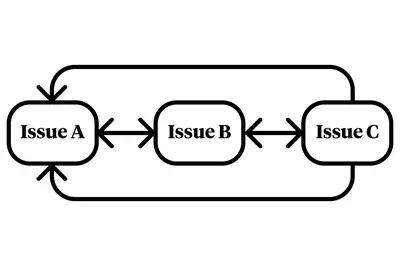
A relationship structure not only discusses the main issues, but the relationships between those issues.
Example
- Introduction
- Main Issues
- Issue A
- Issue B
- Issue C
- Relationships
- Relationship between A and B
- Relationship between B and C
- Relationship between C and A
- Conclusion
- Recommendations
You can also think of the relationships like a Venn diagram. This structure of intersecting circles not only identifies the interconnections between the main issues in your report – but also focuses on the new structures and ideas emerging from the intersection points between two and three components.
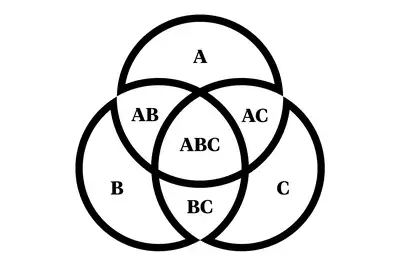
The structure then becomes:
Example
1. Introduction
2. Discussion
2.1 Main issues
2.1.1 Issue A
2.1.2 Issue B
2.1.3 Issue C
2.2 New and emerging issues
2.2.1 A and B
2.2.2 B and C
2.2.3 A and C
2.2.4 A, B and C
3. Conclusions and recommendations
Related content