The School of Veterinary Science – Tāwharau Ora started a review of the BVSc curriculum in 2022 – the first year of which will be implemented in 2023. The veterinary student selection process will also be revised for implementation in 2023. These reviews jointly are referred to as the BVSc Curriculum project and will continue until 2027.
The curriculum review will be led by Nic Smith (Associate Dean – Curriculum), supported by Jenny Weston (Academic Lead - BVSc), Eloise Jillings (Associate Dean – Admission and Students) and Dani Aberdein (5th-year coordinator). The selection process review will be led by Eloise Jillings, and supported by the Veterinary Student Selection Committee.
Drivers for the Curriculum Project
There are a range of factors, both external and internal, that are driving the curriculum project. We've outlined below what is motivating this review.
Accreditation
One of the major driving factors is accreditation. The BVSc programme is accredited by:
- Council on Education (CoE) - Canadian (CVMA) and American Veterinary Medical Associations (AVMA)
- Royal College of Veterinary Surgeons (RCVS) for the UK
- The Australasian Veterinary Boards Council (AVBC) for Australia and New Zealand
- South African Veterinary Association (SAVA)
All of these accreditation bodies have been moving to more outcomes-focused accreditation standards. We need to ensure that our curriculum, including our assessment methodology, can meet the requirements of these new standards. The outcomes-focused approach is sensible and will help us continue to train highly sought-after graduates in the future.
Outcomes or competency focus of graduates
To deliver an outcomes-focused curriculum, we will use a competency education approach. Rather than assessing our students' acquisition of knowledge (“what they know”), we need to determine “what they can do” or in other words, their ability to use and apply knowledge.
Curriculum mapping and alignment
This project provides a real opportunity to enable a curriculum mapped to what students are learning and how those learnings align with student outcomes clearly visible. It’s also an opportunity for us to think about the pedagogy or the ways we teach and support our students, to enable it to be aligned with current and future-focused approaches.
Class size
The number of domestic students funded by the Tertiary Education Commission (TEC) has been 100 for several years. TEC has announced it would fund 25 more domestic veterinary students in 2022. However, due to accreditation requirements, this can’t be implemented totally in 2022 but will be achieved over two years (2022 and 2023). There may also be an increase in international students in the programme (to be determined).
Staff and students – workloads and wellbeing
We must consider how to manage the larger class size within the programme, especially within the clinic. We need to think about how best to utilise our teachers efficiently. Part of the review will consider how we make the best use of our new Clinical Skills Lab so that graduates are well-prepared to meet Day One competencies while reducing animal use in teaching wherever possible.
Due to the AVBC accreditation-mandated staff-student ratio, more students will mean more staff. However, we must address staff workload so people can work and teach effectively and not at their personal expense. The wellbeing of all members of our school, both staff and students, will be considered in this curriculum review project.
Health Profession Education Research
While there is some veterinary-specific education research, it is small compared to the breadth and quality of medical education research. As such, medical education research is being heavily relied upon to inform the curriculum and student selection reviews. The medical profession has been using competency-based (aka outcomes focussed) education for many years (including NZ medical schools). So there is a large body of literature on successes and lessons to be learned that we can draw on.
CBVE – an outcomes-focused curriculum
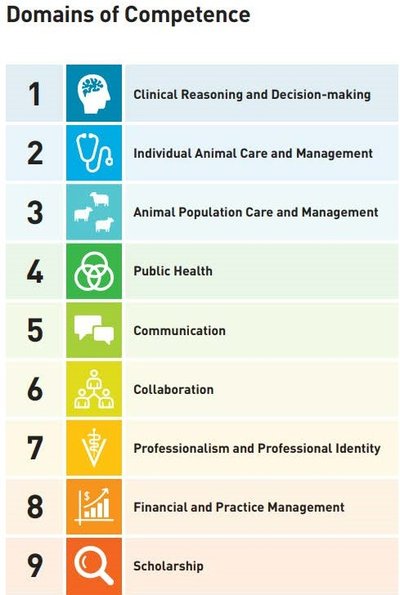
Our new curriculum will be modelled on the Competency-Based Veterinary Education (CBVE) Framework.
The CBVE framework was developed by a group of experienced international veterinary educators with substantial feedback from global members of the veterinary profession. In the CBVE framework, the work of veterinarians is categorised into nine domains (areas) of competence and then further broken down into 32 competencies. These competencies, and their associated sub-competencies, can be thought of as “what the student should be able to do” by the time they finish their veterinary degree.
There are multiple reasons why the CBVE framework is a good fit for Massey:
- The CBVE framework development was based on research literature regarding competency-based medical education.
- The CBVE Framework is ready to use, having already been through a long consultation process with the profession worldwide.
- Using the framework offers an opportunity for a shared language and model of competencies amongst schools, with the long-term plan of sharing resources. A little less reinventing of the wheel is always welcome.
- The CBVE framework is recognised as meeting the AVMA CoE's nine clinical competencies by the AVMA CoE.
- While the domains of competency and actual competencies cannot be altered, there is room to customise the sub-competencies to really suit our context in New Zealand.
Want to know more about the CBVE Framework?
You can find information about the framework and associated resources at CBVE.org.
We need input from the profession
We need input and feedback from the profession to ensure this curriculum meets what the veterinary profession needs veterinary graduates to be able to do on day one of their careers. If you’re willing to be contacted in the future to provide feedback by survey and/or focus group, please click this link to provide your details. Thank you in advance if you are able to provide your support to help educate tomorrow's veterinarians.
Contact us
If you have any questions or comments regarding the curriculum project, please email us at bvsc.curriculum@massey.ac.nz