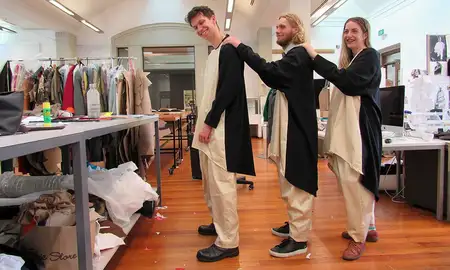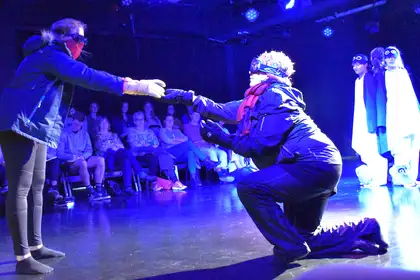
Charlie Tilley and Pipi Reisch in the Penguins in 2017
Eight years after first waddling across stages worldwide for Climate Change Theatre Action, playwright Professor Elspeth Tilley’s feisty penguin characters are returning to theatres in Edinburgh and Te Whanganui-a-Tara Wellington.
They will appear twice at Venue 13 at the 2025 Edinburgh Fringe Festival, first on 14 August as a participatory storytelling curated by Mike Fallek and Bill Moore, then in a different production on 21 August performed by Tess Carruthers and Rosa Thomas as part of ‘Comedy, Creatures, and Post-Human Perspectives.’
Then, on 6 December, The Penguins will be back on stage in Te Whanganui-a-Tara as part of a Te Kunenga ki Pūrehuroa Massey University climate play reading event.
All three productions are part of Climate Change Theatre Action (CCTA), a global movement that has been using theatre to spark constructive conversations about climate change since 2015. This 10th anniversary year, CCTA is restaging the 40 most popular plays of the previous decade including The Penguins.
Professor Tilley said she was delighted to see her short Antarctic comedy resurrected.
“There aren’t many ways that humans can laugh at ourselves in relation to climate change, but sometimes laughter can be just the key we need to unlock more self-aware, hopeful and proactive responses.”
Written as an official selection for CCTA in 2017, The Penguins was first produced that year in New York, Paris, London, Shanghai, Rome, and Los Angeles, among multiple other productions in the USA, UK, and Aotearoa New Zealand. It was translated into French, Italian, and Mandarin, and has since been published in China and Canada, with a forthcoming Spanish-language publication also confirmed.
“There’s something about penguins that crosses cultural boundaries,” Professor Tilley says.
“They don’t belong to any one nation, given Antarctica is an international rather than national territory, so perhaps that gives them a broad appeal. Plus, they’re highly intelligent and very cute. It’s an irresistible combination for a playwright to play with.”
In the CCTA programme for Edinburgh Fringe, The Penguins is described as ‘a sharp, satirical climate play that imagines a world in which penguins—not humans—are the ones with scientific insight, observational prowess, and critical analysis of ecological collapse. Loosely inspired by The Birds by Aristophanes, this short play flips the traditional human-animal hierarchy on its head.’
Professor Tilley said she was inspired by The Birds, but she mainly chose penguins as characters because Antarctica is a place where humans’ ability to reverse our mistakes is visible.
“We took action to ban ozone-depleting chemicals and the hole in the ozone layer is repairing. This proves that we can change our behaviours and that it is worth changing them. I didn’t want to preach that message though, so I used some smarty-pants penguins cracking jokes about it to get the point across.”
Mike Fallek and Bill Moore, who are producing the first reading of The Penguins in Edinburgh, claim that it will be a ‘joyful, chaotic, and utterly unmissable experiment in collective storytelling.’ They will use audience members as the cast, in ‘the largest ensemble ever assembled at Venue 13,’ and are expecting a ‘wild, collaborative, and delightfully unpredictable reading that’s equal parts performance and participation.’
Professor Tilley explains how involving the audience will make for a more a poignant and powerful performance.
“No one’s ever done that before! It’s great to see things reinterpreted and given new life, especially by involving lots of people at once. Participation and embodiment are two of theatre’s superpowers, so I love how this idea plays with those strengths.”
She is also excited about the second Edinburgh staging, in which The Penguins will be paired with another animal play, Canadian-American playwright Elaine Ávila’s Brackendale, which features two bald eagles living at a garbage dump and musing on what humans do and do not value.
Scottish actors and producers Tess Carruthers and Rosa Thomas will give a live reading followed by a physical workshop exploring how movement, mask work, and comedy can help us embody more-than-human perspectives.
The Edinburgh Fringe programme says their event aims to explore posthuman futures and challenge human-centred thinking, reimagining our place in nature with curiosity, connection, and embodied performance.
Professor Tilley said theatre is one of the few places where humans can physically walk in the steps of other creatures, which can help encourage outward-facing thinking, empathy, and better recognition of our place within larger ecological communities.
The Penguins will also be among a range of plays on the programme at the Massey CCTA Aotearoa event in the Theatre Laboratory at Wellington campus at 3pm on 6 December..
“It too will be a participatory event, there will be a workshop, and it will use comedy to start conversations. Unlike a trip to Edinburgh, it will be cost-free and low-carbon. So we hope to see lots of people come along and join the penguin fun and have a constructive kōrero about climate,” Professor Tilley says.
Stay connected with what’s coming up on Massey’s CTA Aotearoa 2025 event here: https://www.facebook.com/HMCCMassey
Study a Bachelor of Communication - Expressive Arts
Related news
Penguins on stage and street in climate change action
Using theatre to turn people into penguins is a symbolic way to highlight some of the planet's most vulnerable species in this year's global Aotearoa Climate Change Theatre Action events in Wellington.