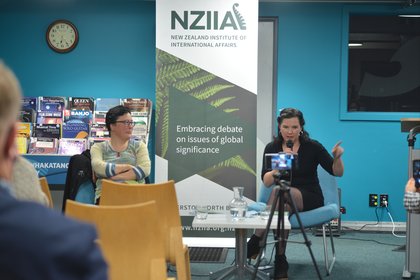
At the launch of Tū Rangaranga: Rights, Responsibilities and Global Citizenship in Aotearoa New Zealand. Photo credit Tushar G.
It can be a depressing business watching the news today. The challenges facing the world – from climate change, the war in Ukraine, to poverty and inequality – seem beyond our power as individuals to try to fix.
This question of how both individual and collective action can tackle urgent global issues is at the heart of a new textbook, Tū Rangaranga: Rights, Responsibilities and Global Citizenship in Aotearoa New Zealand, the third in a series published by Massey University Press to accompany Bachelor of Arts core courses.
School of People, Environment and Planning Senior Lecturer Dr Sharon McLennan, a leader of a team of five editors of the book, says students can get overwhelmed. “They come in passionate and full of energy, wanting to change the world, and then they start to understand the reality of what’s going on and they just crash. So as well as presenting the challenges, we try to provide balance and highlight positive and interesting ways in which people, communities and nations around the world are responding. The aim is that by the end of the course students come out with some hope, but also with an understanding of their place and how we collectively might respond to global problems.”
The book underpins the Tū Rangaranga: Global Encounters compulsory course on global citizenship offered as part of Massey’s redesigned Bachelor of Arts. While the course was developed before Massey’s commitment to becoming Te Tiriti-led, the importance of emphasising the perspectives of Māori and indigenous perspectives more generally was a central concern for the course designers.
Under the guidance of Associate Professor Margaret Forster (Ngāti Kahungunu, Rongomaiwāhine), from Te Pūtahi-a-Toi, School of Māori Knowledge, the course taught from 2017 reflects this commitment with several examples of Māori knowledge woven into the curriculum.
“It’s reminding people of the validity of Māori knowledge and its relevance to a contemporary context,” Associate Professor Forster says.
Tū Rangaranga means 'to weave together' or 'make connections'. The textbook is structured around the idea of weaving the contribution of its 30 authors together into a cohesive commentary about global encounters in the New Zealand context.
“Most edited volumes have a mix of authors talking about their passion, and it’s not always obvious how everything fits together,” Associate Professor Forster says. “But Tū Rangaranga has a theme running through it.”
The book is divided into three sections based around the harakeke (New Zealand flax) as a central design metaphor.
“Te Take, the beginning, builds a base of key concepts. Then we explore the three specific issues – conflict, climate change and poverty and inequality (Te Rito, the central shoots) – and we finish with agency (Te Puāwai/the flowers).”
The team of writers includes indigenous, non-white and female voices as well as new and emerging academics, with representation from across the College of Humanities and Social Sciences.
Editor Dr Rand Hazou, Senior Lecturer in the School of Humanities, Media and Creative Communications, cautions that Tū Rangaranga is not a handbook for how to solve problems. “It’s more about understanding our place in the world. Academia can be very European and very white and very Western-centric. This book showcases a range of voices from different cultural backgrounds that allow us to better understand our global connectedness.”
Dr Hazou notes that concepts of citizenship have changed. Within the Western tradition the idea of the rights and responsibilities of the citizen in the city state in ancient Greece shifted in time to the nation state.
“Now because of globalisation it’s changing again. Certainly this applies to our students. They might have a Malaysian dad and a Singaporean mum, and they might have spent some time in India, but now they're living in Aotearoa. So these old structures of nationalism don't seem to fit us anymore, particularly when we come to think about some of these big global problems.”
Associate Professor Forster says individuals might feel a sense of hopelessness in the face of global challenges, but there is still agency, particularly at the collective level.
“These problems are too big for the individual to resolve, but one of the things we're promoting through the book and the course is the power of collective activity. A lot of the voices in the book have engaged in some really awesome projects around the country. We also emphasise the importance of cleaning up your own backyard first before you start helping out somewhere else," she says.
Dr McLennan agrees. “It’s about being citizens in a global world. We are connected to people, places, processes all around the globe just by the fact of living our daily life. So we want to draw out those connections and ask what does that mean in terms of rights and responsibilities.”
Tū Rangaranga is the third book in a trilogy exploring ideas of citizenship, along with Tūrangawaewae (2017, 2022) and Tūtira Mai (2021). The team of five editors also included Dr David Littlewood, Lecturer in the School of Humanities, Media and Creative Communication, and Dr Carol Neill from the School of Education at Auckland University of Technology.
Related news
New book asks: ‘what does it mean to be a citizen?’
New book asks: 'what does it mean to be a citizen?' What can history tell us about the state's duty to its citizens? A bold and timely new book from Massey University Press brings political theorists and historians from the College of Humanities and Social Sciences together to examine the role of, and need for, a critical, global and active civil society.
New book looks at experiences of Chinese immigrant families in New Zealand
A new book co-authored by Senior Lecturer Dr Liangni Sally Liu and PhD graduate Dr Guanyu Jason Ran looks at Chinese immigrant families in New Zealand.

New book from Massey press examines indigenous rights
Conversations About Indigenous Rights: The UN Declaration on the Rights of Indigenous People in Aotearoa New Zealand, edited by Selwyn Katene and Rawiri Taonui and published by Massey University Press.