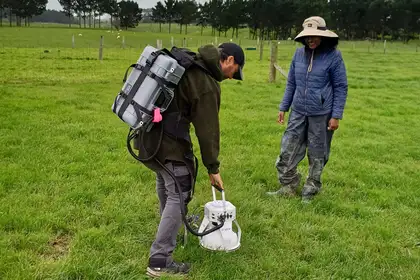
L-R: Senior Technician Eduardo Sandoval and PhD student Nishamani Weerasinghe.
The technology is expected to improve sustainable farming practices, enhance research insights and provide practical learning opportunities for students.
Senior Lecturer in Grassland Science Dr Andrew Cartmill, a T.R. Ellett Agricultural Research Trust-funded member of the school, had previously used the technology in the United States. Recognising its potential for use in Aotearoa New Zealand, he led the bid to bring the analysers to Te Kunenga ki Pūrehuroa Massey University.
“The portable trace gas analysers, made by LI-COR Incorporated, are a game changer,” Dr Cartmill says.
“They provide us the ability to quickly measure gases coming from farmed land, helping us understand how different crops and farming practices affect emissions. Being able to track changes over the day and across seasons gives us the insights we need to develop better ways to reduce greenhouse gases and make farming more sustainable.”
The school has bought the LI-7810, which measures methane, and the LI-7820, which measures nitrous oxide. The analysers arrive at a time when global research is increasingly focused on understanding the underlying mechanisms behind emissions.
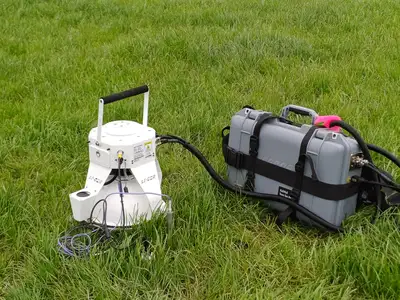
Historically, research of this kind has been limited due to cost and time restraints. With the new technology, data collection will be faster, more affordable and allow more samples to be collected in a day compared to traditional techniques.
Dr Cartmill says that given how different Aotearoa’s soil types, management and farming systems are from the rest of the world, having the ability to perform this research in New Zealand for New Zealand is a big draw.
“It’s critical that going forward, we have a better understanding of our particular environment so we can make informed decisions to develop farming practices and mitigation strategies that are truly effective for New Zealand conditions.”
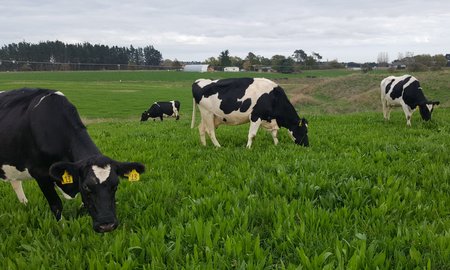
The analysers are already being used to study how different grass species release nitrous oxide, a key greenhouse emission.
Doctor of Philosophy (PhD) student Nishamani Weerasinghe, also funded by the T.R. Ellett Agricultural Research Trust, is comparing emissions from grasses like browntop and cocksfoot, which dominate much of the country’s sheep and beef farms, to those from ryegrass. Until now, most research on nitrous oxide emissions has focused on ryegrass, making this an important new area of study.
Senior Lecturer in Sheep Production Systems Dr Lydia Cranston says the LI-COR analysers allow researchers to measure emissions directly while animals are grazing – something that wasn’t possible before.
Another PhD project, also funded by the T.R. Ellet Agricultural Research Trust, is investigating how climate factors such as rainfall, season and drought, as well as farm practices like fertiliser application, grazing and animal urine, influence soil and pasture greenhouse gas emissions. Dr Cartmill says interest in these research opportunities is big, with many scholarship applications under review.
Head of School of Agriculture and Environment Professor Paul Kenyon says the team is excited to see the analysers in action.
“This equipment will help us better understand our environmental footprint, not just on agricultural and horticultural land, but also across other managed landscapes and conservation areas. We’re keen to partner with others who may wish to use this technology, and plans for collaborative research with other universities are already underway.”
The technology will also play a major role in the Whenua Haumanu programme, a partnership between Massey and the Ministry for Primary Industries, which focuses on understanding how farming practices affect the environment while supporting productive, resilient farms.
Programme lead Professor Danny Donaghy says the team is ready to take their research to the next level.
“Early results suggest that grazing more diverse pastures, rather than the usual ryegrass and white clover, could help cut nitrous oxide emissions during spring. With this technology, we’re now looking to track gas emissions across the seasons to see how this plays out in dairy, sheep and beef systems.”
Related news
Celebrating rising stars at the 2025 Agriculture, Horticulture and Environmental Science Awards
The future of Aotearoa New Zealand’s primary industries was in the spotlight at the 32nd annual Agriculture, Horticulture and Environmental Science Awards in Manawatū last Friday.
Launch of practical guide to create resilient pastures in a changing climate
A new publication has been launched that offers a comprehensive and up-to-date resource on commercially available grazing pasture species in Aotearoa New Zealand.
Research shows plantain can significantly reduce nitrogen leaching on farms
Innovative research from the School of Agriculture and Environment has shown that feeding cows the leafy herb plantain can reduce nitrogen leaching from dairy farms by 20 to 60 per cent.