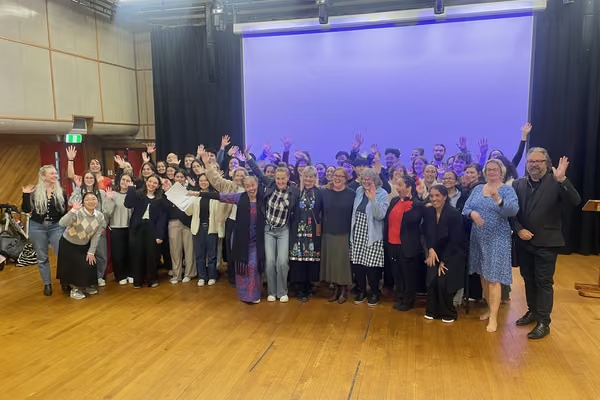
Professor Julia Ioane
The recognition celebrates Professor Ioane's PhD thesis which explored the experiences of Pacific parents whose children had become involved in the youth justice system in New Zealand. Rather than being researcher-led, the study grew directly from conversations with families who wanted their own experiences to be heard after her earlier research focused on Pacific young people.
Professor Ioane says this research was called for by the Pacific community, led by Pacific and undertaken for and with Pacific people.
"When I spoke to parents as part of an earlier study, it was clear they wanted their voices to be heard too."
Her research found many parents felt they were "doing time too" as they supported their children through a justice system that often felt unfamiliar and culturally disconnected.
Using the metaphor of an ‘ie toga’, or ‘fine mat’, Professor Ioane wove together the experiences of parents through a culturally-aligned research approach grounded in Pacific worldviews, values and knowledge.
The findings highlighted a range of systemic challenges facing Pacific families, including limited understanding of Pacific worldviews within the youth justice system, the importance of family involvement, the emotional burden of shame and the impact of financial hardship when a child enters the justice system.
The research also offers practical recommendations to strengthen parental engagement across the justice sector, including Police, Oranga Tamariki and Ara Poutama Aotearoa, while providing guidance for Pacific parents navigating the system.
Professor Ioane says one of the most interesting aspects of the research was the generosity shown by the families who took part.
"Despite some very difficult experiences, parents were willing to share their stories so other families might have a better journey through the justice system."
She says the greatest challenge was ensuring the research honoured the voices of participants while meeting the expectations of a doctoral thesis.
"I wanted to produce research that continued to promote and prioritise Pacific worldviews while maintaining the integrity of an academically robust PhD."
To achieve that, Professor Ioane worked closely with an expert advisory group comprising Pacific and non-Pacific researchers, health practitioners and justice sector leaders, while drawing on her own lived experience as a Pacific leader, clinical psychologist and academic.
Receiving news that her thesis had been included on the Dean's List came as an unexpected surprise.
"It was incredibly humbling. Like everything I achieve, I did not do it alone."
"It recognises the honour and privilege of producing research that embedded Pacific worldviews, principles and values throughout its journey, and having that acknowledged within a Western academic framework was very humbling."
Professor Ioane says the recognition also belongs to the many people who supported the research, particularly the parents who generously shared their experiences, her supervisors Professor Ross Flett and Professor Kirsty Ross, the expert advisory group, along with her family and friends.
Related news
New guidance aims to improve brain imaging experiences for Māori
Despite Māori being disproportionately affected by traumatic brain injury, there are currently no national guidelines for conducting neuroimaging in a culturally safe way in Aotearoa New Zealand. New research is helping to change that.

Research highlights how teachers use data to improve learning
Teachers across Aotearoa New Zealand are using a range of information to support student learning, but new research suggests a stronger collaboration and shared approach could help schools make better use of data.
Learning from communities to better serve communities
Future clinical psychologists at Te Kunenga ki Pūrehuroa Massey University are learning directly from Pasifika communities as part of a unique annual event designed to strengthen culturally responsive mental health care in Aotearoa New Zealand.