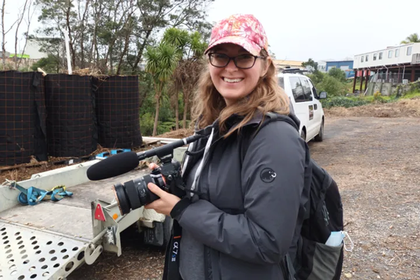
Dr Cadey Korson.
The video research will look at the social impact of volunteering on an integrated and community-based urban conservation project.
The research project is multi-faceted – the documentary is an output, capturing the urban restoration on video, but the interviews will also form part of the data, offering Dr Korson and fellow researcher, Lecturer Dr Natalie Mathews, the chance to observe how people interact with the site and reflect on their experiences with Te Hōnonga a Iwi.
Dr Korson is a Senior Lecturer in human geography, and became interested in video about three years ago.
“I blame my husband, a landscape and travel photographer who tried to get me interested in photography. But I found videography much less tedious. Now I look for research opportunities that use that skillset.”
She says there are increasingly creative ways for academics to publish research.
“I was interested in how I could use film not just to communicate what was occurring in my research, but also as a way to communicate back with the people involved in the project.”
The Restoring Rosedale Park video was an opportunity to research in the local community and built on connections Dr Korson had already had with organisations such as Long Bay College and Albany Senior High School.
Having previously produced short films and course videos, she wanted to challenge herself with a feature-length documentary.
It’s a year-long project, and she's hoping the documentary will be finished mid-2023 and available online.
Dr Korson and Dr Mathews are conducting video interviews with several stakeholders in the restoration, including some of the secondary school students taking part. They will rely on participant observation and mediums such as artwork projects to understand how younger students from local kindergartens and primary schools experience the restoration work.
As well as the video, their research will be published in written form in an academic journal.
“Video is a much more accessible way to present traditional research findings. The target audience for the video is not other academics, although I would like to encourage them to get involved with these types of projects. But I want to inspire other communities to take up the call to carry out these types of initiatives."
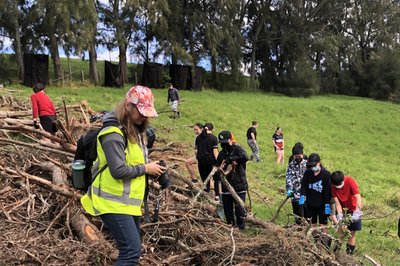
Filming on location.
As a geographer, Dr Korson says she loves to travel and learn about other places, including the human impact on the natural landscape.
“I’ve seen some incredible examples of people looking after our earth, and the reverse.”
She notes that certain activities and ways of thinking about the natural environment are culture-based.
“Living in New Zealand has made me more conscious of single-use plastics and single-use products, and the things we use and discard that might be better recycled. Things like clothing.”
During a recent trip home to the United States, she was horrified to still see plastic shopping bags in use.
“It might seem like a small thing but it’s important. If we can’t even get rid of plastic bags, how are we going to tackle the big environmental issues.
“I want to have an impact on how people interact with the environment, and that starts with me.”
Story and images courtesy of Te Hōnonga a Iwi Restoring Rosedale Park.
Related news
New film rethinks how land use is classified in NZ
A new film that explores the complexity of human environmental relationships will be premiered at Fieldays.
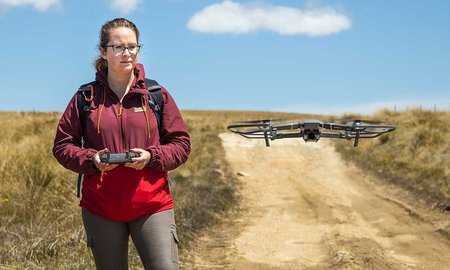
Drone film for reality check of NZ environment
Geography, sociology, philosophy students and staff will swap lecture theatres for the wilderness this summer to use aerial and underwater drones for a film revealing land use, environmental issues and human-environment relationships in Aotearoa.
