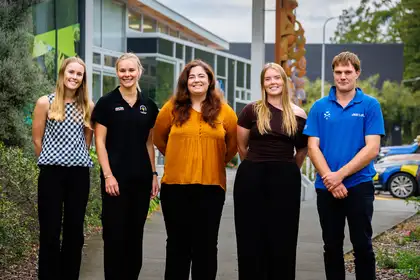
L-R: Scholarship recipients Emma Grigg, Renée Zwagerman, Troye Hudepohl, Alyssa Koller-Orr, Mac Williams.
In their last year of study, veterinary students spend almost a full year undertaking clinical placements at Te Kunenga ki Pūrehuroa Massey University’s teaching hospitals and veterinary clinics throughout Aotearoa New Zealand. These placements are an essential part of their training, giving students the opportunity to experience a range of veterinary practices and helping them decide where they would like to work after graduation.
However, the nature of the final year means students have limited time or opportunity to earn income, and travelling for placements can add significant financial pressure. The new scholarships, each worth a little over NZ$8,000, will help support students to complete their training and gain valuable hands-on experience.
Tāwharau Ora Academic Lead Professor Jenny Weston says the school was encouraged to apply to the fund by MSD Animal Health New Zealand Veterinarian Penelope Mehrtens, who recognised the potential impact the scholarship could have for students and rural communities.
“The MSD Global Impact Fund supports sustainable solutions to key global health challenges and strengthens the communities it works alongside around the world. Veterinary education is an important part of this work, as veterinarians contribute to animal health, public health and the resilience of rural communities.
“For our students, this funding will improve access to rural placements by reducing financial barriers such as travel and accommodation costs. By creating more opportunities for students to gain experience in rural practice, we hope to see more Massey veterinary graduates choosing careers in mixed and rural practices. In the long term, this will benefit rural communities through improved access to veterinary services and support for livestock health.”
Professor Weston adds that ensuring a strong pathway for veterinary graduates into rural areas is critical for New Zealand.
“Primary industries are a significant export earner for our country, and the veterinary profession significantly contributes in this area by supporting the quality and sustainability of our food and fibre industries. Around 50 per cent of the veterinary workforce works in rural practice – a much higher proportion than in Australia, the United Kingdom, Canada and the United States.”
All of the recipients have shared the significant impact the scholarship will have during their final year of study, allowing them to focus their energy on the placements and experiences that will shape them as veterinarians rural communities can rely on. They have expressed their gratitude not only for the financial support from MSD, but also for the recognition of the importance of rural New Zealand and the role future veterinarians will play in supporting these communities. With this support, they are excited to be one step closer to completing their training and giving back to rural communities.
The selection criteria for the scholarships included a demonstrated passion and commitment to rural veterinary practice. Applications were assessed by a panel comprising a Massey senior production animal veterinarian and representatives from the dairy and sheep and beef branches of the New Zealand Veterinary Association.
Meet the recipients:
Emma Grigg: Growing up on a sheep and beef farm in Marlborough, Emma spent her holidays working on the farm or with horses. She plans to start work in a mixed veterinary role and ‘just get stuck in’. Emma has a strong interest in sheep and beef, especially internal parasite management as it’s an area where she feels vets can make a genuine difference to animal health and farm productivity.
Troye Hudepohl: Alongside her studies, Troye helps run a fencing business with her partner and relief milks on local dairy farms. Being so closely involved in day-to-day farm life has given her a real appreciation for the pressures farmers are facing and the value of being a veterinarian who clients feel comfortable and confident in. These experiences have shaped the kind of veterinarian Troye hopes to become – someone who is approachable, reliable and able to offer advice that is both evidence-based and practical. Troye wants to be a trusted point of contact for her clients, in both routine and more challenging situations.
Alyssa Koller-Orr: While Alyssa started out as a self-confessed ‘townie’, these days her life is an even split between study, cows and trying to stay on top of her ever-growing collection of animals at home. Living and working on a dairy farm while studying has given her a front-row seat to farming life in its realest form – the hard work, the people, the constant problem-solving and the occasional chaos that keeps everything interesting. Along the way, Alyssa has found that her passion is for rural life and that rural mixed practice is her destiny.
Mac Williams: Growing up on the West Coast of the South Island, Mac had well and truly caught the bug for the outdoors and agriculture before coming to Massey. His goal is simple – to be a large animal vet working alongside farmers, focused on solutions that improve performance on farm and make a real difference day to day.
Renée Zwagerman: Originally from a dairy farm in Western Southland, Renée plans to work in rural veterinary practice in New Zealand, building strong relationships and supporting farmers to create sustainable, productive farming systems through preventative animal health. She is excited to give back to the rural communities that have shaped her and to contribute to the future of agriculture in New Zealand through her veterinary work.
ABOUT THE MSD GLOBAL IMPACT FUND
Through the MSD Global Impact Fund, MSD supports initiatives that develop sustainable approaches to global health challenges and strengthen communities worldwide. MSD (Merck, Sharp and Dohme, known as Merck in North America) is a multinational pharmaceutical company. Rural communities will be most familiar with MSD Animal Health in New Zealand, as they provide a wide range of veterinary medicines, alongside having a vaccine manufacturing plant in Upper Hutt.
Related news
Professor Jenny Weston appointed to global expert panel shaping future veterinary education
Professor Jenny Weston has been appointed to an international expert panel established by the World Organisation for Animal Health (WOAH) to review and update its Competency and Curriculum Guidelines for Graduating Veterinarians.
Pathology: Shaping future vets into guardians of food and health
Inside the leading veterinary school in Australasia, Tāwharau Ora School of Veterinary Science has a pathology suite purpose-built with a clear vision: to support advanced veterinary teaching and deliver high-level capability in animal health investigation and response.
Massey University unveils new $70m veterinary research facility
The final new build in a ten plus year project to upgrade the veterinary facilities at Te Kunenga ki Pūrehuroa Massey University was officially opened this morning by Minister for Universities, Honourable Dr Shane Reti.