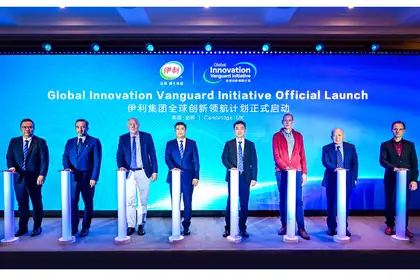
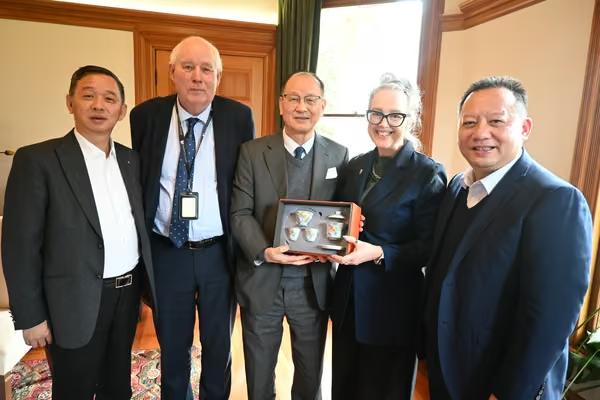
Distinguished Professor Paul Moughan (third from left) appears at a Yili event at the University of Cambridge in May.
Riddet Institute Fellow Laureate and protein expert Distinguished Professor Paul Moughan was invited to speak at the University of Cambridge in May, as part of a launch of a global research strategy by the Yili Group. He spoke about how Riddet Institute research has led to significantly improved infant milk formulas and advanced nutrition products.
The Yili Group is one of the world’s largest dairy companies and producer of nutritional products.
Distinguished Professor Moughan said the research done at the Riddet Institute at Te Kunenga ki Pūrehuroa Massey University was a notable example of basic science leading to better nutritional products that are then used by industry.
"The type of research undertaken at the Riddet Institute was discovery-based research and is research that would not be undertaken by industry itself, yet not only do we have an enhanced understanding of breast milk, of great importance to the growth and development of babies, and a major contribution to global knowledge, but also significant economic innovation.”
He said Riddet Institute findings were made in collaboration with Aotearoa New Zealand milk companies Oceania Dairy and Westland Milk Products. Both are part of the Yili Group.
At the University of Cambridge launch, Distinguished Prof Moughan spoke on the Riddet Institute’s legacy of work to improve the amino acid composition of infant formulas.
Breast milk is the preferred source of nutrition for the newborn baby, but for numerous reasons many infants receive infant formula as their sole source of nutrition.
He said in 2013 the United Nations Food and Agriculture Organization (FAO) recommended the amino acid composition of infant formulas should be based on the amino acid composition of human breast milk, but scientists only had an estimate of what these were. Since then, the Riddet Institute has determined exact proportions of the absorbed amounts of nine key amino acids found in human breast milk.
Human milk contains a multitude of different proteins, of which the concentrations are variable, and although the amino acid sequences of some of the more common milk proteins are known, not all of the proteins have been sequenced. However, all of these amino acids play critical roles in infant growth and development.
Distinguished Professor Moughan says scientists soon found a big gap between the amino acid proportions breast milk provides an infant and what the earlier FAO infant formula guidelines recommended. Eight out of the nine amino acids investigated were in higher quantities in breast milk, some up to 48 per cent higher, than in the FAO formula guidelines.
The Riddet Institute research was groundbreaking in that it also accounted for digestibility and the ability for these nutrition building blocks to be absorbed in the infant gut. In 2023, researchers published the findings of this work, correcting earlier assumptions and advancing the argument for new nutritional guidelines for infant formula.
The findings were taken up by Oceania Dairy and Westland Milk Products, leading to innovations in baby formula products.
Related news
Research leaders receive New Year Honours
Two Te Kunenga ki Pūrehuroa Massey University Distinguished Professors have been awarded Companions of the New Zealand Order of Merit in the 2026 New Year Honours List. A total of 15 staff and alumni have been recognised this year.
Kiwi protein expertise in demand in United States
Aotearoa New Zealand’s reputation in protein research is so significant Kiwi scientists have been asked to organise an international conference, not once, but twice.
Pioneering fungi research collaborators celebrate 20 years
More than 20 years ago Professor Yihuai Gao began working with Te Kunenga ki Pūrehuroa Massey University to extract the reishi mushroom’s active ingredients for immunity and cardiovascular health.
Massey scientist to advise Bill and Melinda Gates Foundation
A Massey protein expert is helping the Bill and Melinda Gates Foundation find ways to feed malnourished mothers in the developing world.