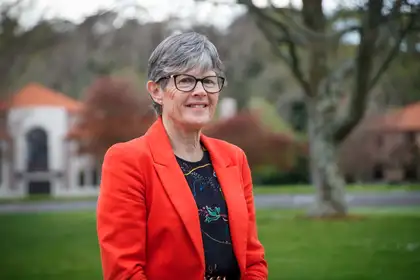
Professor Jenny Poskitt
The roadshow, held across Dunedin, Christchurch, Tauranga, Wellington and Auckland, brought together secondary school leaders to discuss upcoming curriculum, assessment and qualification changes.
Professor Poskitt was invited to provide a research perspective on senior secondary assessment and qualification changes. She delivered a keynote address and contributed to an assessment and qualifications panel alongside representatives from education and industry.
She says research evidence is critical when considering changes to education systems.
“Education is about building human capacity for wider life, lifelong learning and contribution at home, work and civic life. Assessment plays an important role in supporting that learning journey.”
In her presentation, Professor Poskitt outlined international and national research on assessment, qualification credibility and student achievement. She discussed declining achievement patterns, persistent inequities and the importance of ensuring qualifications remain relevant, trusted and accessible.
She says effective assessment systems need to balance several purposes.
“Assessment is a means to sit beside or with students, to guide and support them. While assessment has different functions, one of the most powerful is formative assessment, where information is used to guide subsequent learning and teaching.”
Professor Poskitt also shared international examples of qualification reform, highlighting the importance of offering both academic and vocational pathways and ensuring assessment approaches are credible, dependable and manageable.
“Qualifications need to recognise accomplishment and competency, provide access to future learning pathways, employment and support equal opportunities.”
The response from attendees highlighted the importance of providing clarity and support as changes are introduced, she says.
“People attended the roadshow because they were seeking information and clarity. There is excitement about opportunities for more coherent subject offerings, vocational pathways and stronger connections with workplaces, while there are also understandable concerns about workload and implementation.”
Professor Poskitt’s involvement reflects her longstanding contribution to assessment practice and policy. Alongside her academic role, she is a representative on the Ministry of Education’s (MoE) National Qualifications Technical Advisory (NQ-TAG) Group, Chair of NZQA’s Technical Overview Group of Assessment (TOGA) and President of the New Zealand Assessment Institute (NZAI).
Following the roadshow, Professor Poskitt was invited to continue discussions with the MoE on assessment and data literacy professional learning for schools, and received requests from schools seeking further conversations about assessment.
She says research-informed discussion is essential as the education sector navigates change.
“When people understand why a change is happening, they can put more energy and attention into adjusting. Supporting schools with time, resources and professional learning is important for successful implementation.”
Related news
Opinion: Why abandoning NCEA isn’t necessarily clear-cut
By Professor Jenny Poskitt
Opinion: The value and portability of NCEA
By Associate Professor Jenny Poskitt.

Academic’s appointment recognises decades of experience
Associate Professor Jenny Poskitt has been selected and appointed as Chair of the NZQA Technical Overview Group Assessment for three years.