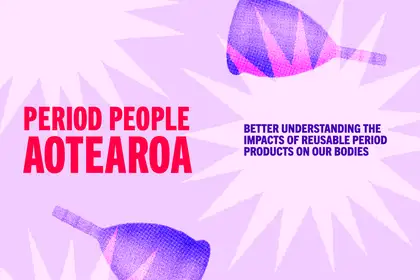
One of the visuals associated with the project.
Period People Aotearoa is a community-led research programme bringing together designers, scientists, health researchers and community members to better understand the impacts of period products on the body. The initiative aims to generate new evidence around sustainable menstrual products, while creating a more inclusive and accessible model for health research.
The project is built on a simple but significant observation. Although more than two billion people worldwide menstruate, many aspects of menstrual health remain under-researched. While sustainable products such as menstrual cups and period underwear are becoming more and more popular, little scientific evidence exists about their long-term use and safety compared with more established products.
The issue reflects a broader pattern within health research, where conditions and experiences that primarily affect women have historically received less attention and funding than other areas of medicine.
Period People Aotearoa is seeking to address those gaps through a transdisciplinary approach that combines science with design, community engagement and public communication. The project is working directly with the communities most affected by the research, in order to identify the questions that matter most.
That approach has strong connections to work developed by Massey's Toi Rauwhārangi College of Creative Arts (CoCA) and Toi Āria: Design for Public Good, where researchers have been exploring how communities and academics can collaborate to create meaningful social impact.
Several Massey graduates and researchers are helping to shape the initiative.
Professor Anna Brown, the founder and director of Toi Āria, co-leads the project with Associate Professor Siouxsie Wiles from the University of Auckland. They have an ambitious aim to improve menstrual health outcomes for the people of Aotearoa.
“This project brings together diverse knowledge and experiences with the hope to make access to better information about menstrual health. We’ve heard from people who are frustrated that periods are poorly researched, and we know there is a lack of independent or well-evidenced research,” Professor Brown says.
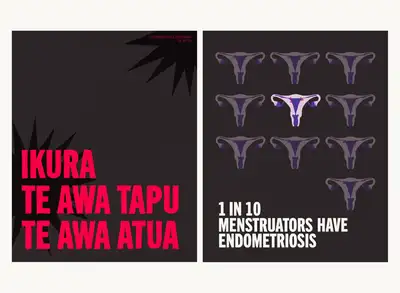
Bachelor of Design with Honours graduate Emma Stein developed the project's visual identity, drawing on themes she explored in her honours research that looked into historical myths and misinformation surrounding historical female healthcare. The project’s visual language contrasts with traditional menstrual health communication, making conversations about menstrual health more accessible while challenging stigma.
“By embracing the messy nature of periods, we can form a collective that connects us through the funny, scary, gross or happy stories that menstruation gives us,” Emma says.
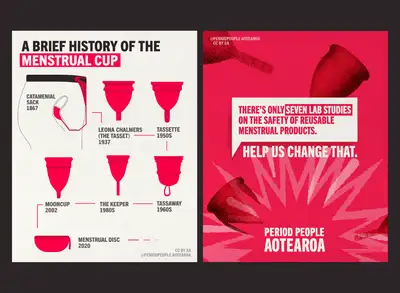
Jean Donaldson, a Master of Design graduate, has helped lead the design of community engagement activities and the visuals of the Instagram campaign. Building on Emma’s foundational design, she ensured the visual language was gender neutral and inclusive.
“Designing a suite of visuals that prioritised gender neutrality was very eye opening to just how ingrained traditionally feminine language and imagery is when talking about menstrual health — something that excludes many people from the conversation.”
Fellow Master of Design graduate Faye O'Sullivan has expertise in participatory design, designing community engagement workshops and ensuring community members remain active contributors throughout the research process.
Faye notes that there are so many unexplored conversations about menstruation. “Listening to the experiences around the tables in our community sessions reminds us how inseparable menstrual health is from our day-to-day health and wellbeing. I think we heard more than some health professionals would!”
Recent doctoral graduate Dr Anjuli Clare used participatory design to explore broad and complex topics across women’s health. The findings from her work were foundational to establishing the community practice for Period People Aotearoa.
Together, these contributions highlight a growing recognition that addressing complex health challenges requires more than scientific expertise alone.
Over the past 18 months, the project has established a cross-institutional research team spanning Massey, the University of Auckland and the University of Otago. Researchers have held four community workshops, built an extensive catalogue of menstrual products, undertaken literature reviews and begun laboratory testing of menstrual cups under conditions designed to mimic real-world use.
The team also recently launched a public awareness campaign for Menstrual Health Awareness Month in May, using design, storytelling and science communication to highlight the lack of research into period products and the broader inequities that continue to shape women's health outcomes.
For those involved, the project is about more than generating scientific data. It is also about changing how health research is conducted.
By combining scientific investigation with community knowledge, creative practice and inclusive design, Period People Aotearoa is working to build confidence in menstrual health research while ensuring the questions being asked are grounded in lived experience and the answers reflect the realities of those most affected.
As the project continues, the team will share findings from its community workshops, continue laboratory testing of menstrual cups and expand its public engagement through new campaigns and partnerships. Future work will focus on reaching a wider range of communities, including younger people, people with disabilities and those working in unusual contexts or environments, while continuing to build momentum for the project's long-term goal: strengthening women's health research in Aotearoa New Zealand and establishing a dedicated women's health research fund.
For further information about this project or to support this research please contact Professor Anna Brown on a.e.brown@massey.ac.nz
Related news
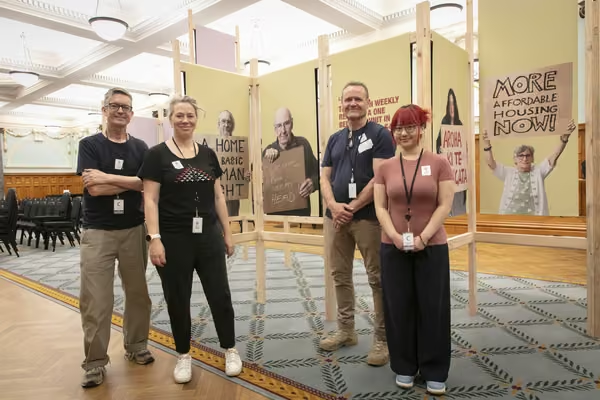
Photography, storytelling and design helps to highlight housing crisis for seniors
Three lecturers from Toi Rauwhārangi College of Creative Arts have combined their photography, graphic storytelling and spatial design talents to give a voice to older New Zealanders facing housing insecurity.
Designing for impact: Massey graduates win big at Red Dot Awards
Honours graduates from Te Kunenga ki Pūrehuroa Massey University’s Visual Communication Design programme have won six Red Dot Design Awards - one of the most respected global competitions celebrating excellence in design.

Ka Mua Ka Muri: Inspiring climate resilience through creativity
A collaborative week-long event in commemoration of the one-year anniversary of Cyclone Gabrielle’s impact aims to ignite a resilient future through a fusion of art, design, music and storytelling.