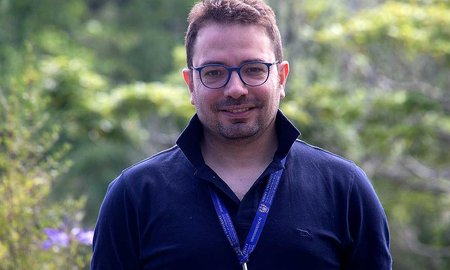
Dr Ruggiero Lovreglio.
Senior Lecturer Dr Ruggiero Lovreglio from the School of Built Environment has been awarded a Rutherford Discovery Fellowship for his research entitled Identification and implementation of fundamental crowd behavioural rules.
He is one of twelve applicants from across the country who have been successful in gaining one of the fellowships and will receive $800,000 in total for five years.
Dr Lovreglio says it’s a true honour to receive the award and lead new research in pedestrian evacuation dynamics.
“Reaching such success was possible thanks to my colleagues, supervisors, mentors, and the students I’ve worked with over the last 10 years. A special thanks goes to my school, my college, and Massey for fostering my research path. This is a victory for us all. A huge thanks also goes to my wife and family back in Italy who are always there for me and support me in my academic career.”
This Rutherford Discovery Fellowship will allow Dr Lovreglio to move toward his ultimate dream of creating the first Research Centre on Pedestrian Evacuation Dynamics in Aotearoa New Zealand.
Research summary
Fires, terrorist attacks, earthquakes, tsunamis and other disasters are increasingly striking across the globe, resulting in the loss of thousands of human lives every year. Well-designed evacuation plans reduce loss of life and injury in disaster events. Equally, the design of physical infrastructure such as buildings and transportation play a key role in a well-designed evacuation plan. To create evacuation-safe infrastructure, Dr Lovreglio models how evacuations could play out. In modelling, one examines people’s behaviour at societal and personal levels, accounting for the ‘hive’ and ‘personal’ abilities of people to ‘react and act’ appropriately.
Current evacuation models mimic some aspects of pedestrian movement but use demographic data from the 1950s-1970’s. Clearly, population demographics have changed, and they are anticipated to change more rapidly in the future. So, how do we design evacuation models that remain timeless? Dr Lovreglio will aim to create a generalised, ‘timeless’ evacuation model. By combining new technologies (virtual/augmented reality crowd experiments, 3D body scanning sensors, machine learning) with traditional field experiments he hopes to find the hidden rules affecting individual movement in crowds. With the ‘timeless’ evacuation model in hand, Dr Lovreglio can aid the design of new built environments and verify the safety of existing ones.
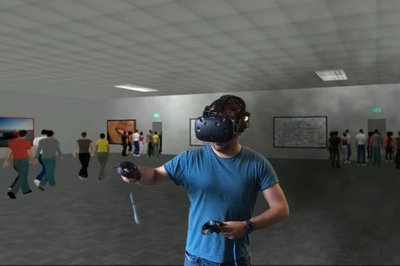
Dr Ruggiero Lovreglio in an immersive Virtual Reality evacuation experiment.
About the Fellowships
The Rutherford Discovery Fellowships seek to attract, retain, and develop New Zealand’s most talented early-to-mid career researchers and support their career development by helping them to establish a track record for future research leadership.
Royal Society Te Apārangi manages the Rutherford Discovery Fellowship programme on behalf of the New Zealand government. The Rutherford Discovery Fellowship scheme receives government funding from the Ministry of Business, Innovation and Employment of $8 million per annum.
More information on the new Rutherford Discovery Fellows is available on the Royal Society Te Apārangi website.
Related news
Award-winning researcher fighting fire with data
Senior Lecturer and Associate Lead of Research in the School of Built Environment Dr Ruggiero Lovreglio has been announced as a winner of the Society of Fire Protection Engineering Five Under 35 .
Using VR to improve fire evacuation understanding
A virtual reality headset may not be the first thing that comes to mind when "fire evacuation" is mentioned, but that is exactly the technology being used to help understand human behaviour in emergencies.