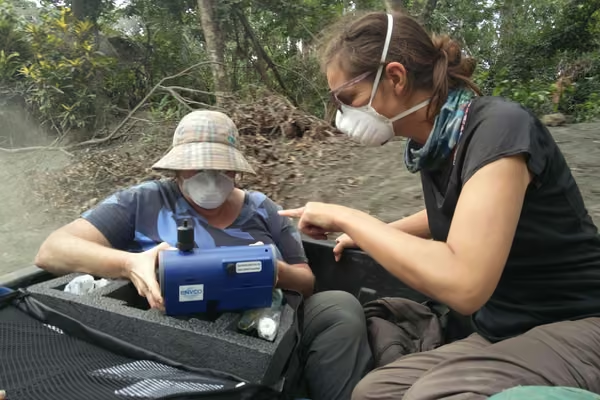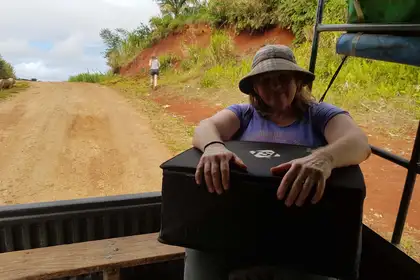
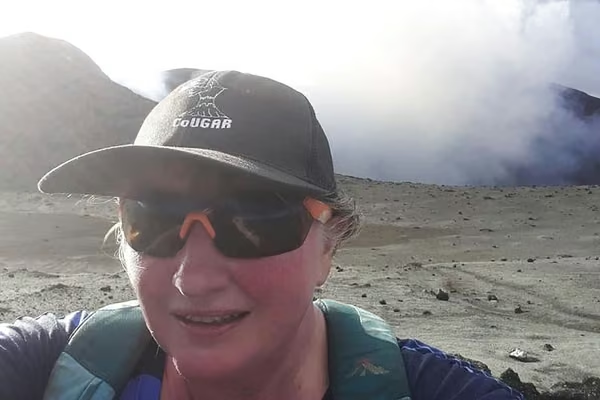
Carol Stewart doing fieldwork in Tanna, Vanuatu.
That's one of the key findings behind a newly published international paper, Getting the Story Straight: Common Misconceptions Around Volcanoes and Eruptions with Case Studies of Recent Events, co-authored by Te Kunenga ki Pūrehuroa Massey University Associate Professor Carol Stewart.
The paper brings together leading volcano researchers from around the world to address common misconceptions that can influence public understanding, media reporting and decision-making during volcanic crises.
Dr Stewart, an expert in volcanic ash impacts from the School of Health Sciences, led sections of the paper focused on misunderstandings about volcanic ash, including the widespread belief that volcanic plumes are ‘smoke’, and concerns that ashfalls will always poison drinking water supplies.
"We have all been frustrated and disappointed by misconceptions and misinformation, both major and minor," Dr Stewart says.
"We saw this paper as a great opportunity to address a whole suite of common misconceptions in one fell swoop with the aim of helping journalists communicate volcanic hazards and impacts more accurately, and generally improve scientific literacy around volcanoes."
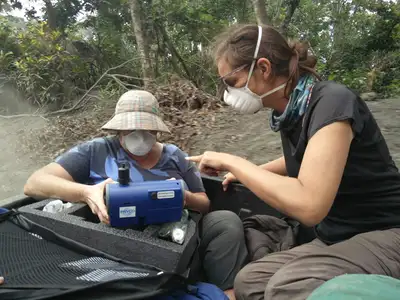
Carol Stewart (left) with Susanna Jenkins (Nanyang Technological University, Singapore) testing ash samples in Ambae, Vanuatu, in 2018, as part of an international team assessing volcanic impacts from the Ambae eruptions. (Credit Graham Leonard)
One of the most persistent misconceptions is the use of the words ‘ash’ and ‘smoke’ interchangeably in media reporting.
"It's common to read in the media about volcanoes producing plumes of 'smoke', and even science agencies have fallen into this trap," Dr Stewart says.
"It's incorrect because smoke is generated by combustion, whereas there's no combustion involved with volcanic ash. It is generated by magma fragmentation."
The distinction is important because the hazards associated with each are very different. While smoke is a well-known respiratory health hazard, volcanic ash can affect a broad range of critical sectors including aviation, agriculture, power generation, water supplies and transport networks.
Another common misconception is that volcanic ash behaves like the soft, lightweight ash left behind in a fireplace.
"The ash left behind in your fireplace is light and fluffy, whereas volcanic ash is as heavy as beach sand and much more scratchy and abrasive," Dr Stewart explains.
The paper also examines fears surrounding volcanic ash and drinking water. While ashfalls can affect water quality and require monitoring, Dr Stewart says the perception that ash will inevitably poison water supplies can create unnecessary anxiety in affected communities.
"There's a common perception that volcanic ashfalls will poison water supplies, which can alarm people unnecessarily."
Research following the 1995-96 Ruapehu eruptions suggested concerns about contaminated water may have contributed to anxiety symptoms among some children living near the volcano.
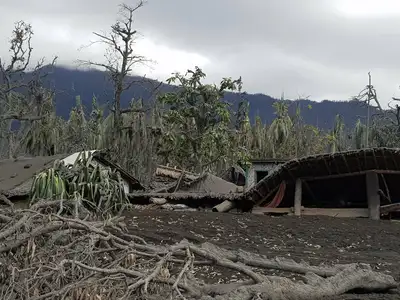
South Ambae ash fall.
As Aotearoa New Zealand is a country with multiple active volcanoes, it’s important that communities have access to accurate information before and during future eruptions.
Dr Stewart says every volcanic eruption produces ash with unique physical and chemical properties.
"After the next eruption in New Zealand we will be very busy collecting ash samples, analysing them and working out what advice needs to be provided for various sectors such as public health, agriculture and infrastructure."
The research also highlights the importance of clear, evidence-based communication during emergencies.
Reflecting on the 2022 Hunga Tonga-Hunga Ha'apai eruption, Dr Stewart says speculation about the hazards posed by volcanic ash spread widely before scientists were able to obtain and analyse samples.
Once New Zealand researchers had access to ash samples, they confirmed those concerns were unfounded.
"There can be a difficult balance between getting information out promptly and running the risk of having to walk it back if you have anything wrong, and waiting until you have more certainty but risking the messaging being too late to be useful," Dr Stewart says.
"On balance, it's best to be prompt but circumspect."
Dr Stewart hopes the paper encourages people to seek information from trusted scientific sources and develop a greater understanding of the country's volcanic environment.
"We have a very active volcano research community in Aotearoa New Zealand, and some excellent information resources," Dr Stewart says.
"And when the next eruption happens, please help us collect ash samples."
Detailed instructions on how to collect ash samples are available online.
Related news
New funding awarded to pioneering research strengthening volcanic resilience
New funding from Toka Tū Ake Earthquake Commission (EQC) has been awarded to a first-of-its-kind research project on infrastructure resilience to volcanic activity, led by Associate Professor Carol Stewart.
Ash samples provide vital information for volcanic eruption response
Massey University’s Associate Professor of Environmental Health Carol Stewart plays a crucial role in determining the extent and types of health hazards people will be exposed to in the aftermath of a volcanic eruption.