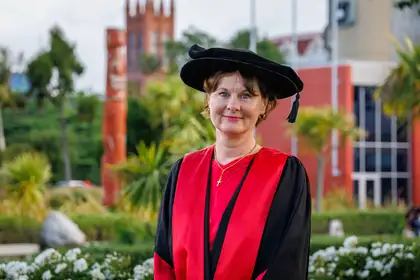
Dr Philippa Wood.
Dr Wood’s PhD research explored how young people participate in local government through youth councils in four communities across Aotearoa New Zealand.
“I wanted to understand how councils support young people to have a say in decisions that affect their lives and whether that participation is genuinely influential or largely symbolic. My background in social work sparked an interest in learning how local government can move beyond simply hearing young people’s views to genuinely sharing power with them.”
Dr Wood found that youth councils operated in different ways across the four communities studied.
“Some councils took a youth development approach, focusing on leadership, personal growth and recreational activities leading to limited influence on policy and decision-making. Other councils adopted an emerging rights-based approach, actively seeking and incorporating young people’s views into decision making.”
One of Dr Wood’s key findings was that young people are often invited into local government spaces but are not always given meaningful influence over decisions.
“The extent to which youth can contribute depends heavily on the willingness of councils to listen, respond and share power. Ultimately, the research shows that meaningful youth participation is about much more than giving young people a voice. It requires structures, resources and relationships that enable their views to be taken seriously and acted upon.”
The research identified several practical ways councils can strengthen youth participation.
“Young people are most effective when participation is supported by clear pathways and genuine opportunities to influence decisions. These structures include participation in council committees, policy submissions, youth summits, youth-led projects, community partnerships and formal pathways for young people to contribute to council decision-making.
“Councils can apply these findings by investing in youth councils, youth-led initiatives, community partnerships and training that helps embed youth participation within everyday governance. The study also informed the development of a Youth Participatory Rights Charter, which provides a framework for moving beyond consultation towards more meaningful and accountable youth participation.”
Dr Wood found that if councils want young people to contribute, they need to invest in structures to make that participation possible.
“Some councils have reduced funding for youth councils leading, to a loss of continuity, accountability and representation for young people. My research found that meaningful youth participation is most effective when it is embedded within governance systems rather than dependent on political goodwill, staff champions or short-term funding. Without structure, youth voices become intermittent and vulnerable rather than embedded and enduring.”
Dr Wood also found that adult perceptions can either support or hinder meaningful youth participation.
“Adults often changed their views about young people’s capabilities when they saw them making thoughtful contributions to policy discussions. This suggests that one of the biggest barriers to meaningful participation is not young people’s willingness or ability to contribute, but the assumptions adults and institutions hold about youth.
“Meaningful participation requires both strong civic infrastructure and a cultural shift in attitudes about youth. Young people need opportunities, networks and institutional support, but adults also need to recognise young people as capable civic actors whose perspectives can strengthen local democracy.”
One thing Dr Wood hopes people take away from this research is that young people are not disengaged from civic life.
“When youth are given meaningful opportunities to contribute, they bring valuable perspectives, energy and insight to local decision-making. The challenge is not convincing young people to participate, but creating the structures, relationships and opportunities that enable their participation to have real influence.”
Dr Wood says Massey was a natural choice when deciding where to study because she wanted to undertake research that connected academic inquiry with real-world practice. Massey’s commitment to applied and community-focused research aligned closely with her expeirences in social work.
Related news
Emerging leaders recognised in social work awards
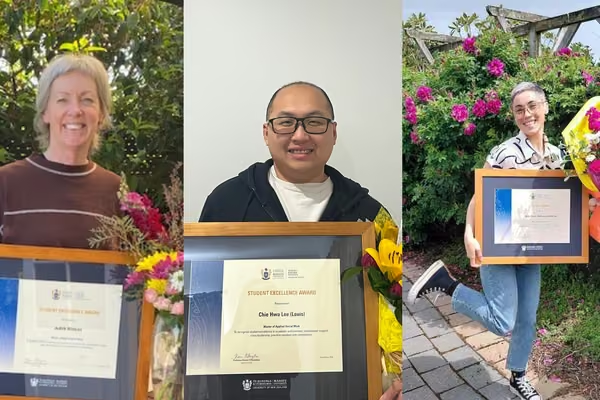
Three Master of Applied Social Work (MASW) students from across Aotearoa New Zealand have been recognised for their academic excellence, leadership and commitment to social justice, receiving the School of Social Work's top student awards for 2026.
Fifty years of social work, generations of impact
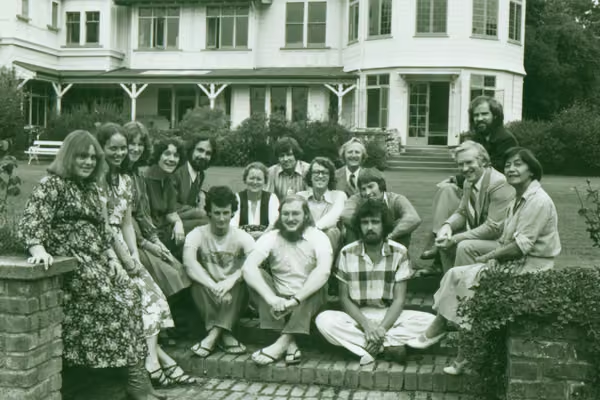
For 50 years, Te Kunenga ki Pūrehuroa Massey University's Bachelor of Social Work has prepared graduates for a profession built on compassion, advocacy and social justice.
Doctoral study unveils spirituality in social work
Dr Hairunnisa Muhammed Shafi fulfilled her grandfather’s dream for her when she crossed the stage at Auckland graduation recently to receive her doctorate.