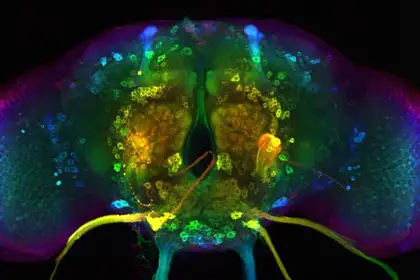
Fruit fly (Drosophila melanogaster) brain that has been imaged by confocal microscopy.
The study identified how disruptions to a protein that plays a vital role in brain development – histone deacetylase 4 (HDAC4) – can lead to the formation of harmful protein clusters that interfere with nerve cell growth.
Lead researcher and molecular biosciences technician Dr Hannah Hawley carried out the work during her Doctor of Philosophy (PhD) and post-doctoral studies at Te Kunenga ki Pūrehuroa Massey University under the supervision of Dr Helen Fitzsimons.
Dr Hawley says the findings could help scientists better understand the cellular processes that underpin conditions such as Alzheimer’s disease, Parkinson’s disease and other brain disorders.
“Our findings suggest that the protein’s ability to form droplet-like structures, known as condensates, is key to how it affects neurons. We’re now looking at what these clusters are made of and exploring ways to break them down. By studying how they form in disease models, we hope to learn whether disrupting them could lead to new treatments.”
Under normal circumstances, HDAC4 moves in and out of the cell’s nucleus to help regulate gene activity during brain development. When this process is disrupted, the protein builds up, forming clusters that disrupt normal cell development.
To investigate how the clusters affect brain function, the team used fruit flies (Drosophila melanogaster) as they are a powerful genetic model that shares many of the same cellular processes as humans. The findings revealed that the more clusters formed in the cell nucleus, the more severe the brain and eye defects became.

Dr Hannah Hawley.
Dr Hawley says the team also identified another protein, myocyte enhancer factor 2 (MEF2) which helps HDAC4 enter the nucleus and form clusters.
“When we stopped the two proteins from interacting, we saw fewer of the harmful clusters forming and fewer problems with brain cell development,” Dr Hawley says.
Further experiments showed that certain parts of the HDAC4 protein cause it to stick to itself. When these parts were changed, it could no longer form clusters, resulting in fewer defects. However, some mutations made HDAC4 even more likely to clump together, causing more damage.
Dr Hawley will continue this work through a two-year post doctorate position funded by a First Fellowship from the Neurological Foundation. She is hopeful the current findings will open new pathways for therapies to restore brain development and slow degeneration in neurological diseases.
The research team also included Associate Professor Andrew Sutherland-Smith and Dr Matthew Savoian from the Molecular Biosciences Group within the College of Sciences. The work was funded by a Marsden Grant Dr Fitzsimons received and Dr Hawley was awarded a summer scholarship from the Palmerston North Medical Research Foundation to assist with this work. The research has been published in Open Biology.
Read the journal article: N-terminal oligomerization drives HDAC4 nuclear condensation and neurodevelopmental dysfunction in Drosophilia.
Related news
Massey neuro-researcher gets $200,000 Neurological Foundation fellowship
A brilliant young researcher born-and-bred in Palmerston North has been awarded a prestigious First Fellowship worth $201,000 in the latest Neurological Foundation funding round for her promising work in Alzheimer’s disease.

Cellular ageing research awarded Health Research Council Explorer Grant
A research project looking at ageing at the cellular level has been awarded one of 17 Explorer Grants by the Health Research Council (HRC) of New Zealand.
Massey researchers awarded Te Pūtea Rangahau Marsden funding
Te Pūtea Rangahau, the Marsden Fund, have announced funding for 11 Massey projects.