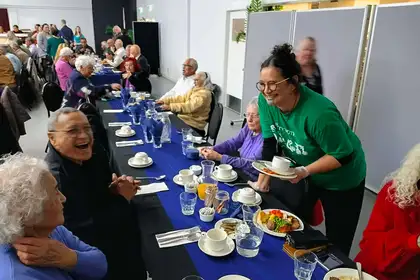
Professor Lisa Te Morenga (green shirt) at a Matariki Kaumatua luncheon held at Ngā Hau e Whā marae in Ōtautahi in July.
New research led by Te Kunenga ki Pūrehuroa Massey University researcher Dr Nikki Renall has found that Māori relationships with kai extend far beyond nutrition, with kai carrying cultural, relational and historical significance that challenges the predominantly Western view of food as simply fuel for the body.
The research explored Māori experiences and understandings of kai across the life course, revealing that while Māori foodways have changed significantly over time, the values underpinning them have endured.
Research participants described how colonisation, land loss, urbanisation and environmental change reshaped access to traditional food sources and altered the way many whānau engaged with food. Despite these changes, values such as respecting kai, avoiding waste, sharing with others and caring for people and place have remained central across generations.
"Our research confirms that kai Māori is much more than nutrition," Dr Renall says.
"Through kai, people connect with their culture, their whānau, their whenua and their wellbeing. Food carries cultural, relational and historical meaning that simply can't be reduced to nutrients.”
Dr Renall says these findings reinforce what many Māori have long understood: that food is a vehicle for expressing identity and values such as manaakitanga, reciprocity and collective care.
"When we gather to share kai, we're not just eating. We're strengthening relationships, showing care for one another, passing knowledge between generations and maintaining connections to our communities and environments. Those are all important contributors to wellbeing, yet they're often overlooked in conventional nutrition practice.”
With a background in clinical dietetics, Dr Renall says the study also highlights a significant disconnect between how nutrition is traditionally taught and practised and the way people actually experience food.
"Nutrition education has largely been built around nutrients, deficiencies and disease. Those things are important, but they're only part of the picture. People don't experience food as carbohydrates, protein or vitamins. Food is about memories, relationships, identity and belonging.
"We know that certain meals remind us of family members or special occasions, or that sharing food is how we care for people. Yet those realities are rarely reflected in the way nutrition care is delivered.”
Dr Renall says this narrow focus can have unintended consequences, particularly when people are advised to avoid foods that hold deep cultural or emotional significance.
"If someone is told they can no longer eat a food that's central to family gatherings or cultural occasions, or that holds childhood memory, it affects much more than their diet. It can affect their ability to participate in important social and cultural experiences. Those relationships matter just as much as the nutrients on the plate.”
Kaumātua (elders) described how the food practices they experienced growing up, the places they lived and the ways their whānau gathered, prepared and shared food helped shape their lifelong attitudes towards eating. Those experiences continue to influence the values and practices they pass on to future generations.
Importantly, the findings challenge assumptions about what Māori eat or how they relate to food.
"People's relationships with kai are shaped by where they grew up, their whānau, their communities and their own life experiences. Assuming everyone shares the same relationship with food overlooks the individual sitting in front of you,” Dr Renall says.
She believes recognising the broader significance of kai could help health professionals build stronger relationships with patients and deliver more meaningful, culturally responsive care.
"When healthcare focuses only on telling people what they should or shouldn't eat, it can unintentionally ignore the cultural and social importance of food. People can come away feeling that their experiences haven't been understood, and that makes it much harder to engage with care.”
Dr Renall hopes the findings will encourage nutrition and health professionals to adopt a more holistic, person-centred approach that considers people's relationships with food alongside their nutritional needs.
"If we understand what food means to someone, we're much better placed to support them in making changes that are realistic, respectful and sustainable.”
The publication forms part of a broader programme of research led by Dr Renall and Professor Lisa Te Morenga examining Māori foodways and wellbeing, Indigenous food sovereignty and patients’ experiences while waiting for dietetic care. Together, the projects aim to build an evidence base that can help reshape nutrition education, influence healthcare practice and create systems that better reflect the diverse ways people experience food.
"My goal is to help change the way nutrition is taught and practised in Aotearoa," Dr Renall says.
"Food is never just nutrients. When we understand the relationships people have with kai, we can provide care that truly meets people where they are.”
Related news
New research warns school lunch debate risks losing sight of children's wellbeing
New research from Te Kunenga ki Pūrehuroa Massey University that analyses media coverage of the Ka Ora, Ka Ako Healthy School Lunches Programme has found competing narratives around the initiative, with debate increasingly centred on cost rather than child wellbeing and equity.
HRC funds study of mātauranga Māori (traditional knowledge) of nutrition-related wellbeing
Dr Nikki Renall, Taranaki, has been awarded a Māori Health Research Postdoctoral Fellowship grant from the Health Research Council of New Zealand.

PhD graduates tackle New Zealand’s obesity epidemic
Diet is one of the key drivers of the global obesity epidemic. Doctoral graduates Nikki Renall and Sophie Kindleysides both chose to research different aspects of this issue for their PhD studies.