El Niño has everyone talking about drought, and while the likely impacts will vary by region, many of us are asking the same question: what can farmers do now to put themselves in the strongest position for the months ahead?
My view is that we should focus on preparing our farming systems to deal with multiple eventualities.
Here in the Manawatū, Te Kunenga ki Pūrehuroa Massey University’s Whenua Haumanu programme is already seeing signs that this season is developing differently, and some of our observations may offer useful lessons for other pasture-based farming systems around the country.
An early start to the season
We’ve come out of a relatively dry winter, which has brought some obvious advantages. Calving and lambing conditions have generally been favourable, and pasture growth has responded well to warming temperatures.
On the Whenua Haumanu farmlets, pasture supply has matched herd and flock demand almost a month earlier than normal, suggesting that the season is running ahead of schedule.
At the same time, we’ve had several significant frosts in succession, something we haven’t seen regularly for many years. That will encourage more grass tillers (shoots) to go reproductive, potentially leading to a larger spring peak than we’ve become used to.
Taken together, these factors suggest pasture growth may peak earlier than normal, creating the potential for a shorter, sharper spring if summer conditions turn dry.
That possibility should influence management decisions now.
Don’t waste pasture
The first priority is making the most of the feed that’s available.
Maintaining grazing residuals close to target remains one of the most important disciplines during periods of strong growth. In many areas, soils have been dry enough to allow better grazing management than what we would normally expect at this time of year, although flexibility will always be needed when rain arrives.
When surplus feed develops, grazing to residual targets naturally lengthens the rotation and generates even more pasture. That’s why I’d be inclined to remove excess feed early where conditions allow.
If seasonal forecasts prove correct, carrying high-quality conserved feed into summer could become valuable insurance.
Nitrogen and silage timing deserve a close look
In many years, September nitrogen applications make little sense for cooler regions of the country. Soil is usually wet and conditions are rainy, so the risk of nitrogen being lost through leaching is high, utilisation by grazing animals is low, and surplus pasture can’t be made into silage. Farmers can quickly create more feed than they can effectively utilise.
This season may be different in many parts of the country, with favourable soil and weather conditions likely to deliver a strong response to carefully targeted nitrogen applications. Used strategically, they can help build covers on paddocks destined for silage or stimulate regrowth after silage has been harvested.
Silage timing may also be more important than usual.
One scenario that would make me nervous is leaving silage-making until the traditional October-November window simply because that’s what usually happens. If large areas of the farm are cut and then dry conditions arrive soon afterwards, those paddocks will struggle to return to the grazing rotation and the farm will see-saw quickly from surplus into deficit of feed.
As a rule of thumb, I like to see silage harvested from paddocks that are no more than 10 days beyond the normal spring rotation. Beyond that point, silage quality declines and regrowth slows.
Earlier silage harvesting offers a double benefit: better-quality feed and paddocks returning to production sooner.
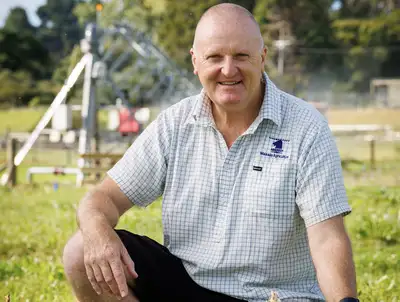
Professor Danny Donaghy.
Get ahead where you can
If you’re planning pasture renewal, now is the time to act. We’re currently broadcasting seeds into pastures, because it’s currently too wet on our farms to use a drill, and by the time that soil conditions improve, they may continue drying and the establishment window will close.
The same principle applies to summer crops - ideally, these should be well established before moisture becomes limiting.
Where budgets and conditions allow, it is also worth applying capital fertiliser sooner rather than waiting until later in the season.
These aren’t panic measures. They’re simply about setting the farm up for success if conditions tighten.
Preparation starts before drought
One lesson I’ve seen repeatedly, both in New Zealand and overseas, is that drought resilience of pastures is determined before the drought begins.
When dry conditions arrive, most farmers instinctively move to longer rotations and supplementary feeding, protecting residuals and giving stressed plants more time to recover.
The problem is that pasture performance during a dry period is heavily influenced by how those plants entered the season.
Pastures that have experienced fast spring rotations, poor residual control or prolonged shading from late silage crops will enter summer with lower energy reserves and smaller root systems. Those plants are inherently less resilient when moisture becomes limiting.
In other words, the management decisions we make today will influence how our pastures perform months from now.
The early bird gets the worm
The most resilient farmers during climate shocks are rarely those who make dramatic changes once conditions deteriorate.
More often, they’re the ones who prepared early.
They’ve updated feed budgets, checked supplements, reviewed fertiliser plans, assessed stock numbers and thought through contingency options before decisions become urgent.
If El Niño ultimately has less impact than expected in your region, those actions still represent ideal farm management.
But if conditions do tighten, preparation completed now could prove invaluable later.
At this stage, “be alert, not alarmed” remains a good mantra. Forecasts still carry uncertainty, and regional outcomes will vary. Rather than reacting to the headlines, the goal should be to put our farming systems in the strongest possible position for whatever the season delivers.
Danny Donaghy is a Professor of Dairy Production Systems at Massey University and the lead of the Whenua Haumanu programme, Aotearoa New Zealand’s most comprehensive programme examining the impacts of both contemporary and regenerative pastoral farming practices. His research focuses on working with the dairy industry to implement research findings on farms.
Related news
Is New Zealand’s grazing system still fit for a warming climate?
The science underpinning Aotearoa New Zealand’s dairy, beef and sheep grazing systems was largely established from the 1950s onward, but new analysis shows that the climate those systems were built for has shifted significantly.
Opinion: How to breed ewe hoggets successfully in today’s high lamb price environment
By Professor Paul Kenyon
Launch of practical guide to create resilient pastures in a changing climate
A new publication has been launched that offers a comprehensive and up-to-date resource on commercially available grazing pasture species in Aotearoa New Zealand.