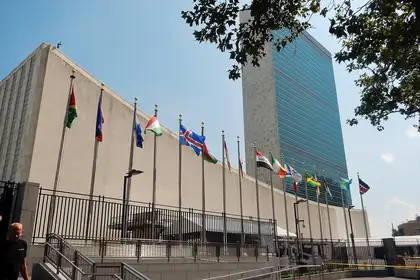
The United Nations Secretary General is based at the Secretariat Building at the UN Headquarters in New York. Photo from Qwesy qwesy, CC BY 3.0 <https://creativecommons.org/licenses/by/3.0>, via Wikimedia Commons.
Most New Zealanders are unlikely to pay much attention to the world’s most powerful diplomats as they determine the next Secretary-General of the United Nations (UN).
Yet they should. Few international appointments matter more to small countries whose foreign policy is best served by fostering the rule of international law that levels the playing field while shaping the roles of intergovernmental organisations that amplify the voices of smaller states.
Security is produced these days within a transnational field comprising statesmen and stateswomen, militaries and intelligence professionals, as well as international civil servants and lawyers, humanitarians, civil society activists and entrepreneurs. They struggle against one another to define what constitutes a security threat, whose security deserves protection and which responses are considered legitimate.
The Secretary-General occupies a unique position near the centre of this hotly contested landscape, mediating between them while exercising the symbolic authority to speak on behalf of the so-called international community.
Since the UN Secretary-General commands no military, controls no intelligence service, and possesses few formal powers over sovereign states, they are often portrayed as the world's chief diplomat who is more secretary than general. However, the Secretary-General performs a significant agenda-setting function by bringing to the attention of the Security Council any matter they think constitutes a threat to international peace and security.
The Secretary-General also mobilises public attention. Whether describing climate change as a security challenge, calling for humanitarian access in Gaza and Sudan, warning about the risks posed by artificial intelligence or advocating for accountability following atrocities, the Secretary-General comments on world events in a way that shapes the language through which governments understand them. In contemporary world affairs, framing the problem often dictates the range of solutions that become politically possible and then permissible.
The next Secretary-General will take office in 2027 at a moment when value of international institutions will be under greater pressure than at any time since the Cold War’s end.
Donald Trump’s return to the White House accelerated a shift away from the rule of law towards the rule of tooth and claw. During both Trump administrations, Washington D.C. argued that intergovernmental organisations should not constrain the sovereign decisions of democratic states. Its current hostility towards the International Criminal Court, including sanctions against Court officials, rejection of its jurisdiction over United States personnel and allies, and criticism of investigations involving Israel, demonstrates a concerted effort to subordinate international authority to national sovereignty.
By questioning the legitimacy of international institutions, this so-called great power weakens the broader architecture of cooperation that the UN depends upon. For countries with significant military and economic leverage, this may be an acceptable trade-off. For countries like New Zealand, this is simply a high-stakes gamble and, over the long term, a losing international political strategy.
As confidence in international institutions declines, the Secretary-General becomes one of the principal custodians of the norms that underpin them. Those norms cannot be defended by military force alone because they depend upon political leadership, institutional legitimacy and the willingness of states to recognise that some interests are more transnational than national.
The Secretary-General cannot reverse geopolitical rivalry, end wars or compel powerful states to obey international law. But the office can influence whether the UN remains a credible forum for diplomacy or becomes increasingly marginalised in a world dominated by transactional great-power politics.
That distinction matters profoundly for countries whose influence depends less on coercion and more on negotiation and reconciliation. This is why New Zealanders should care deeply about the selection of António Guterres' successor.
New Zealand has an opportunity to contribute constructively to the selection process. Rightly or wrongly, Wellington has earned something of a reputation as a principled supporter of multilateralism. It should use that credibility to support a transparent appointment process and to champion a candidate committed not simply to administrative competence but to defending the principles of international law, political independence and collective security.
The next Secretary-General will require exceptional diplomatic skill, but also the political courage to defend the legitimacy of international institutions when they are increasingly questioned by some of the world's most powerful governments.
The debate over who succeeds Guterres is a contest over the future direction of world affairs. If New Zealand diplomats actually believe that New Zealand’s security and prosperity depend upon international rules rather than the preferences of great powers, then they cannot afford to treat the next Secretary-General as someone else's concern.
For a small country whose security is best advanced when law prevails over military power, choosing the next Secretary-General is one of the most important international political decisions of the coming year.
Dr Damien Rogers is an Associate Professor of International Relations and Security Studies atTe Kunenga ki Pūrehuroa Massey University in Auckland.
Related news
Opinion: Are Royal Commissions of Inquiry fit for purpose?
By Associate Professor Damien Rogers
How are security agencies keeping us safe?
How concerned should we be about threats to our security - from terrorists to cyber hacking? What are the boundaries for our intelligence agencies when it comes to protecting the safety of citizens while respecting personal privacy?