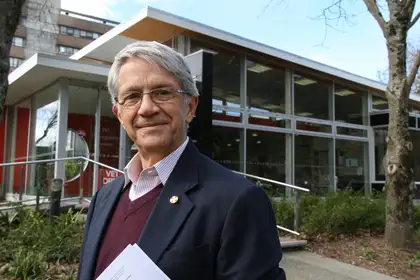
Presented by the Animal Welfare Chapter of the Australian and New Zealand College of Veterinary Scientists, the award acknowledges Professor Mellor’s pioneering contributions, most notably his development of the Five Domains Model which has transformed how animal welfare is assessed and managed worldwide.
A global welfare framework
Beginning his academic journey at the University of New England, Professor Mellor studied rural science before transitioning to physiology, driven by a desire to understand how body systems connect and function as a whole.
His Doctor of Philosophy research at the University of Edinburgh was focused on animal fetal physiology, deepening his understanding of the complex interactions between mother and fetus. This ‘big picture’ approach continued during his time at the Moredun Research Institute in Scotland, where long-term studies on pregnant sheep laid the groundwork for what would become the Five Domains Model.
It was shortly after joining Te Kunenga ki Pūrehuroa Massey University in 1988 that Professor Mellor experienced a pivotal moment in his research. During a university-wide bioethics discussion group, he presented cautious arguments against anthropomorphism (the attribution of human characteristics to animals or objects), views shaped during his time in Edinburgh, only to be challenged by a Massey philosophy professor who asked: “Do you doubt that animals can and do feel pain?”
“I said no, I don’t. In fact, I’m convinced they do,” Professor Mellor recalls.
“And that was the major lightbulb moment. I realised I did not need to start with doubt, when the evidence supported the positive conclusion. So, I adopted an assertive precautionary principle, that if in doubt, finds in favour of the animal.”
First published in 1994 and updated over the past 30 years, the Five Domains Model evaluates animal welfare across four functional domains – nutrition, environment, health and behaviour, which together inform the animal’s mental state, encompassing feelings such as pain, fear, contentment or pleasure.
By considering mental state as a central domain, the model acknowledges that animals, like humans, experience emotional and psychological states that impact their overall welfare. Professor Mellor’s work has helped shift what was once a physical-only view of animal care toward a holistic, integrative understanding of animal welfare.
The model has replaced the older ‘Five Freedoms’ approach, becoming the preferred framework among many governments, welfare organisations and veterinary educators around the world. The 2020 version of the model has been downloaded more than 125,000 times, highlighting the growing consensus that sentience, the capacity of animals to have positive and negative experiences, is a foundational principle in veterinary science, welfare science and ethics, and legislation.
A career guided by the ‘Big Picture’
At the heart of Professor Mellor’s impact is what he calls his ‘big picture’ way of thinking, seeing beyond individual parts to understand the broader system. This perspective enabled him to integrate biology, behaviour, environment and ethics into a unified framework for assessing welfare.
“I’ve always been driven to explore how systems work together, whether that’s within the body, or across ethical, scientific and practical dimensions of animal welfare,” he says.
Professor Mellor faced severe learning challenges and adversity during his childhood and was eventually diagnosed with dyslexia later in life. With support from his parents, a dedicated tutor and hands-on farm experience, he overcame those difficulties and embarked on an academic path marked by original thinking and achievement.
“I consider dyslexia a hidden gift. It wired my brain in a way that naturally seeks connections and broader meaning. With support, I was able to turn that into a strength. I credit most of my professional success to the gifts that dyslexia gave me.”
A legacy of influence
Having been instrumental in shaping animal welfare thinking both in New Zealand and internationally, Professor Mellor remains humble about his role.
“No one individual owns the model, it belongs to everyone who uses it to improve animal lives. I see myself merely as one player in a truly vast orchestra of exceptionally talented instrumentalists, both at home and overseas”
His work spans farm animals, horses, companion animals and animals used in science. He has authored and co-authored dozens of influential reviews and policy-shaping papers, covering topics such as tail docking in puppies, mouth pain in horses and extending animal welfare assessments to include quality of life. Over his career, he has published more than 570 scholarly works.
An online course on applying the Five Domains to the welfare of sport and recreational horses, developed by Cristina Wilkins, has had participants from 18 countries, and continues to expand.
Professor Mellor emphasises the importance of collaboration in advancing animal welfare science, and credits many colleagues, mentors and students for their contributions to the evolution of ideas.
“I owe my colleagues and students a huge debt of gratitude for the diverse ways they, knowingly or unknowingly, fully participated in what for me has remained a journey of delight-with-discovery and wonder at the mystery which is life.”
Professor Mellor retired from Massey in 2018 but remains active in the university community as Professor Emeritus and Foundation Director of the Animal Welfare Science and Bioethics Centre, which he established in 1998 and led for 30 years. The Centre remains internationally recognised for research excellence and continues Professor Mellor’s work, with a collaborative approach to animal welfare as part of the School of Veterinary Science - Tāwharau Ora.
Related news
Sciences researchers secure funding to advance animal care through new technology
Two projects led by researchers from the College of Sciences have received funding from the Ministry of Business, Innovation and Employment Endeavour Fund.
Animal health takes a team: celebrating the diverse roles in the veterinary field
World Vet Day 2025 celebrates the many essential roles professionals play in the veterinary and animal health field. We caught up with a few of our experts from Tāwharau Ora School of Veterinary Science to learn more about their contributions to animal health, welfare and public safety.
Large Animal Teaching Unit celebrates 30 years of shaping veterinary education
The Large Animal Teaching Unit (LATU) marks a milestone this year, celebrating three decades of enriching veterinary education by enhancing students’ practical skills and deepening their knowledge of animal welfare.