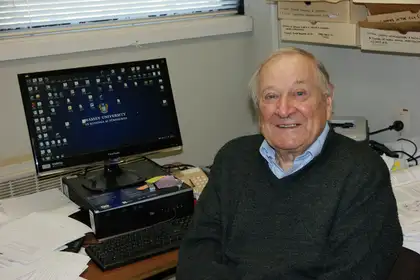
Robert (Bob) Dudley Jolly, BVSc, PhD, DSc, FRSNZ, FANZCVS (Hon), FRCPA (Hon), MNZM. Professor Emeritus, School of Veterinary Science, Massey University, Honorary Life Member NZVA.
Growing up in rural Hamilton, Professor Jolly developed an early interest in veterinary science. He began his formal training at the University of Sydney, graduating with a Bachelor of Veterinary Science in 1955. After five years in veterinary practice in Rotorua, he returned to Sydney to complete his doctoral studies before teaching at the Ontario Veterinary College from 1963 to 1965, then joined Massey University as a Senior Lecturer.
His appointment to the inaugural staff of Massey’s veterinary faculty in 1965 came at a time when veterinary science was still establishing itself in Aotearoa New Zealand. Specialising in veterinary pathology, Professor Jolly brought a strong interest in the fundamental mechanisms of disease. Over the following 30 years, he helped establish Massey as a centre of excellence in veterinary pathology while mentoring generations of students and researchers.
Professor Jolly became an internationally recognised expert in his field, focusing on inherited metabolic and neurodegenerative diseases in animals – complex conditions caused by genetic defects that disrupt cell function. While his research was grounded in animal health, its significance extended far beyond. By studying naturally occurring diseases in sheep, dogs and other species, he demonstrated how animal models could provide critical insights into equivalent conditions in humans.
One of his most influential contributions was the identification of sheep affected by ovine ceroid lipofuscinosis, a form of Batten disease. Once thought to be a metabolic lipid storage disorder, Professor Jolly’s then-controversial hypothesis that the storage material was composed of hydrophobic proteins which disrupted normal cell function, was proven correct. This transformed understanding of the disease, recognising it as aneurological condition that leads to progressive loss of vision, movement and cognitive function. The sheep model Professor Jolly established became a vital platform for international research, enabling scientists to test new treatments. Decades later, that work contributed to breakthroughs in gene therapy, with techniques developed in sheep informing treatments now used in human patients.
Over his career, Professor Jolly published extensively, authoring 188 scientific articles and book chapters which received over 5,800 citations, reflecting his influence on the global research community. Of these publications, 57 were published after his retirement, the last of which being in October 2025, when he was aged 95.
During his career, Professor Jolly had the opportunity to be guided by or collaborate with three Nobel laureates who had a pivotal influence on his work. He also secured long-term international funding from the United States National Institutes of Health to support his work investigating diseases affecting livestock and their implications for New Zealand’s animal industries. Across his long tenure at Massey, he mentored generations of veterinary pathologists and researchers and contributed to the development of the pathology curriculum in the veterinary programme.
Professor Jolly was elected a Fellow of the Royal Society of New Zealand in 1985, and was also an honorary fellow of the Australian and New Zealand College of Veterinary Scientists and of the Royal College of Pathologists of Australasia. In 1995, he was awarded the Hector Medal, one of New Zealand’s highest scientific honours, and in 2005 he was appointed a Member of the New Zealand Order of Merit in recognition of more than 40 years of service to veterinary science. He also received the Massey Medal during the Vet School’s 50th anniversary in 2013.
While he retired from full-time duties in 1995, Professor Jolly remained closely connected to Massey as Professor Emeritus and an active research contributor well into his later years. His career spanned almost 70 years, including three decades at Massey before his retirement and a further 30 years as Professor Emeritus. He is remembered by those who knew him as someone who valued rigorous thinking, encouraged collaboration and inspired those he taught and mentored to pursue meaningful questions.
Head of Tāwharau Ora School of Veterinary Science Veterinary School Professor Jon Huxley says Professor Jolly leaves an enduring legacy at Massey and across the veterinary profession.
“Bob was undoubtedly a legend, and someone who will be sorely missed. He had a long and very distinguished association with our School, and shaped how we understand disease in both animals and people for more than half a century. His contributions to advancing the veterinary profession and health research more broadly are inspiring, and his legacy will continue through those he mentored and the ongoing impact of the research he helped set in motion. Our thoughts are with his family.”
Professor Jolly leaves behind a legacy spanning veterinary, medical and biochemical science across continents and generations. He was a scientist of the highest order, a mentor of rare generosity and a man who never stopped being curious.
Related news
Pathology: Shaping future vets into guardians of food and health
Inside the leading veterinary school in Australasia, Tāwharau Ora School of Veterinary Science has a pathology suite purpose-built with a clear vision: to support advanced veterinary teaching and deliver high-level capability in animal health investigation and response.
Massey University unveils new $70m veterinary research facility
The final new build in a ten plus year project to upgrade the veterinary facilities at Te Kunenga ki Pūrehuroa Massey University was officially opened this morning by Minister for Universities, Honourable Dr Shane Reti.
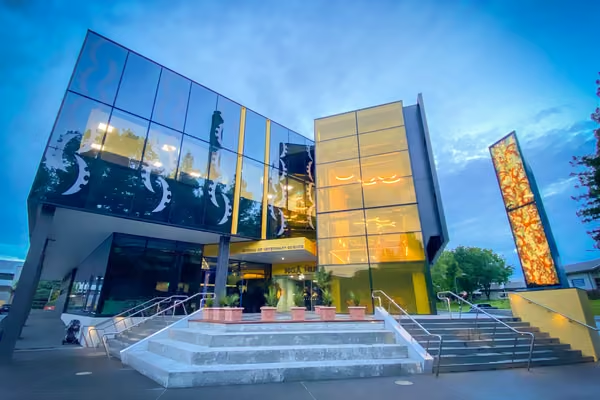
Celebrating six decades of nurturing veterinary talent
As the institution for veterinary education in Aotearoa New Zealand, we are proud to celebrate World Veterinary Day by shining a spotlight on the enduring legacy of Tāwharau Ora School of Veterinary Science .