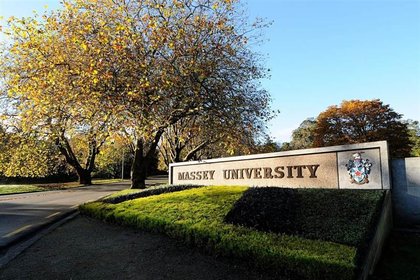
The Manawatū campus hosted the student group for a week.
In late September, Massey hosted 36 students and three teachers from Kumon Kokusai High School, Yokohama, Japan.
The group, who were in Palmerston North for a week, were studying ‘Diversity in People', with the aim of learning more about the differences in people.
As part of their visit, School of Psychology Lecturer Dr Sharon Crooks provided a two-hour introduction to neurodiversity, from the perspective of lived experience.
“I introduced the students and their teachers to how we are increasingly recognising diversity in neural functioning and becoming accepting of our neurodivergent students,” Dr Crooks says.
Through short videos made by neurodivergent people, the Japanese students gained a first-hand glimpse into what it might be like to have to dyslexia, Attention Deficit Hyperactivity Disorder (ADHD) and/or ASD (autism spectrum disorder). This helped to dispel some myths and broaden their knowledge of difference.
“I challenged some common misperceptions that neurodivergence is purely about disorder and deficit by considering the array of typical strengths that some neurodivergent people also experience.
“I also challenged some of the misconceptions around communication to highlight the joy many neurodivergent people experience when they are in the company of compatible people of a similar neurotype.
“This was something that came up in my research with Dr Kathryn McGuigan, along with the problems of miscommunication. There seems to be global communication differences that have real-world impacts for neurodivergent people.
“One recent study, for example, investigated a social problem common to neurodivergent people in the workplace. The researchers found that neurotypical people performed worse than neurodivergent people when asked to fathom the intentions of a neurodivergent character. This is called the double empathy problem," Dr Crooks explains.
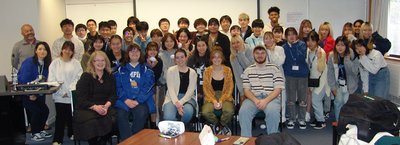
The visiting students with Dr Sharon Crooks (seated, front left) and student panellists.
After introducing diversity and challenging some commonly held beliefs, four neurodivergent Massey students who wanted to share their lived experiences joined the session. This brought to life many of the issues Dr Crooks had discussed in the first hour.
The panel members were all Massey students, including Oscar Humberstone-Simpson (ASD), Ania Wieliczko (ASD/ADHD), Sydney Jones (ADHD) and Jackie Lethbridge (dyslexia/ADHD). The participants were keen to share the diversity of their experiences spanning their earliest memories of difference, to general experiences of primary school, secondary school, tertiary aspirations and recent tertiary experiences.
The panellists were all in the first or second year of their degree. Some were 'twice exceptional', meaning alongside their neurodivergence they had recognised aptitude. Two of the panel had been informed that they were ‘gifted’.
The panellists had varying early experiences of education, ranging from ‘good’ to ‘hellish’. They shared how they encountered various people or support systems that worked for them along the way, as well as what it was like to feel like a 'square peg being hammered into a round hole'. This idiom resonated with the Japanese students, as they have a similar expression: ‘the nail that sticks out, gets hammered down’.
The panel highlighted how a one-size fits all education approach does not work well for neurodivergent students. Some told of the trauma they experienced and the painful scars they still carry. They also highlighted that there were supports and support people along the way who understood and left an impression upon them.
“Entirely unscripted, the panel demonstrated diversity in their own way, too. One panel member shared their significantly more positive primary and high school experiences,” Dr Crooks says.
“This suggests that we need to do away with stereotypes and focus instead on getting to know individuals, expecting diversity in the population and then meeting all students as much as possible where they are at. This means expecting neurodivergent people to have greater diversity of strengths and disabling challenges, with expression of both, dependent upon environmental conditions.”
More positively, all participants felt that university suited them more than formal education. They were trying new challenges, accessing support on their terms (or not), and wanted the opportunity to speak out and share their experiences so that education might change for the better in the future.
Ania commented that being a panel member was a first for her and that she wanted to speak out and have her story heard. The Japanese students appreciated the story Ania brought out into the open and the diversely different stories of all the participants.
“The discussion resonated with my doctoral thesis exploring the lived experiences of autistic high school students in mainstream Aotearoa New Zealand high schools. We have a long way to go, but hearing people’s lived experiences is a great first step towards understanding the depth of trauma some neurodivergent students bring to university and the subsequent needs they have, to ensure they experience inclusion once here," Dr Crooks says.
The group also visited the Manawatū Multicultural Centre and listened to refugees’ and migrants’ journeys/stories about how they came to New Zealand and what life is like for them now. They also paid a visit to Te Papa Tongarewa and looked at the many exhibitions that explained about tangata whenua, and stories of people who have migrated to New Zealand over the past 200 years.
ADHD awareness is for the entire month of October.
Related news
Study on the experiences of neurodivergent tertiary students
The study, led by School of Psychology Lecturers Dr Sharon Crooks and Dr Kathryn McGuigan, explored the experiences of 11 neurodivergent tertiary students.
Opinion: Initiatives to support neurodivergent students and staff
By Dr Kathryn McGuigan.
Supporting neurodiverse students
Academics in the College of Humanities and Social Sciences have been working to identify the challenges neurodiverse students may encounter, and ways to support them during their time at university.