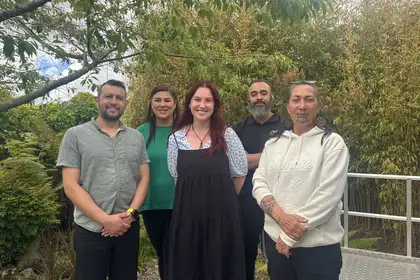
Maraea alongside the Highbury Whānau Centre Transitions Team. L to R: Juan Garzon Buitrago, Astryr Halligan, Maraea Alexander (centre), Daniel Tavita Fryer and Kat Maxwell.
She was 18 and had booked in with a counsellor, but when she arrived at the agreed time the receptionist said someone had forgotten her appointment and they would get in touch to reschedule.
“I never heard back. That moment stuck with me, I was a young person reaching out for help, and the door was literally and figuratively closed on me.”
Choosing a career in social work Maraea hopes to prevent other young people encountering similar challenges and barriers. Studying a Bachelor of Social Work at Te Kunenga ki Pūrehuroa Massey University is like a calling rooted in her own life experiences and values.
Despite her passion, she began her studies unsure of her abilities.
“I lacked confidence in my ability to complete the degree when I started, unsure whether I had what it took to succeed. As I started classes, I found that I was so passionate about what I was learning, that writing assignments became interesting rather than daunting.”
Finding connection through kaupapa
Maraea’s placement at Highbury Whānau Centre Palmerston North strengthened her love for working with rangatahi and the importance of kaupapa Māori spaces that connection.
“Being in a Kaupapa Māori organisation has allowed me to practice in a non-judgemental space where I can be myself. I am able to naturally integrate te ao Māori into my practice and work alongside kaimahi who share the same values and pride in being Māori. It has been empowering to be part of that environment, and I have learned so much from it.”
Maraea says she’s constantly learning from the rangatahi she works with.
“I feel extremely privileged to be walking alongside them in their journey to achieving their moemoeā. The challenges they face in a 2025 world have been eye-opening; their experiences are different from mine at that age, but there are still similarities.
At times, it can feel disheartening seeing young people trying to navigate systems that were not built for them. The current economic climate does not make it easier either; I have supported young people who literally cannot afford bare necessities to survive, things that should be guaranteed as human rights, not privileges.”
Every day on placement offered fresh learning and growth.
“It is a pivotal and sometimes turbulent time as they learn to become more independent, discover who they are and figure out what they want for their futures. I admire the openness many rangatahi have toward seeking support when they need it. When I was younger, conversations about mental health were not as common or accepted, and now there is a growing willingness to talk about these things, which is powerful and inspiring.”
Maraea says she has found that rangatahi are learning to show pride in who they are, which she tries to nurture in her practice by encouraging them to stand tall in their identity, recognise their achievements and believe in their ability to reach their goals and moemoeā [dreams].
“Sometimes all they need is someone in their corner, offering gentle encouragement and reminding them of the potential they already hold. I want to be the kind of social worker who is consistent, believes in them (even on the days they struggle to believe in themselves), and cheers them on from the sidelines.”
Mana-enhancing approach to care
Working in social services can be emotionally demanding, and for Maraea, maintaining balance is essential. Her approach is grounded in care, reflection, and clear boundaries – both for the betterment of rangatahi and herself.
“I try to approach everything from a holistic perspective. Reflection, open-ended questions, and critical thinking across all aspects of a young person’s life provide a clearer picture and allow for more meaningful, therapeutic work rather than just putting a band-aid on a situation.
A key part of my approach is meeting each young person where they’re at. Referrals come with information about a person’s past, but I try to begin each engagement with unconditional positive regard, no judgment, and space to listen to who they are right now. I want the people I work with to feel that I am not just another professional, but someone who genuinely cares and is walking alongside them, as they are the experts in their own lives.”
Her wellbeing practices are equally considered. Before each placement, she actively incorporates te ao Māori models such as Sir Mason Durie’s Te Whare Tapa Whā.
“Before each placement, I created a wellbeing plan using the Te Whare Tapa Whā model. Exercise, good sleep, mindfulness practices like spending time in the ngāhere [forest], and a strong support network keep my energy up and support my wellbeing. I lean on my whānau and friends for encouragement and perspective.”
Maraea says a key learning objective from her Bachelor of Social Work is supporting yourself first so you can better support others.
“I try to listen to my body. If I feel uneasy, I pause and check in with myself. Sometimes that means taking a break, stepping outside, having water and recentring myself.
I have felt the negative impact of booking appointments without breaks. Having space to reflect, shift focus, and be present for the next engagement is important to ensure you are giving people the best support possible.”
Call for diversity in the profession
Now preparing to enter the workforce, Maraea hopes the social work profession continues to evolve with stronger collaboration, greater diversity, and more support for community-based services.
Reflecting on the future of the field, she says:
“One of the biggest things is stronger collaboration between support services — teamwork really does make the dream work. There is rarely just one support person or service around someone; it takes a village. Through networking, I have often come across services I never knew existed, and being able to connect rangatahi to them has been so beneficial.”
She believes this kind of connection helps the sector step outside of ‘its own little bubble’ and better recognise what exists within the community.
“I also hope to see more diversity within the profession: social workers from different backgrounds, religions, ethnicities, genders, and sexualities. Every perspective adds something valuable and helps the field evolve to better reflect the world we live in today.”
Maraea also emphasises the importance of strengthening frontline, community-based work.
“Both of my placements have been in the community sector, and I have seen first-hand how stretched resources can be. Working at the ground level with rangatahi helps build real relationships, creating a foundation for meaningful change.”
Discover how you can make a difference
Related news
Whānau, hapū, iwi: Anchoring Social Work in collective responsibility
As Aotearoa New Zealand Social Workers' Day is celebrated across the motu, Te Kunenga ki Pūrehuroa Massey University’s School of Social Work is bringing the kaupapa to life with a seminar filled with powerful kōrero, international insights, and an unwavering focus on future generations
End of life social work inspired by hospice care
The amazing care offered to Stevie Muller’s dying mother and whānau by a hospice inspired her to complete the first placement of her Bachelor of Social Work at Hospice West Auckland.
First Doctor of Social Work graduate explores neurodevelopmental approach to childhood adversity
Dr Braden Clark used his doctoral research to offer social workers a new pathway for responding to early trauma, applying a neurodevelopmental lens to understand how adversity shapes young minds and how to provide more effective support.