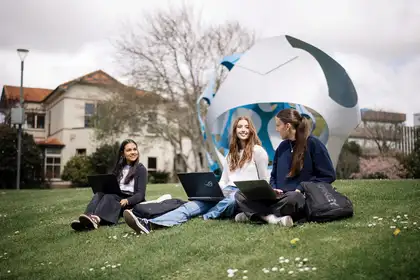
From its earliest days, the programme has combined theory and practice, equipping students with both the conceptual understanding and the real-world skills needed to succeed in a rapidly changing field.
Associate Professor Doug Ashwell believes the difference starts with the people.
“Staff are deeply invested in both the subject and their students. We engage with contemporary issues, we’re enthusiastic and we care about teaching relationship skills. We want to see our students grow and thrive so they can become leaders in the world.”
That focus is reflected in the way the Bachelor of Communication (BC) is taught. Students work on real-world briefs, create content for clients and develop practical skills across a range of formats, from written communication to video and digital media.
For example, students on the Pukeahu Wellington campus work alongside businesses such as The Good Registry, or long-term community partners The Compassion Soup Kitchen or Te Rākau theatre company, to develop communication plans and collateral.
Professor Elspeth Tilley says these relationships are long-lasting, creating tried and tested opportunities for students to get the hands-on experiences employers value.
“This year our BC students worked with people who are housing deprived on the podcast Chur From the Curb, which shares lived experiences of homelessness. It’s the result of a working relationship since 2016 with local community housing organisations and it means students can do real work that makes a genuine difference while they put their learning into action.”
Senior Lecturer Dr Elena Maydell says internships play a key role in preparing students for the industry.
“Our students are doing brilliant things in internships. They’re leading projects, building websites and learning how to take responsibility and delegate. That kind of experience is exactly what they need to step straight into great jobs.”
Massey’s communication programme has more than 300 internship-host relationships in Wellington alone, but students have also interned all over Aotearoa New Zealand and the world, receiving support from both an academic supervisor and a workplace supervisor in a unique ‘dual care’ model.
Professor Tilley points out that Massey’s track record of teaching communication for half a century means there are thousands of Massey communications graduates in the workforce who welcome new Massey graduates.
“Our alumni reach out to us with entry level positions they have available, or to request interns for a project. They love hiring grads who ‘speak the same comms language’ as them. With a Massey comms qualification, you don’t just get a degree, you join a family.
“I think that’s a big part of our very high employability rates. We are ranked number one in Aotearoa, based on both employer views and staff research quality. We’ve been excelling on both those markers consistently over time, which means our students get evidence-based, research-informed teaching, and then they get jobs at the end of it.”
External evaluation of high employability and quality curriculum have also led to another unique feature of Massey’s programme: it is the only BC in Australasia with Accrediting Council on Education in Journalism and Mass Communication accreditation, the global gold standard for communication education.
In the Master of Communication (MC), preparation for the workplace comes through flexible pathways in which students can either focus deeply on communication and media or broaden their studies to add a closely related discipline such as emergency management, Māori development, human resources or environmental sociology.
“Industry advisors have told us that senior comms professionals need to span different functions within organisations, so we developed the only truly transdisciplinary MC in the world, where students can come with a communication problem they want to research and study a suite of things that combine to offer practical solutions,” Professor Tilley explains.
Across both undergraduate and postgraduate programmes, the communication studies learning environment is another defining feature.
Senior Lecturer Dr Pansy Duncan highlights the value of smaller, high-support classes that allow for more personalised teaching.
“We can offer boutique, customised workshops and give students plenty of attention. Learning through doing has always been key at Massey, and we’ve become very good at delivering it.”
Massey’s strength in distance learning also sets it apart, allowing students to study from anywhere while still engaging in practical, hands-on work.
Senior Lecturer Dr Collin Bjork says this flexibility is particularly powerful in areas like podcasting.
“Students can create professional-level content from wherever they are. We use the medium itself as part of the teaching, which brings out the best in students who are already excellent communicators.”
Underlying all of this is a clear understanding of why communication matters. In a world shaped by digital platforms, global connections and constant information flow, the ability to communicate effectively has never been more important.
Massey’s Bachelor of Communication will position you at the forefront of a rapidly changing world, giving you the human skills in connecting, creating and thinking critically that organisations in every field are actively seeking. Find out more here.
Massey’s Master of Communication will deepen your understanding of communication as both a science and a set of real-world practices. Find out more here.
Related news
50 years of communication graduates making their mark
For five decades, Bachelor of Communication graduates from Te Kunenga ki Pūrehuroa Massey University have gone on to build careers across government, media, business, the creative industries and beyond.
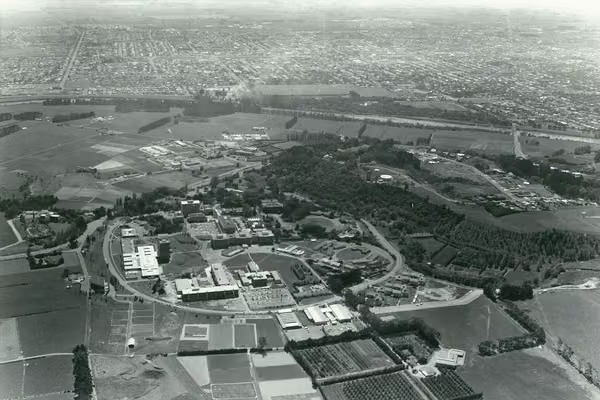
Five decades of communication at Massey
This year marks 50 years of teaching communication at Te Kunenga ki Pūrehuroa Massey University, a milestone that reflects not only the growth of a programme, but the transformation of an entire discipline.
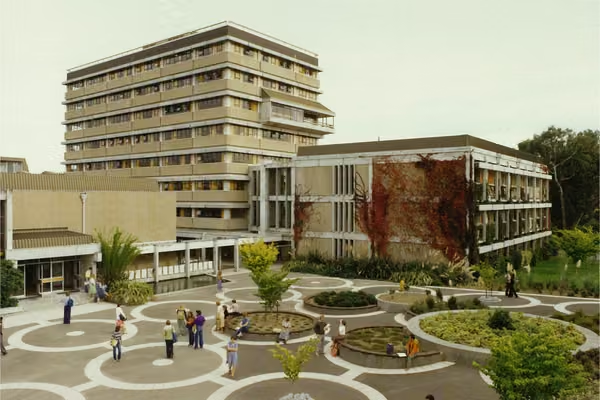
60 years of journalism: Then, now and what comes next
For journalism students at Te Kunenga ki Pūrehuroa Massey University today, a university ‘newsroom’ isn’t just a class with desks and computers. It’s a constant rhythm of deadlines across a range of platforms, including live social media updates, audio packages, video reports and web-first storytelling, often produced side by side.