On this page
- Increasing renewable energy use
- International collaborations
- Community collaboration for climate change solutions
- Massey professors honoured for Sustainability and Environment contributions
- Show Your Stripes campaign
- Climate Change Theatre Action
- Green theatre guide for Aotearoa
- Promoting sustainable commuting
- Climate action publications
- Love to Ride challenge
- Climate Action Week
- Climate Action major for Master of SDGs
- Art films illuminate climate change
- Citizen science and weather forecasting
- Fulbright awards fuel climate change research
- Lead expert on Tourism Panel on Climate Change
- Related content

Increasing renewable energy use
Massey University has numerous initiatives to increase its renewable energy usage:
- adopting heat pump technology to replace less efficient heat sources
- upgrading to more efficient lighting systems
- enhancing building management systems
- partnering with Solar Bay to host a large solar power system on campus.
In 2024, 59.9% of the university's energy consumption was from low-carbon sources – comprising 32.0 gigawatt-hours of a total energy consumption of 53.4 gigawatt-hours. Total energy includes natural gas and electricity used by our main campuses, our aviation school, several off-campus building spaces leased by the university, the Massey Research farms and some student accommodation.
Although the percentage of energy consumption from low-carbon sources decreased by 2.0 percentage points from 2023 to 2024, it remains 1.1 percentage points higher than in 2022.
- In 2022, low-carbon sources made up 57.9% of energy use.
- In 2023, this increased to 61.0% – or 33.2 GWh of a total 54.5 GWh consumed.
International collaborations
More than 6 out of every 10, 64%, of Massey University’s 307 SDG13 Climate Action publications between 2020 and 2024 resulted from international collaborations (Scopus database extracted using SciVal in October 2025).
The number of publications per year has shown an upward trend in recent years, with a significant emphasis on research on carbon removal technologies, climate governance and the effects of agriculture on climate change.
Community collaboration for climate change solutions
Climate change collaboration with iwi
Massey's Professor Glavovic is working with a group of trustees who are the mana whenua to a piece of land on the Waitara River in New Plymouth. The land faces flood risk, coastal erosion and intensified storms due to climate change. This work also involves local government through the New Plymouth District Council.
The university, Māori communities and local government are working to develop a climate adaptation plan. The goal is to prevent people from needing to leave their communities and to protect their urupā and rare taonga that are at risk, as well as people’s wellbeing and livelihoods.
Tangimoana and Pūtiki climate response plans
Massey worked with local and regional government through the Horizons, Manawatū and Whanganui District Councils to develop climate response plans for the Tangimoana and Pūtiki communities, where grave flood risks exist due to the impacts of climate change. This project, running from 2022 to 2024, was in collaboration with local Māori communities, including Rangitāne and other iwi and hapū. The action plans will inform the councils’ future decisions about priorities, approaches and funding. They will be made in consultation with affected communities.
Enhancing climate resilience after Cyclone Gabrielle
Massey is partnering with Environment Hubs Aotearoa, an NGO, to support communities affected by Cyclone Gabrielle, co-developing strategies to boost local climate resilience. The research project aims to create a roadmap to guide authorities in building better-prepared, climate-resilient communities that can respond and recover more effectively.
This work also involves several other NGOs: Zero Waste Network, Community Energy Network, Para Kore, Te Weu Tairāwhiti, Waiheke Resources Trust and Sustainable Hawke’s Bay.
Read more about our partnership with Environment Hubs Aotearoa
Community collaboration on the Coromandel
Massey researchers are collaborating with community groups on the Kuaotunu Peninsula in the Coromandel through Coastcare to understand how shifts in seasonal rhythms due to climate change are experienced by local people.
As part of this research, a Massey PhD student has helped plant hundreds of native coastal plants within the dunes around Kuaotunu’s beaches, working alongside Coastcare groups in exchange for participants sharing their local knowledge with her.
Read more about our work with local communities on the Coromandel
Whanganui flood strategy
Horizons Regional Council engaged Massey experts to develop a flood risk and resilience in a changing climate strategy. The focus is on Anzac Parade – the main road alongside the river in Whanganui.
Global climate change assessment
The university is also actively involved in Working Group II of the Intergovernmental Panel on Climate Change. This group is assessing the impacts of climate change, looking at ecosystems, biodiversity and human communities at global and regional levels. As part of this, Professor Bruce Glavovic was a key contributor to the Intergovernmental Panel on Climate Change’s Sixth Assessment Report on Impacts, Adaptation and Vulnerability, which was published in 2022.
Professor Bruce Glavovic is also the lead author for the Intergovernmental Science Policy Platform on Biodiversity and Ecosystem Services nexus report. This addresses the interconnected issues of biodiversity, water, climate, food and health as part of a project spanning from 2022 to 2024.
Massey professors honoured for Sustainability and Environment contributions
Several Massey University academics have recently been honoured for their outstanding contributions to sustainability, environmental research and climate change science.
- Professor Emeritus Ralph Sims was appointed a Companion of the New Zealand Order of Merit (CNZM) in 2023 for his lifelong service to sustainable energy research.
- Professor Huhana Smith (Ngāti Tukorehe, Te Mateawa, Ngāti Rangitāwhia, Ngāti Kapumanawawhiti ki Kuku) was named a Member of the New Zealand Order of Merit (MNZM) in 2023 for her significant services to the environment.
- In 2024, Professor Bruce Glavovic received an Honorary Doctorate in Visual Arts from the Institute for Doctoral Studies in the Visual Arts in the USA, recognising his work on climate change science. He also received the prestigious President’s International Fellowship from the Chinese Academy of Sciences, acknowledging his global leadership in climate change, natural hazards planning, coastal governance and collaborative planning.
Show Your Stripes campaign
Massey staff joined the global effort to raise awareness about the climate crisis with the Show Your Stripes Campaign, as part of the Green Impact Cup in 2024 and 2025. The campaign uses "warming stripe" graphics, which visually represent the change in temperature over the past century in different countries, regions or cities.
As part of the campaign, teams were challenged to creatively communicate the warming stripes for their local area, helping to highlight the urgent need for climate action.
Climate Change Theatre Action
Professor Elspeth Tilley's play, The Penguins, is part of Climate Change Theatre Action. It is a global movement that has been using theatre to spark constructive conversations about climate change since 2015. The play uses humour to educate viewers about the risks of climate change. It was performed in both Edinburgh and Wellington in 2025 as part of the 10th anniversary Climate Change Theatre Action celebrations.
Green theatre guide for Aotearoa
Professor Elspeth Tilley has published a practical and locally relevant green guide for theatre makers, drama teachers and performers in Aotearoa New Zealand. The guide provides educational resources and actionable steps to reduce the carbon footprint of theatre productions, providing practical steps to teach and promote sustainable, low-carbon performing arts practices across New Zealand.
Promoting sustainable commuting
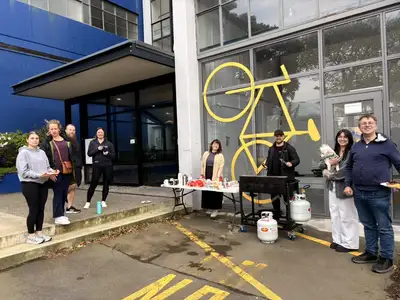
The Bike Space Buddies Pukeahu Green Impact team is working with Campus Co-Lab in 2025 to raise awareness of secure bike parking facilities on the Wellington campus. By encouraging the use of these facilities, the team is promoting healthy, low-carbon and pollution-free commuting options to the university.
Aligned with SDG 3: Good Health and Wellbeing, SDG 11: Sustainable Cities and Communities, and SDG 13: Climate Action, this ongoing initiative emphasises the role of sustainable transport in combating climate change.
As part of this project, the team hosts regular breakfast events in the bike space, providing opportunities for students and staff to connect, share ideas and collaborate on making the campus a more sustainable place.
Climate action publications
In 2023, several articles published by Massey academics in The Conversation focused on climate change.
Topics included strategic considerations for construction in the face of more extreme weather and suggestions for enhancing the effectiveness of the Intergovernmental Panel on Climate Change.
Love to Ride challenge
In February 2023, 75 Massey staff members completed almost 1,000 rides for Love to Ride’s 2023 Aotearoa Bike Challenge. Additionally, a new bike and scooter storage area for students and staff was opened on the Wellington campus. This was made possible with support from the Wellington City Council.
Climate Action Week
Climate Action Week
As part of Massey’s commitment to being net carbon zero by 2030, the university held an online Climate Action Week in 2022 to encourage Massey students to be active partners in the journey.
The activities comprised short videos, speakers, panel discussions, kōrero, creative ideas and competitions.
Climate Action major for Master of SDGs
Climate Action major for Master of SDGs
A new Climate Action specialisation has been developed for Massey’s Master of Sustainable Development Goals, with the first enrolments from 2023. In 2024, 14 students are majoring in Climate Action.
Find out more about our Master of Sustainable Development Goals
Art films illuminate climate change
Art films illuminate climate change
A collection of short art films addressing climate change and greenhouse gas reductions featured on the Whairepo Lagoon water screen in Wellington Harbour during Matariki, the Māori New Year.
Massey’s Toi Rauwhārangi College of Creative Arts and Wellington production company Storybox led the event.
Citizen science and weather forecasting
Citizen science and weather forecasting
Massey’s Joint Centre for Disaster Research examines how citizen science can contribute to weather forecasting. This work forms part of a 10-year research project with the World Meteorological Organization.
Fulbright awards fuel climate change research
Fulbright awards fuel climate change research
The university received the Fulbright New Zealand Scholarship Awards to investigate critical aspects of climate change. The research focuses on:
- sustainable development and resilience in coastal communities
- the impact of climate change on women’s reproductive decisions.
Lead expert on Tourism Panel on Climate Change
Lead expert on Tourism Panel on Climate Change
Dr Apisalome Movono was appointed Lead Expert on the Tourism Panel on Climate Change, launched at the United Nations Climate Change Conference.
This panel brings together more than 60 leading experts from over 30 countries and focuses on climate-resilient global tourism with the aim of achieving zero emissions by 2050.
Related content