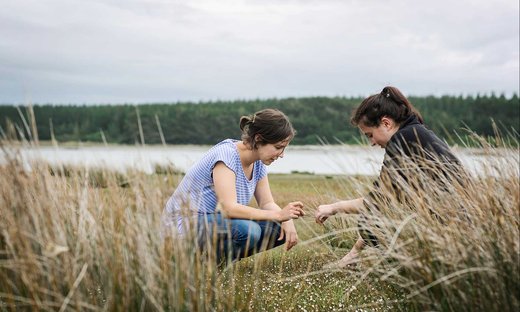
Professor in Creative Communication Elspeth Tilley has dedicated her research career to critical and creative activism. With a focus on ethics and social justice, she looks at the ways representation is depicted and challenged and creates texts, performances and community opportunities that spread awareness, inspire and change minds.
Tilley’s critical and literary research has a global impact, particularly in climate change theatre action and anti-colonial narrative telling, but she also hosts creative writing and literacy development workshops for the unhoused in Wellington.
Climate Change Theatre Action
When the international movement Climate Change Theatre Action (CCTA) started in 2015, Tilley joined to lead the Pacific representation. CCTA brings communities together through creative performance to encourage local and global climate action. Every 2 years, 50 invited professional playwrights representing all inhabited continents write short plays about climate change based on a prompt. CCTA distributes the plays freely and offers guidance and marketing support to those performing the plays in conjunction with educational, social or political/civic action events.
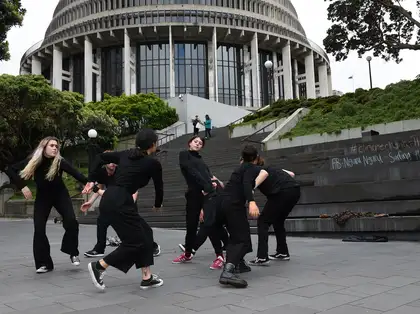
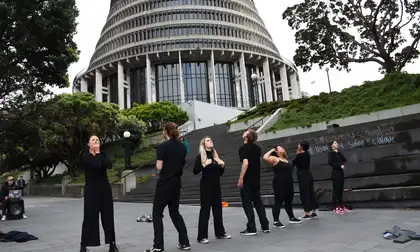
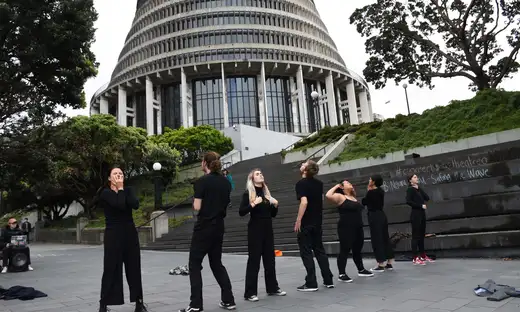
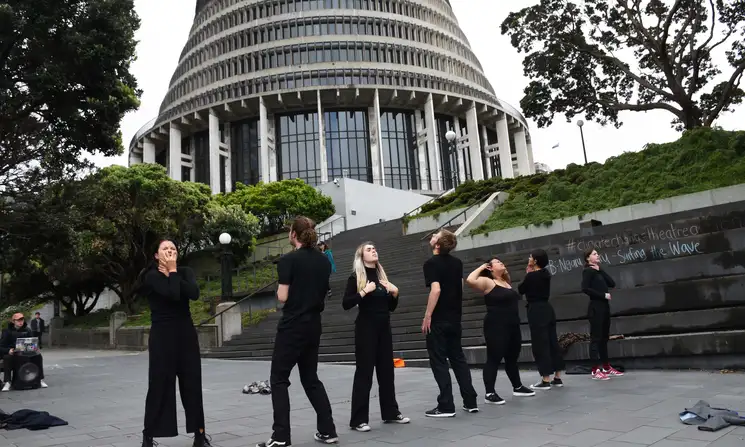
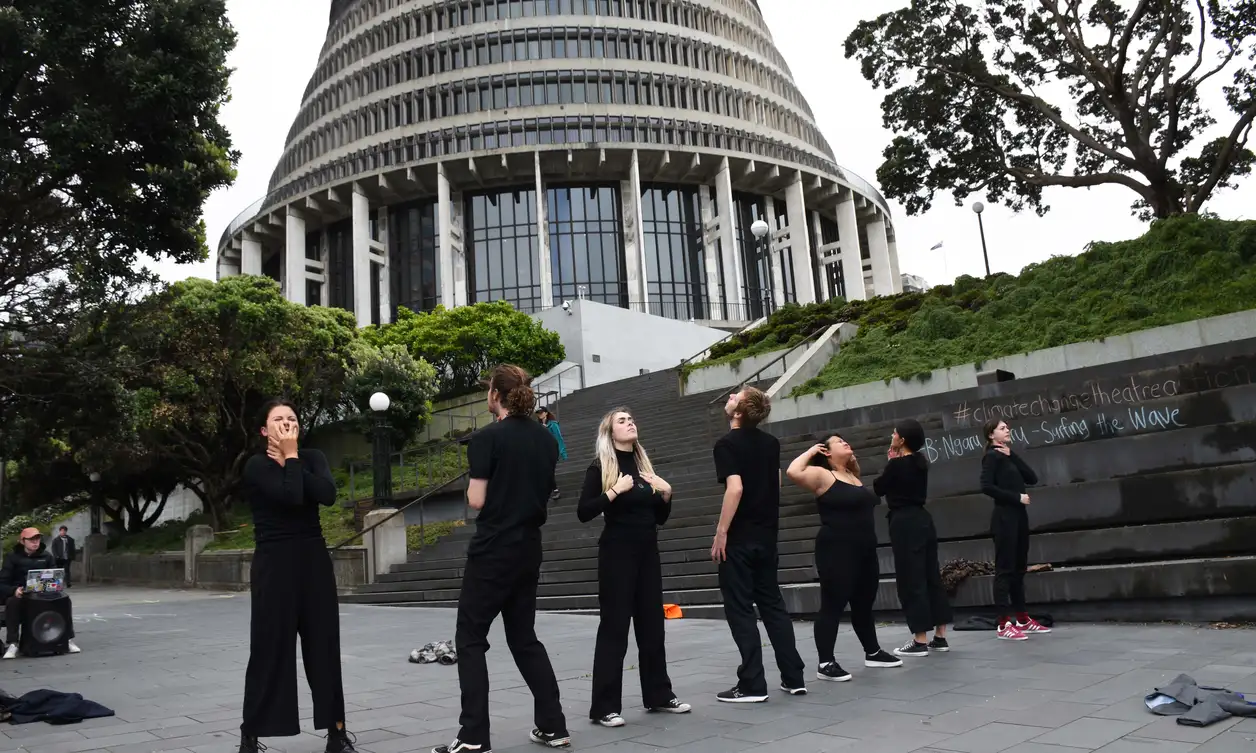
Tilley’s 2015 entry ‘Flotsam’ depicts a white mother and daughter who confront their privilege during an argument about climate change refugees in the Pacific. It had 12 international performances and was acknowledged in the New Zealand Parliament as a contribution to enhancing understanding of Pacific climate issues. Her 2017 entry ‘The Penguins’ was accompanied by numerous ‘human penguins’ walking the Wellington streets to raise awareness of the climate change threat to Antarctica’s penguins. ‘The Penguins’ was performed in 14 global locations and continues to be picked up globally as a short play choice. Her 2019 play, ‘Lin and Ash’ had 19 international performances, including translation into Italian by the Italian National Theatre for touring to 3 Italian cities.
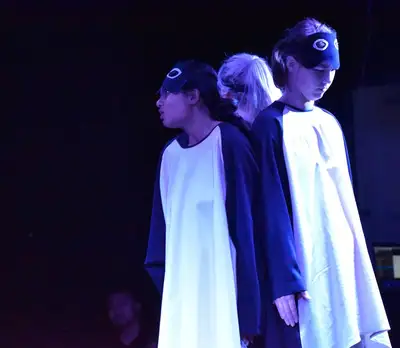
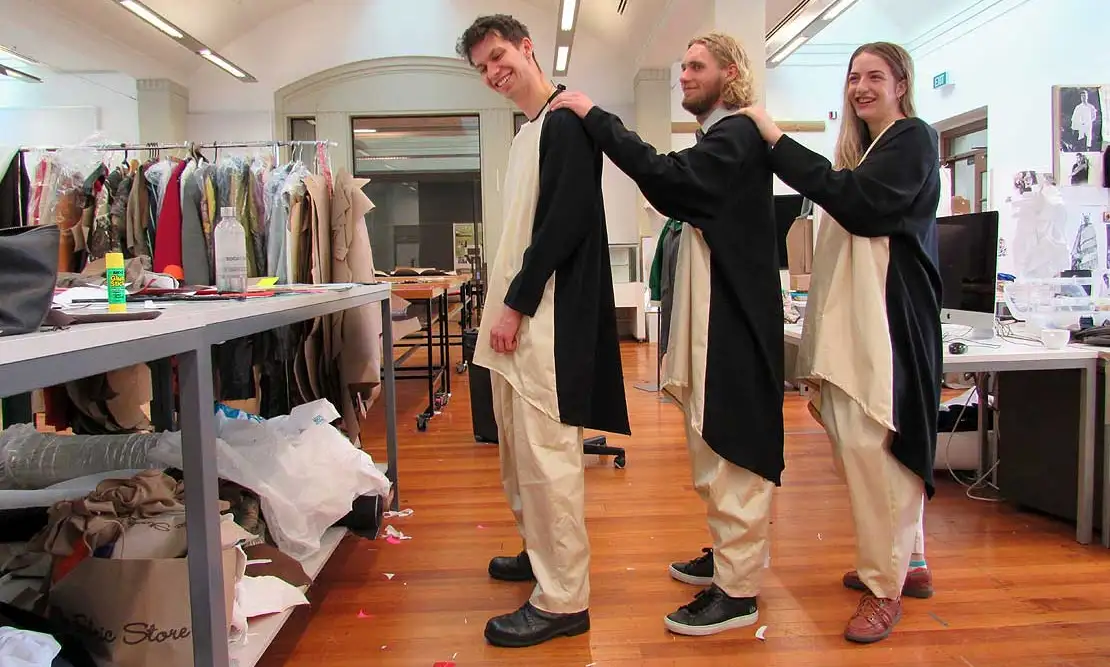
The Penguins starring Nalini Singh, Leah Tebbut and Kayleigh Besseling, CCTA Aotearoa 2017.
Heike Scherf, a teacher at the Gutenberg School in Wiesbaden, Germany, set her Drama Club students to perform 3 Tilley plays – The Smiths, Casting Call and I am not a cup of tea – in 2021. Performed in the schoolyard due to pandemic requirements, Scherf says each of the 3 evening performances was a success. The students grew confident and self-assured as this opportunity helped them recover from the pandemic. During a Casting Call rehearsal, the students had the idea to stage a real protest march and encourage the audience to advocate for women’s rights.
“Staging these plays made my students and me recognise the power of the arts. And staging them in cooperation with professional artists helped us recognise the humanity of others, taught us that disruption can help us bust ingrained habits.” —Heike Scherf
Tilley has also produced biennial local CCTA Aotearoa performances since 2015, involving Massey students alongside professional actors and co-directors. In 2019, she used the opportunity to test her ideas for a carbon-neutral theatre production template, which is now used globally, and the related ‘The Aotearoa Green Theatre Plan' was published this year (2024). The plan provides an accessible template and checklist for sustainable theatre production practices. It also incorporates mātauranga Māori environmental values and practices for an Aotearoa-specific lens. Murray Lynch, Director at Playmarket, the national not-for-profit service organisation for playwrights and theatre-makers, approached Tilley to write the plan to be published in their best practice guideline series because she has a strong reputation in green theatre. He reports that “the theatre community wants to be environmentally conscious, so the guidelines will be helpful.”
Playmarket: 07:The Aotearoa Green Theatre Plan
In 2021, Tilley’s ‘Creativity in the Community’ class produced the ‘8 Broke Students Present: Climate Change Theatre Action Aotearoa 2021’ podcast. The pandemic lockdown halted the 2021 CCTA events, so the students brought CCTA to the airwaves with 5 episodes of performances, one of which they wrote themselves – ‘Bridge the Gap.’
Podcast: 8 Broke Students Present: Climate Change Theatre Action Aotearoa 2021
Recently, Tilley was invited to bring her environmental and social justice creative expertise to Beijing, China, where she co-produced two CCTA plays with Peking University’s Professor Zhao Baisheng. She has also, in collaboration with Massey University’s Professor Leonel Alvarado, twice taken CCTA plays to Bogotá, Colombia, as part of international climate change theatre exchange programmes for Massey students that are funded by Education New Zealand’s Prime Minister’s Scholarships to Latin America scheme.
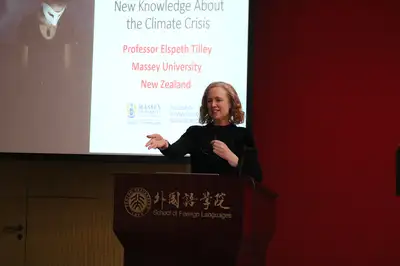
Tilley lecturing in Beijing China.
Beyond the CCTA movement, Tilley has written numerous short plays about climate and social justice that have received attention in other contexts. For example, she has 3 times won the British Theatre Challenge. An international playwriting competition that is open to plays on any topic, with plays about the environment, animal rights and public health rights.
No ‘doom and gloom’ here: Theatre puts hope into climate challenges
White Vanishing
Tilley's monograph 'White Vanishing: Rethinking Australia's Lost-in-the-Bush Myth' addresses the recurring trope in settler literature of white people vanishing in the Australian bush, a trope that foregrounds white suffering while overwriting Indigenous presence. One example Tilley analyses is Joan Lindsay's 1967 fictional novel 'Picnic at Hanging Rock,' and Peter Weir's popular 1975 film adaptation, about a group of schoolgirls, led by Miranda, who disappear at Hanging Rock following a picnic on Valentine's Day 1900. Hanging Rock is a distinct geological feature and a popular tourist destination outside Melbourne. It is also a culturally significant landscape for the Taungurung, Wurundjeri and Dja Dja Wurrung peoples of the Kulin Nation.
Lindsay's story is routinely celebrated in Australian culture. People hold picnics and call out for Miranda when visiting Hanging Rock. Many believe the story is based on fact. Artist and researcher Amy Spiers, guided by Tilley's critical rangahau, recognised a white vanishing fiction obscured real losses and traumas caused by colonisers' incursions on an important Kulin meeting place. Consequently, Amy launched '#MirandaMustGo' in 2017, a creative campaign that calls on non-Indigenous people to remember troubling colonial pasts and rethink stories told at Hanging Rock. Alongside a website, posters, t-shirts and video artwork, the campaign spread its message through a protest "anti-picnic" held on Valentine's Day in 2017. Tilley wrote the play 'How It Goes' for the event, a decolonial tongue-in-cheek parody, which anti-picnic attendees read aloud. After attracting significant national and international media attention, the #MirandaMustGo campaign continues to help prompt reconsideration of the narratives surrounding Hanging Rock. Recently, the Hanging Rock Precinct Master Plan (2023) acknowledged that recognition of First Peoples' enduring connection to Hanging Rock is long overdue, and the State Government committed to jointly managing the site with them.
How White Australia and Picnic At Hanging Rock have tarnished the legacy of a sacred Aboriginal site
“While literary theory might seem at first disconnected from contemporary social issues, in this case it was applied on the ground to make a profound impact on how the settler public perceived and honoured Hanging Rock.”—Amy Spiers
'White Vanishing' influenced the writing process for Lia Hills' 2024 'The Desert Knows Her Name.' Drawing on Tilley's formulation, Hills calls the novel a "reverse lost-in-the-bush" story about an unknown girl who walks out of a Wimmera desert and finds refuge with a woman working to regenerate her family's farm, the girl's presence creating tensions in the local community that has failed to deal with its colonial past and present. Tilley's book deepened Hills' commitment to thinking more rigorously about "contemporary white presence and desire for belonging" and encouraged her to examine in new ways her role and responsibilities as a settler-colonial writer. Based on 'White Vanishing's' concluding template on how to write from that viewpoint, Hills wrote a checklist of key 'colonial traps' to avoid that served as a guide while she composed the novel. In conjunction with continual Indigenous consultation, she drew on Tilley's ideas to check what she was doing in her writing. Hills explains, "I see a kind of companionship in 'White Vanishing.' Even though it's hugely challenging, it's a generosity, a work of solidarity."
Now, with the novel published, Hills sees the final product "as a question, not an answer." She considers the story an important part of her contribution to broader conversations about bettering Indigenous and non-Indigenous relations, countering colonial literary tropes, and the potential for art to be a decolonising project.
Google Books: White Vanishing: Rethinking Australia's Lost-in-the-Bush Myth
Soup kitchen writing group
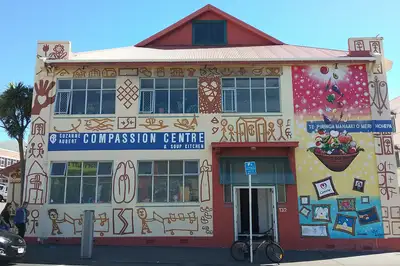
Soup kitchen image
Te Pūaroha, the Compassion Soup Kitchen in Wellington’s Te Aro neighbourhood, sits between the heart of downtown and Massey’s Wellington campus. The Compassion Soup Kitchen’s main purpose is food provision, but Project Coordinator Scott Tynan explains that periphery activities bring people into the kitchen and help them build trust with patrons. With the help of partner organisations, they offer laundry, showers, nursing, haircuts, sewing and a writing group.
Tilley has been serving breakfast and hosting the morning writing group on Fridays for years. The writing group provides practical communication support for people writing to lawyers and housing providers, for example, as well as space to develop and workshop creative writing, such as poetry, short stories or memoirs.
Tynan explains how rare the writing group is for this marginalised demographic, and its existence as a longer-term offer is extraordinary. The writing group, he says, is an “incredibly important and meaningful bit of work. To hold that space for people and the structured commitment every week without Elspeth, it would die.”
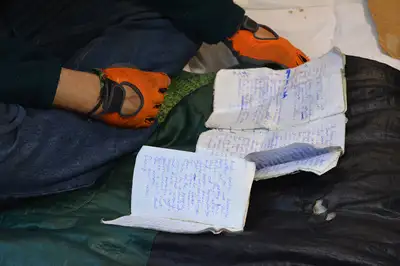
A member of the housing deprived community sharing their writing at the Soup Kitchen.
Poems by writing group members have featured in Regenerate Magazine and other publications and are also featured in Tilley’s edited book ‘Te Hā Tangata – the Breath of the People,’ which arose from a collaborative project between the Compassion Soup Kitchen, Kahungungu Whānau Services (now called He Herenga Kura) and Tilley’s ‘Creativity in the Community’ students. Extracts from the book have been crafted into an award-winning short play, which has been performed in Sydney and Florida and toured Aotearoa as part of the annual Young & Hungry Arts Trust Schools Tour.
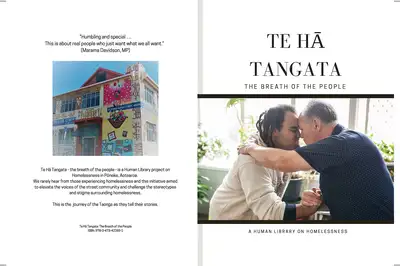
Te Hā Tangata book cover.
Massey News articles on Professor Tilley's work




Elspeth Tilley
Discover more about Professor Tilley's achievements and extensive career.

Professor Elspeth Tilley
Elspeth is a three-time winner of the British Theatre Challenge international playwriting competition and a three-time official playwright for Climate Change Theatre Action. Her award-winning plays have been published and produced globally including off-Broadway and off-West End. Elspeth received the 2018 College of Humanities & Social Sciences award for Sustained Excellence in Teaching.
UN Sustainable Development Goals

Related content