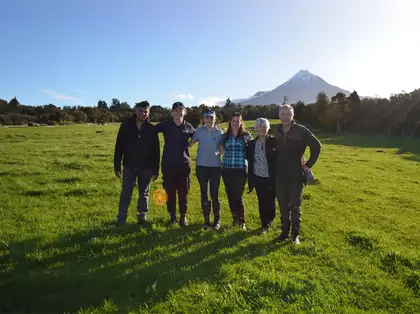
The Pivot Award provides a unique science connection opportunity. In 2022, it funded the project Measuring Impacts of Regenerative Agriculture on Innovating Taranaki Farms: do these have potential to improve our farm systems and outcomes? co-led by Massey and the Taranaki Regenerative Agriculture team, who have since helped establish the Taranaki ReGen Charitable Trust.
Pivot Award
The Pivot Award is a Massey University, Bashford Nicholls Trust and Bishop’s Action Foundation joint initiative to support Taranaki community stakeholders working alongside researchers to create research-informed, innovative agricultural change.
Developing a regenerative monitoring framework
Dominated by traditional dairy, beef and lamb industries, the Taranaki region has been building momentum in Regenerative Agriculture (Regen Ag) for several years. Regen Ag is a conservation and rehabilitation approach to food and farming systems. The Regen Ag approach optimises soil health and vitality to improve overall farm wellbeing, product nutrition and quality, overall resilience, profitability and environmental outcomes.
The Pivot Award allowed project co-leaders Fiona Young (Taranaki ReGen Charitable Trust founder), Cynthia Northcote (Taranaki Regen Ag Advisor), Associate Professor Lucy Burkitt (School of Agriculture and Environment), and a diverse group of stakeholders, including participating Taranaki farmers, to develop a regenerative monitoring framework. This framework addresses soil, pasture and animal health; farmer wellbeing; product nutrition; financial performance; and greenhouse gas emissions that affect water quality and biodiversity. The team then developed protocols for a spring monitoring programme to sample soil and pastures on ten Taranaki grazed pasture farms. Eve Kawana-Brown, in her joint role as Business Development Manager (Taranaki) with Massey University and Venture Taranaki, supported the team through project management and regional community and industry engagement.
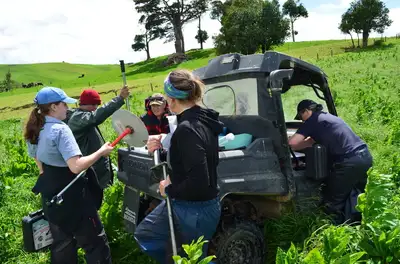
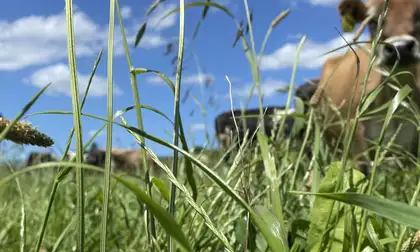
Researchers getting ready to do soil and pasture sampling work in a long grass field in November 2022.
The project engaged farmers in understanding the process and science involved in soil and pasture sampling, what characteristics they could focus on and how that evidence could assist them with decision-making to improve soil health and pasture quality.
Fiona says, “There’s been a strong call and need for more science to back regenerative agriculture in Aotearoa New Zealand. This Pivot Award project has enabled citizen science capacity to grow alongside research scientists to strengthen scientifically backed monitoring recommendations.” After receiving the award, the team held an initial two-day hui in mid-2022 with diverse stakeholders. The community collaboratively worked through a process to determine the project priorities and created the monitoring framework led by farmers’ feedback. The lead team then determined what the most useful soil and pasture health indicators might be for a Spring monitoring programme.
The farmers, Massey researchers and Taranaki team conducted soil and pasture sampling during the 2022 and 2023 Spring seasons. They applied a range of management strategies, and some farmers chose their worst-performing paddock to learn from. They measured and monitored soil fertility, biological and physical properties, as well as plant species and nutrient content. Their research showed that the pastures contained lower herb and legume content and higher grass content in Spring 2023, likely due to a colder winter, which resulted in pastures with lower calcium content. They also found a suggested link between pasture protein content and soil carbon cycling and a significant positive correlation between soil structure and earthworm numbers, soil porosity and total fungi, and plant-available phosphorus in the soil and the phosphorus concentration in the pasture.
Growing capability and growing relationships
Associate Professor Burkitt, also working on Massey’s seven-year Whenua Haumanu programme, notes that the monitoring approaches have informed Whenua Haumanu’s soil monitoring methods. She says that in the case of the Taranaki project, “there was a lot of emphasis on two-way learning, discussion about what we’re measuring, what it means, and how it’s changed from the last time we took samples.” Whenua Haumanu intends to mobilise Massey postgraduate students to continue working with the Taranaki research partners and community on additional monitoring, specifically around soil trace elements, biological nitrogen fixation in legumes, and soil microbial activity and diversity.
Further engagement is planned between Massey’s School of Agriculture and Environment, the Horticulture and Agriculture Teachers Association (HATA) and Taranaki’s high schools. Burkitt has provided Taranaki’s Regional Ag Education Support lead, Ross Redpath, with soil infiltration monitoring equipment to engage high school students with soil health activities. She explains the goal was always “building capacity and appreciation around the role of soil monitoring so it could enable participants to make good farm management decisions.”
Fiona Young is enthusiastic that this engagement enabled farmers to better understand the impact of their management based on monitoring and measurement evidence on their farms. As farmers strengthened their observation and gained more science knowledge and understanding, the data enabled greater agreement around what soil monitoring practices could best assist the wider farmer community.
“It’s about growing capability, growing relationships, helping support farmers to understand the process so they can do things themselves, if they’d like to, or at least have a better understanding to be more involved with decision making. At the heart of this project is helping farmers to have practical, accessible and scientifically backed recommendations for tracking their management outcomes from the soil up.”–Fiona Young
Northcote organised the data collation, analysis and reporting management to the farmers, as well as resources related to water quality monitoring at the farm scale. The team created individual and collective reports and hosted farmer workshops and online sessions with Jules Matthews, regenerative farming coach and educator, and the Whenua Haumanu team (Burkitt, Dr Jeya Jeyakumar, Master’s student Rebekah Wood, Research Technician Ben Carter, Senior Tutor Robert Southward, and Associate Professor Ignacio Lopez) to help with data interpretation and understanding.
Whenua Haumanu
Whenua Haumanu is a partnership with Te Kunenga ki Pūrehuroa Massey University and the Ministry for Primary Industries. It is the most comprehensive programme on both conventional and regenerative grazing systems in New Zealand.
Regen Ag hui
In addition to the two initial direction-setting 2021 hui and the group’s mid-2022 hui to determine a regenerative monitoring framework, a post-Spring 2022 monitoring hui was held to share the lab results, and an outcome hui held in early 2024. Along with participating farmers, other interested farmers and community parties were invited along. By the second hui, the co-leads found that the researchers and participating farmers were acting as one team, and good relationships, trust and collaboration had grown within the wider community. The active inquiry and strengthening relationships, Young reflects, “open doors to create more of a conversation.”
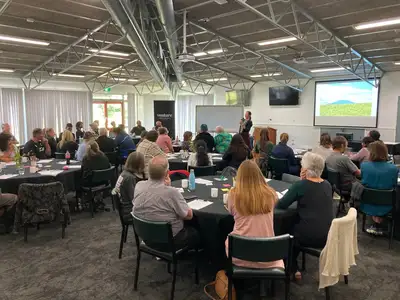
Regen Ag Hui, Stratford, 29 Feb 2024
Associate Professor Burkitt agrees that more came out of the project than she imagined. She says they accomplished all they wanted to do and more, from the positive relationships built to Whenua Haumanu receiving good feedback from farmers that will help the research team with the implementation side of their mahi, for example, adding extra measurements to the project that came from the feedback.
The Pivot Award was the first step in establishing longer-term support for farmers and researchers engaging together, sharing ideas and finding synergies across the knowledge they each contributed. The Pivot Award seed funding has sprouted new opportunities with further funding secured from the Toi Foundation to grow the partnership between Taranaki ReGen Charitable Trust and Taranaki farmers. The Trust has a new website and is hosting more events to keep Taranaki Regen Ag engaged and get the word out further afield to progress a flourishing, sustainable agricultural community.
Research funders
Bashford-Nicholls Trust Pivot Award

Bishop's Action Foundation (BAF)
UN Sustainable Development Goals
Related content