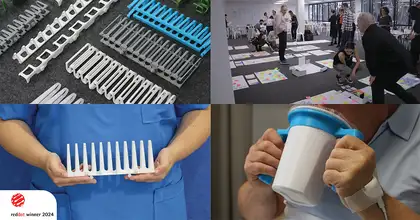
Our purpose
The Medical Design and Innovation research cluster creates positive impact for health providers, patients and the community through collaborative design research.
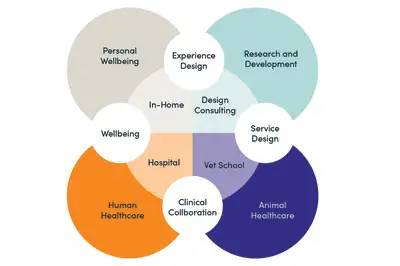
We partner with researchers from Massey University’s College of Health and School of Veterinary Sciences, as well as clinicians, health entities and government across human and animal health sectors in public and private contexts.
Through consultation with our network, we identify projects for investigation and work together to deliver solutions. Our core focus is to commercialise innovative research in association with our partners.
Our people
We are a design-led group of design and technology researchers with expertise across a range of disciplines including product, technology, system and service design.
We respond empathetically to complex problems and utilise design methods to find insights and opportunities that benefit people.
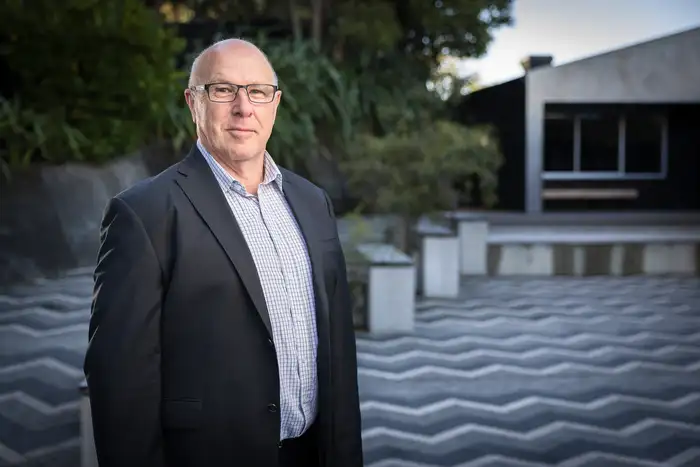
Associate Professor Rodney Adank
Rodney is a design academic with a research focus on medical devices and equipment innovation. Leveraging prototyping and user experience to develop higher levels of performance and utility in product design. His experience managing and leading successful research initiatives and postgraduate supervisions has produced many award-winning designs and designers for Massey.
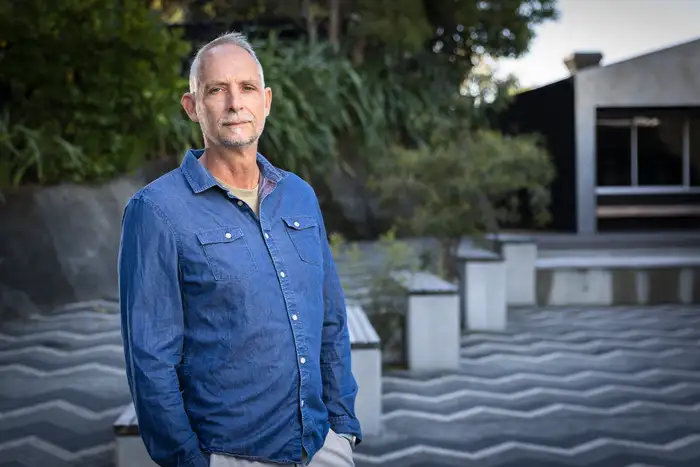
Jason Mitchell
Jason is a researcher and industrial designer working across health and wellbeing projects. His expertise explores products, systems, and services to complex problems within hospitals and the wider health ecology. Jason co-founded several start-ups, including Fab Lab Wellington. He works across disciplines and with healthcare partners, focusing on the commercialisation of research outcomes.

Dr Zené Krige
Zené is an early-career researcher in Industrial Design, gaining a PhD in 2025 (Dean’s List). Her work with Health New Zealand as an Advisor explored the role of design in producing and communicating positive outcomes, as well as the means of facilitating creative workshops and user testing. She has worked on major projects that span from initial idea to manufacture and commercialisation.
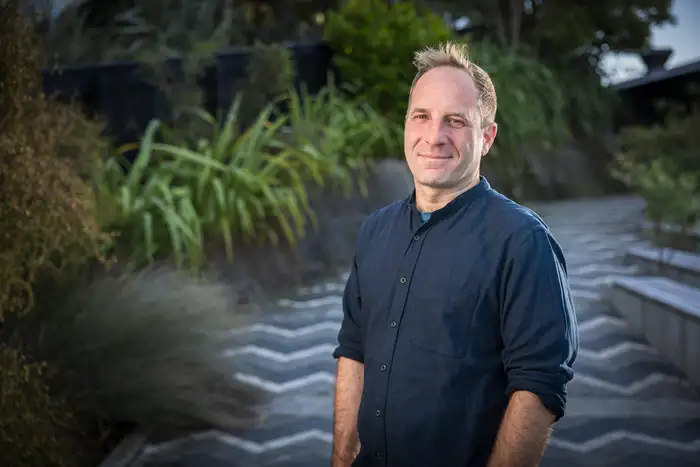
Klaus Kremer
Klaus is a communication designer, researcher, and educator with focus on interaction design (IxD), information design and integrated design practice. Guided by humanistic values and the exploration of omitted and unconventional methodologies, he advocates for life-centred design principles to aid policymakers and individuals in informed decision-making for adaptable environments.
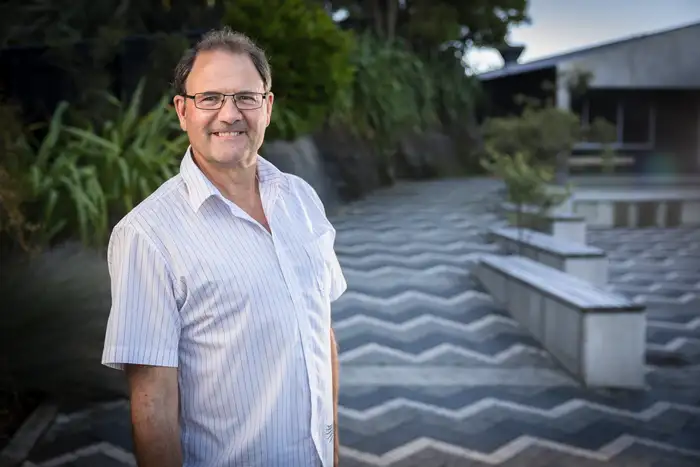
Associate Professor Dr Wyatt Page
Wyatt is Associate Professor and Deputy Head of the School of Health Sciences. He is a key member of the Environmental Health team that delivers a range of qualifications at Massey. His current research interests are diverse and include environmental, occupational and recreational noise exposure, acoustics of teaching spaces, immersive sound and technology for hyper-instruments.
Our expertise
We have knowledge and expertise that extends across:
- product research and development
- hospital based improvement and innovation
- technology and health sciences
- service and graphic design
- design facilitation.
Our partners
We work with and across the health sector. This includes a range of entities with health innovation agendas for human and animal health. We partner with:
- MedTech IQ – Aotearoa
- Te Whatu Ora – Health New Zealand
- Environmental Science Research
- Securitas Healthcare
- Turanga Health
- Ripple Healthcare
- Massey Ventures Limited
- Massey University School of Veterinary Science.
Our process
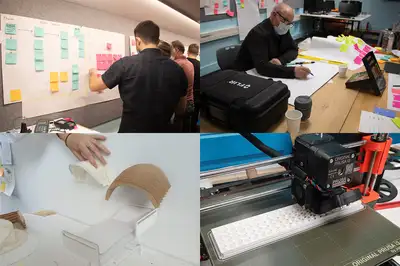
We get to know each other and establish a shared understanding of the project, the problem and the opportunity for innovation. From there, we plan out the project, including methods, processes, design execution and resolution.
Projects
Examples of award winning and health focused projects we have been involved with.
Red Dot award winner – Ribb
Red Dot award winner – Ribb Ribb provides a solution to internal fridge management. It improves physical organisation that meets spacing requirements for Temperature Sensitive Pharmaceuticals (TSP’s).
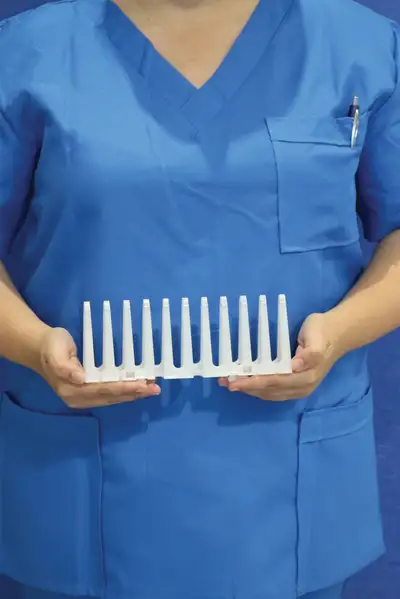
Ribb is the result of a collaboration with Te Whatu Ora – Health New Zealand to investigate the management of Temperature Sensitive Pharmaceuticals (TSP’s).
Within hospitals and pharmacy environments TSP’s, including vaccines and medicines require refrigeration. Cold Chain is the system of storing TSP’s within the recommended temperature range of +2°C to +8°C from the point of manufacture through to administering to a patient, ensuring pharmaceutical efficacy. It requires spacing between individual items (25-30mm), to ensure airflow within the refrigerator.
It relies on busy pharmacy staff to:
- organise, pack and repack fridges
- maintain TSP spacing and avoid the freeze and thaw potential of cold bridging
- avoid a temperature breach where the medicine efficacy is compromised and discarded.
Ribb provides a solution to internal fridge management. It improves physical organisation that meets spacing requirements for TSP’s, quicker access to medicines and improved effectiveness of fridge operation for pharmacy staff.
It significantly reduces the potential of cold bridging between fridge walls and TSP’s. It supports:
- airflow throughout the fridge
- customisation to internal fridge dimensions
- utility across a range of tray wire rung spacings
- use as a perimeter bumper or a tray spacer.
Ribb is the recipient of a 2024 International Red Dot design award.
Catch
Catch Catch is a respectful and empathetic solution to the management of vomiting within hospitals. It is designed to ensure patient and hospital staff dignity.
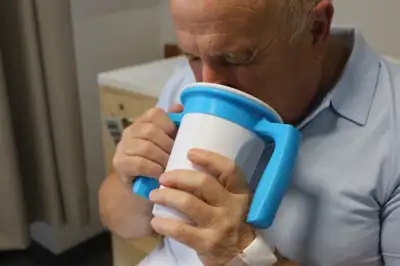
The sight, sound and smell of vomit can negatively affect patients in a hospital, including making them feel nauseous themselves. People feeling unwell and vomiting often experience a loss of dignity and embarrassment.
Catch is a modular system. It enables different methods of use in a range of scenarios based on user preference.
Catch’s moulded paper pulp cup with perforated line reduces smell by allowing the cup to be vomited into and then folded shut after use. The angled cup enables easy location to the face and reduces the risk of spillage. The cup grip indentations is easy to hold.
For greater security the cup component clips into a twin-handled frame. The frame handles provide easier, secure relocation for placement on trays and bedside storage. The handles make use easy in an upright, seated or on-side orientation.
Handing over Catch with its handles provides a sense of dignity for patient and recipient. Handles also make it simple to securely hook Catch to a bed rail. Catch provides certainty, confidence and comfort when people are feeling nauseous and vulnerable.
Sleep in the Future
Sleep in the Future An investigation into how design can help people sleep better in medical environments like hospitals.
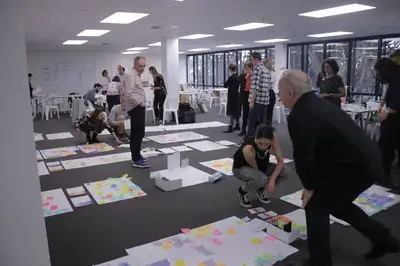
We undertook an investigation into design interventions that would improve patient sleep in hospitals. This was undertaken in collaboration with the Auckland DHB. Patient sleep is impacted by state of mind, pain, discomfort and environmental conditions like sound and lighting.
We surveyed patients and clinicians to gather baseline information about the hospital sleep experience. We also monitored sound and circadian lighting.
The team hosted large scale design workshops with engineers, scientists and clinicians to identify problems, understand needs and find potential solutions.
Further design development translated the solutions into product concepts that would positively impact sleep.
Sleep in the Future – pillow concept
Sleep in the Future – pillow concept One of several pillow concepts that adjust for comfort and support, and helps to mitigate sound and light interference.
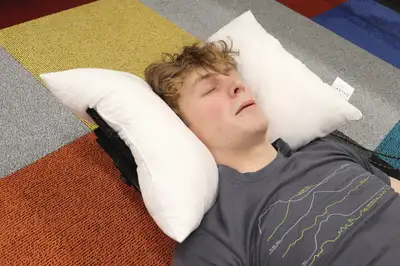
The mechanical curl concept also helps to facilitate patient rolling when required.
Sleep in the Future – Bloom – Over-bed privacy sleep aid
Sleep in the Future – Bloom – Over-bed privacy sleep aid An over-bed privacy sleep aid, improving sleep through a patient-controlled baffled curtain system with integrated lighting.
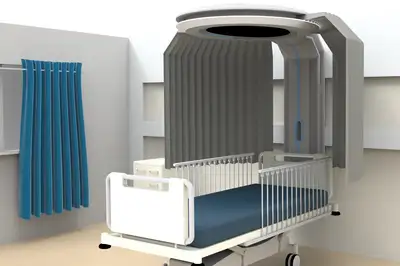
Constant hard light conditions are bad for sleep. Bloom improves sleep through a patient-controlled baffled curtain system with integrated lighting. It offers patients the agency to control their privacy and reduce the impact of other patients, machines, clinicians and central lighting.
Sleep in the Future – Hand Rail Lighting
Sleep in the Future – Hand Rail Lighting Handrail lighting responds to a patient’s need to have personalised controlled lighting in easy reach of the bed.
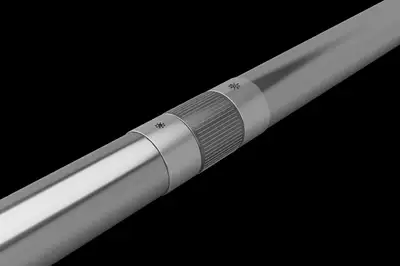
The light can be swivelled and adjusted as needed for reading or other activities.
Tylt – Red Dot award winner
Tylt – Red Dot award winner Tylt is a board for people who need stimulation from movement. It allows users to fidget with their feet, keeping their hands free for tasks.
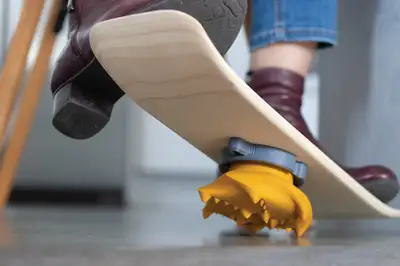
Tylt makes movement possible even when sitting at a desk, typing and other activities. It turns an otherwise uncomfortable environment like workplaces into a comfortable space for people who need stimulation from movement.
Given the growing awareness of neurodivergence and the case for movement, it’s no surprise that the popularity of tools like fidget toys has sky-rocketed. Fidgeting and stimming produce repetitive body movements or repetitive movements of objects. They are effective in many situations but have limitations. Current products are hard to fidget and type with at the same time. Tylt is different – it allows fidgeting with the feet so people can keep using their hands for tasks.
The board is placed on the floor, rocker-side down. Users then control the board with their feet through a combination of rocking, rolling and twisting. People can choose between a range of rocker designs depending on what they like. Rockers are designed differently to prioritise relaxation or concentration.
Both neurotypical and neurodiverse participants reported a significant positive impact on wellbeing, focus and emotional regulation. These findings have been validated by lead researchers in specialist fields of education, medicine, psychology and literacy.
Publications and awards
We invite you to explore some of our recent publications and awards, and we are excited to be sharing more achievements in the near future.
Awards
Awards
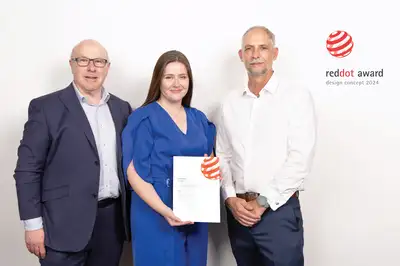
- Red Dot Concept Award Winner 2024 – Ribb
- Finalist IF Design Awards 2024 – Ribb
- 2025 - RAP 1: Project Lightbox in collaboration with ESR.
- 2021 Massey Innovation Prize: Cold Chain
- 2019 Massey University Strategic Investment Fund – Healing, recovery and wellbeing: Designing sleep interventions for the hospital environment
Publications
Publications
- Krige, Z. (2024) Developing factors of trust for the design of trustworthy Human - Product interactions, in Gray, C., Ciliotta Chehade, E., Hekkert, P., Forlano, L., Ciuccarelli, P., Lloyd, P. (eds.), DRS2024: Boston, 23–28 June, Boston, USA. https://doi.org/10.21606/drs.2024.695
- A number of confidential publications and more coming in the following year.
Media releases and news
Media releases
In the news
In the news
Medical Design & Innovation Research Cluster – MedTech IQ introduction
Contact and collaborate with us
If you would like to work with us, or just have an enquiry please reach out by email.
Rodney Adank at R.G.Adank@massey.ac.nz, or
Jason Mitchell at J.K.Mitchell1@massey.ac.nz